
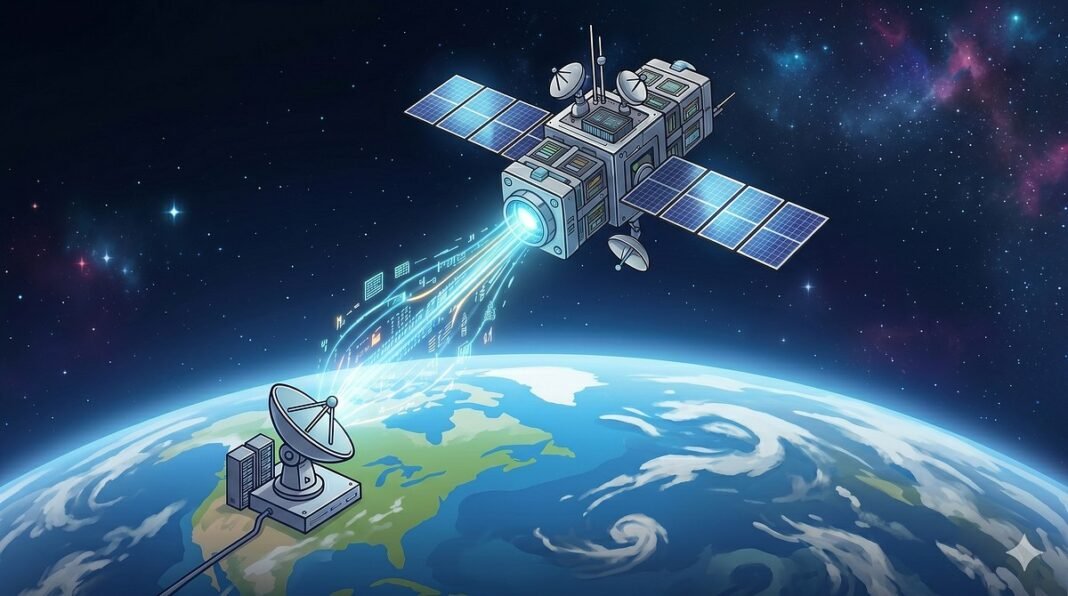


Sprawling networks of space data centers could make it nearly impossible for humans to stargaze, according to a new report that warns companies and governments to move slowly before putting large numbers of AI computers into orbit. The report, “Space-Based Data Centers Roadmap: The Case for Caution”, was released on 12 November 2026 for the Innovation for Cool Earth Forum, a Japanese government-backed climate technology conference, and reported by Axios on 15 November. Its lead author is David Sandalow of Columbia University, working with nine co-authors from Columbia, Georgetown, Northwestern, and Lawrence Livermore National Laboratory. The paper is a working paper and has not been peer reviewed.
Why space data centers could fill the sky
The report starts from a simple count. About 19,000 satellites are in orbit today. If the announced plans for space data centers are fully built, the paper forecasts that the number of satellites in low Earth orbit would rise by more than 50 times. At that scale, the most visible points of light in the night sky across much of the world could be satellites rather than stars. The finding describes a full build-out, not a prediction of timing.
The reason is the size of the hardware. Space data centers need large solar arrays to catch sunlight and large radiator panels to shed heat in the vacuum of space, and those broad surfaces catch and reflect sunlight back to Earth. Ground-based telescopes already pick up streaks from broadband satellites; a fleet of computing satellites would add far more bright objects to every exposure. Astronomer Samantha Lawler told CTV News that she once worried about a couple of thousand satellites in orbit. “There won’t be a dark time where you can go out and look at the night sky and not be impacted by them,” she said.
The filings behind the space data centers boom
The scale of the plans for space data centers is visible in filings with regulators. SpaceX has applied for up to 1 million data center satellites, a number that dwarfs the other filings. Starcloud has filed for 88,000, a company called Orbital has filed for up to 100,000, and Blue Origin’s Project Sunrise covers up to 51,600, according to Axios and the Secure World Foundation. None of those filings has been reported as approved, and none of the satellites has been launched.
That gap between filing and flying matters. Caleb Henry, director of research at Quilty Space, told Axios that companies often file for far more satellites than they actually intend to deploy. The report’s warning is about what happens if the filings turn into hardware, not about what is in orbit today. Even a fraction of the filed numbers would change the night sky: a tenth of the SpaceX filing alone would be 100,000 satellites, more than five times the number in orbit now.
Money and launches behind the plans
Money is already moving into space data centers. Market research firm Quilty Space reported that investment tied to orbital data centers rose from about 197 million dollars in 2025 to 1.11 billion dollars so far in 2026. The attraction is clear: orbit offers constant sunlight for power and a way around the land and grid limits that slow data center building on Earth. The cost is also clear. To place just 10 percent of anticipated AI data centers into orbit by 2030 would need more than 700 large rocket launches every year, Columbia University reported.
The risks go beyond the view from the ground. Thousands of facilities circling Earth at roughly 17,000 miles per hour would raise the chance of collisions and add to dangerous space debris. The report also warns that large orbital computing networks could become military targets, and that the rocket emissions from building them carry a climate cost that has not been fully measured. Sandalow told Axios that large unknowns remain about those environmental effects.
What the report asks for on space data centers
The report on space data centers does not call for a ban. It calls for rules before the build-out, including brightness limits for satellites, mandatory impact assessments before launch, required mitigation measures, caps on satellite numbers, and international standards. “If this is going to happen, it should happen slowly and with care,” Sandalow told Axios. “Not just launching lots and lots of these things and, kind of, seeing what happens. There are big risks.” Astronomers have been pressing regulators for brightness limits since the first broadband constellations appeared.
For now, the debate about space data centers is about paper plans rather than hardware in the sky. No decision by the Federal Communications Commission on the SpaceX application has been reported. The question it leaves open is whether the rules will arrive before the rockets do.