
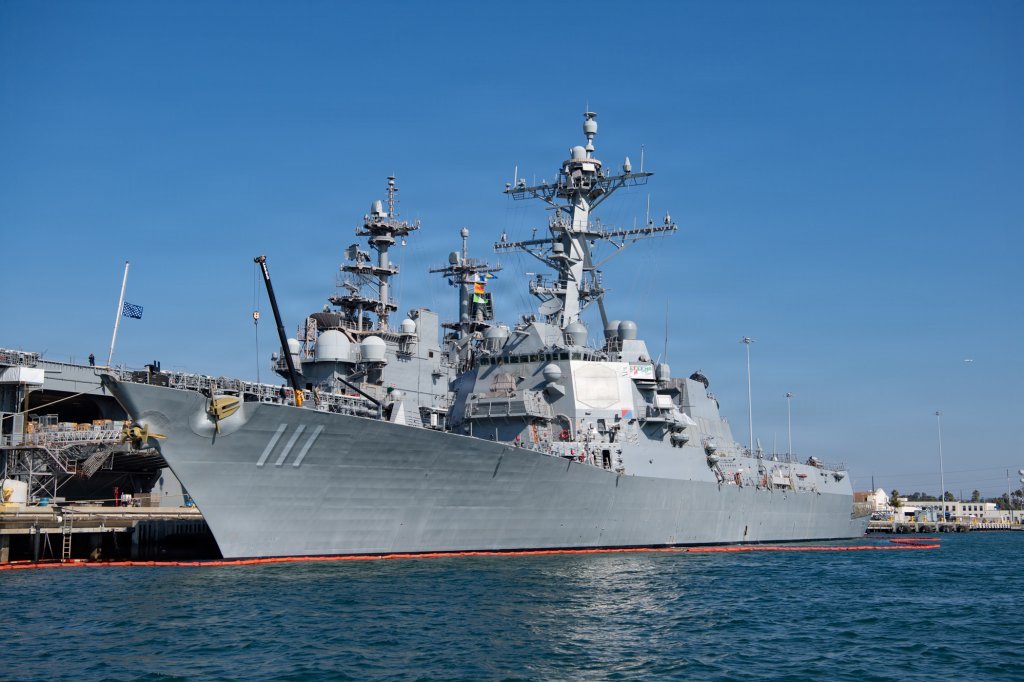


Iran has threatened two United States Navy officers it accuses of ordering the missile strike on a school in Minab that killed 168 children, telling them in a message on social media: "We will find you." The Iranian Embassy in South Africa posted the warning on X on 13 November, renewing accusations it had first made against the officers in March.
The Iran threat named Commander Leigh R. Tate, commanding officer of the guided-missile destroyer USS Spruance, and Lieutenant Commander Jeffrey E. York, the vessel's executive officer. The post shared photographs of both officers alongside the warning. It quoted an earlier embassy message that called the two men "criminals" and alleged they ordered Tomahawk missile launches three times, killing 168 children at the school.
The Iran threat and the officers named
The Iran threat was first set out in a post on 28 March, about a month after the strike, when the embassy identified the officers. "Remember these two criminals. Leigh R. Tate, the commander, and Jeffrey E. York, the executive officer of the USS Spruance, who ordered the launch of Tomahawk missiles three times, killing 168 innocent children at a school in Minab," that post read. It also asked: "Don't they have children of their own?"
The embassy's claims about the officers' personal responsibility for the school strike have not been independently substantiated, and US officials have dismissed the allegations. The two officers were serving aboard the Spruance during its deployment in the Middle East, and the ship's role in the February war against Iran put its crew in the centre of Tehran's public blame for the attack.
The Iran threat after a long deployment
The latest Iran threat came as the Spruance returned to its home port at Naval Base San Diego in California on 13 November, after a 357-day deployment that included combat operations against Iranian forces. The deployment was described as the longest by a US Navy destroyer since the Second World War. The ship had set out on 21 November 2025 with the USS Abraham Lincoln Carrier Strike Group.
The Iran threat and the public naming of the two officers have raised security concerns in the United States. Behnam Ben Taleblu, a senior fellow at the Foundation for Defense of Democracies, told Fox News Digital the threat should prompt concern among American security agencies. "This should be setting off alarm bells in Washington, in the White House, the Pentagon, and even within CENTCOM," he said, adding that any potential plot against the officers must be detected and disrupted.
The Iran threat and the Minab school strike
The school attack took place at the start of the US-Israel war against Iran in February. At least one US missile struck the Shajareh Tayyebeh school in Minab on 28 February, killing at least 156 people, including 123 children, according to the figures cited in the first reports. Iranian officials have put the death toll at 168.
Speaking at the NDTV World Summit 2026, Ayatullah Abdul Majid Hakeem Ilahi, the representative of Iran's Supreme Leader and a senior diplomat, accused Washington of failing to apologise for the attack. He said some of the children's bodies had still not been recovered. "They attacked Iran. On February 28, they attacked a primary school two times and killed 168 innocent people at the school. Till now, some of the bodies of these children couldn't be found," he said. He added that the families continued to grieve because they had no graves to visit.
The Iran threat came a day after US President Donald Trump warned Tehran against attacking senior American officials. Asked in an interview how Washington would respond if a senior US official were assassinated, Trump said: "They will not exist very long, any longer." The Iran threat also followed reports of death threats against senior members of the Trump administration. US Treasury Secretary Scott Bessent recently moved from his home in the Washington area to a military base after receiving threats linked to Iran, on the advice of the US Secret Service, he said. Iran has denied plotting attacks against US officials or individuals on American soil.
The Iran threat has kept attention on the Minab strike, which was also discussed at the NDTV World Summit 2026, where the role of artificial intelligence came up. A former director of the US Central Intelligence Agency said the final decision to carry out the bombing was made by a human, with assistance from a machine. "Actually [that was] a human judgement. That was not the machine making the decision, I believe. It was a human that decided, and it was helped by AI with targeting," the former chief said. The remarks ran against an earlier report that blamed an AI-driven "kill chain" for the tragedy.