
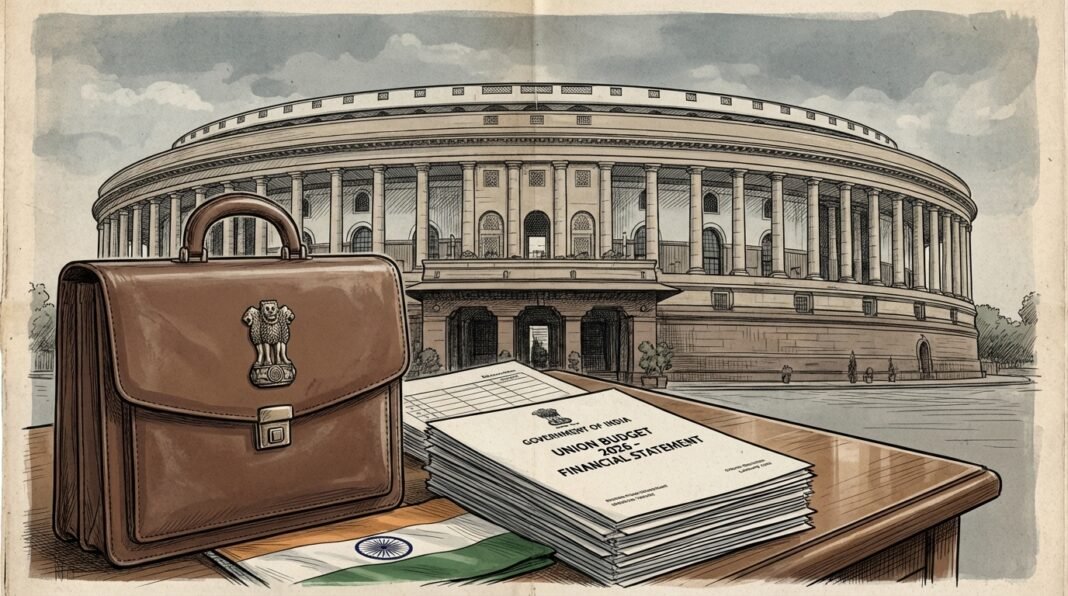


The Federation of Indian Chambers of Commerce and Industry has proposed restoring the LTCG tax exemption on listed securities held for more than three years, as part of its recommendations for Union Budget 2027-28. The industry body submitted its proposals on Tuesday, 17 November, to Finance Minister Nirmala Sitharaman. It is the most direct ask yet from industry for relief on the tax long term investors pay, with a trade off designed to protect the government’s revenues.
FICCI wants the exemption restored as it prevailed when securities transaction tax was introduced in 2004, alongside a calibrated increase in securities transaction tax on delivery based transactions. “The Government may consider restoring the exemption from LTCG tax on listed securities, as prevailed when STT was introduced in 2004, alongside a calibrated increase in STT on delivery-based transactions to protect some of the government revenues,” the industry body said in its submission. The pairing matters: the exemption would cost the exchequer money, and a higher transaction tax is FICCI’s answer to that cost.
LTCG tax exemption sought with higher STT
If a complete LTCG tax exemption is not possible, FICCI offered a graded alternative. Under that structure, investors would pay 10 per cent on holdings of between one and two years, 5 per cent on holdings of two to three years, and nothing on holdings of more than three years. “May we also request that if a complete LTCG exemption is not possible, perhaps a graded scale of taxation for capital gains be considered with longer term holdings being taxed at a lower rate say 10 per cent for holding period between 1 to 2 years, 5 per cent for holding period of 2 to 3 years and nil rate for holding period of more than 3 years,” the chamber suggested.
The current LTCG tax rules are the reason the demand has gathered force. The rate on listed securities was raised from 10 per cent to 12.5 per cent, and the regime in force since 23 July 2024 taxes long term gains above 1.25 lakh rupees a year at 12.5 per cent, with short term gains taxed at 20 per cent. FICCI argued that capital gains tax, charged on top of the securities transaction tax, eats into returns from equities and needs a review to make India a more attractive place to invest. The chamber also said a deep capital market is needed to mobilise long term capital for manufacturing expansion.
Manufacturing credit sits beside the tax ask
The tax proposal was part of a wider set of recommendations centred on manufacturing. FICCI proposed a dedicated development finance framework for the sector, saying more than 100 lakh crore rupees in incremental credit may be needed over the next decade to lift manufacturing’s share of GDP to 25 per cent. It suggested a dedicated development finance institution to provide long term capital for sectors including batteries, semiconductors, green hydrogen, defence and advanced materials.
The chamber said access to long term financing at competitive rates remains a major challenge, with borrowing costs in India nearly 400 to 500 basis points higher than in peer economies such as China and South Korea. Its assessment identified 10 foundational sectors accounting for nearly 36 per cent of India’s non-petroleum imports, with 36 priority products needing domestic capacity. FICCI also proposed a dedicated production linked incentive scheme worth 12,000 crore rupees for Advanced Chemistry Cell components, noting a cost disadvantage of about 35 to 50 per cent against Chinese imports.
LTCG tax debate widens before Budget 2027
FICCI is not alone in pressing the case on LTCG tax. ASSOCHAM, in its own pre-Budget memorandum, suggested 10 per cent for holdings of more than one year but less than two, and a nil or reduced rate of around 5 per cent for investments held beyond two years. SBI Research, in its Ecowrap report dated 2 November, estimated that LTCG tax collections were about 1 lakh crore rupees in 2025-26 and will be 40,000 to 50,000 crore rupees in 2026-27. The report suggested replacing the flat 1.25 lakh rupee exemption with an inflation linked threshold and charging nothing on holdings beyond two to three years.
The government is also reviewing the wider capital market tax framework, with options including the abolition of securities transaction tax, a tiered LTCG tax structure and tax concessions on corporate bond interest income. No final decision has been announced, and the Finance Minister has said only that the government recognises the changing picture. The chambers’ demands are requests the government is free to accept or reject. For investors who have held shares for years, the difference between the current 12.5 per cent LTCG tax rate and the zero rate FICCI wants after three years is the difference the Budget will decide.