
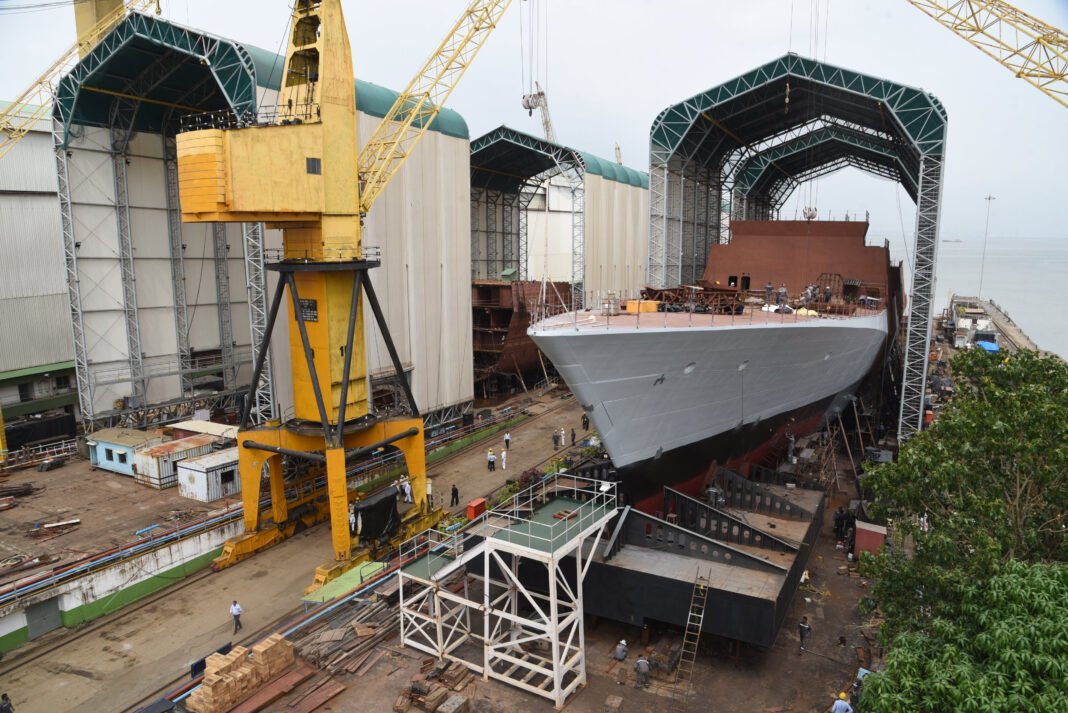


India’s maritime push has put shipbuilding at the centre of its industrial plans, with the government stepping up efforts to attract international investment, expand manufacturing capacity and increase vessel exports. Shipping Minister Sarbananda Sonowal said on Monday, 16 November, at the India Shipbuilding Investment Conclave 2026 in New Delhi, that the government is developing five greenfield shipbuilding clusters across Andhra Pradesh, Gujarat, Maharashtra, Odisha and Tamil Nadu. The government has approved a landmark 8 billion dollar maritime package, and the active shipbuilding order pipeline has crossed 150 vessels, valued at more than 1.7 billion dollars, with export orders accounting for over 80 per cent of its value.
The government aims to make India one of the world’s top 10 shipbuilding nations by 2030 and among the top five by 2047. The maritime push has set identified domestic demand at more than 400 vessels, representing an estimated investment opportunity of nearly 24 billion dollars. The government is seeking nearly 10 billion dollars in investment across the five clusters. Around 30 international shipyards and global shipping companies took part in the conclave, including South Korea’s HD KSOE, Samsung Heavy Industries and Hanwha Ocean, along with Fincantieri, Damen, Maersk, MSC and CMA CGM.
Maritime push centres on five new clusters
The five clusters are planned at Dugarajapatnam in Andhra Pradesh, Kuchhadi in Gujarat, Dighi in Maharashtra, Kendrapada in Odisha and Thoothukudi in Tamil Nadu. The government intends to develop these locations into maritime manufacturing hubs. The clusters put land, port access and suppliers in one place so yards can build at scale.
The maritime push builds on earlier policy. The Sagarmala Project, approved in 2015, and the Maritime India Vision 2030, launched in 2021, laid the groundwork by clustering ship repair and building activity around major ports. The 8 billion dollar package, approved by the central government in 2025, now arrives as the financial support for that plan. The government’s Shipbuilding Development Scheme provides support for both greenfield clusters and brownfield expansion of existing shipyards, and several yards have already received in-principle approval to expand.
Shipyard stocks in focus as orders build
Cochin Shipyard is among the most direct listed beneficiaries of the maritime push, given its presence in both commercial and defence shipbuilding, besides ship repair. The company builds tankers, bulk carriers, passenger vessels and other specialised ships. Cochin Shipyard and Dutch shipbuilder Damen signed a memorandum of understanding at the 16 November conclave to collaborate on future shipbuilding projects, which gives the stock a direct link to the maritime push.
Mazagon Dock Shipbuilders is one of India’s leading defence shipyards, specialising in the construction of warships and submarines for the Indian Navy. While its core business is defence oriented, the maritime push could provide a favourable long-term backdrop as the government works to strengthen domestic shipbuilding capacity. Garden Reach Shipbuilders and Engineers is another listed yard with exposure to the expanding maritime manufacturing ecosystem. Apart from warships, frigates and patrol vessels, the company builds commercial vessels such as ferries and dredgers.
Swan Defence and Heavy Industries is another company to track as India looks to expand its commercial shipbuilding and ship repair capabilities. The company operates the Pipavav shipyard in Gujarat, which has substantial shipbuilding and ship repair infrastructure. According to the Ministry of Ports, Shipping and Waterways’ 2024-25 industry statistics, Swan Defence had the country’s highest reported ship repair capacity at 150,000 DWT.
Titagarh Rail Systems is worth tracking through its naval systems business, which has exposure to the shipbuilding ecosystem. The government’s Shipbuilding Development Scheme has identified Titagarh Naval Systems’ Falta facility in West Bengal for brownfield expansion, with in-principle approval granted. Shipping Corporation of India, Great Eastern Shipping and Knowledge Marine and Engineering Works are also on the radar.
Maritime push faces a test on delivery
The question for investors is how much of the maritime push turns into real business. Three developments will decide that: whether participation by global shipbuilders translates into concrete investments, joint ventures and technology partnerships; whether Indian yards secure fresh domestic and international vessel building contracts; and how quickly the five greenfield clusters and existing yard expansion projects become operational. The order pipeline of more than 150 vessels is a start, but export orders make up over 80 per cent of its value.
Global shipbuilding is dominated by China, South Korea and Japan, and India starts from a small base. The package will be watched for the instruments it deploys, whether financial assistance, production linked incentives or equity support for yard upgrades. For now, the conclave has put the plan in front of the world’s largest builders and shippers, and the yards named in the government’s own announcements are the ones the market will watch first as the maritime push moves from plan to building.