
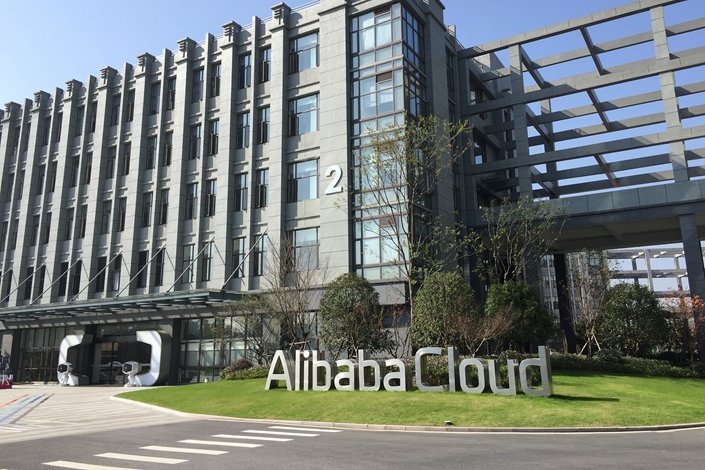


Alibaba earnings are due before the market opens in the United States on Thursday, and the numbers arrive at an awkward moment for the Chinese technology group. The company reports its fiscal second quarter, covering the three months to 30 September, with investors focused on its cloud business and its push into AI chips.
Analysts polled by Zacks expect earnings of $1.71 per share on revenue of $40.41 billion. That would compare with 61 cents per share and revenue of $34.81 billion a year earlier, a rise of 16 per cent in revenue and a sharp jump in earnings. Other estimates put earnings closer to $1.61 per share on revenue of about $40.25 billion, so the exact figures will matter less than the direction of the cloud and chip businesses. The Alibaba earnings release will be the first full update since the summer.
The Alibaba earnings report comes two days after the United States moved to tighten access to advanced chips. An interim rule from the Commerce Department on 16 November requires licences for advanced chips shipped to data centres in Singapore, Malaysia, Indonesia and Thailand, extending controls to facilities that supply computing power to China-headquartered companies.
Alibaba has rented computing capacity in Malaysia from Megaspeed International, a Singapore-based company under United States scrutiny over chip supplies. The company is not the target of that investigation, but its shares fell in Hong Kong on 17 November, down about 4.9 per cent. The stock has lost almost 40 per cent of its value in 2026.
Alibaba earnings and the cloud question
Cloud is where the growth is. In the June quarter, external cloud revenue rose 45 per cent, and Citi and Morgan Stanley both expect growth above 50 per cent in the September quarter. Revenue from AI-related products has now grown at a triple-digit rate for twelve quarters in a row, and Alibaba expects annualised AI-related product revenue to approach $10 billion in the quarter just ended. The Alibaba earnings report will show whether that pace held in the September quarter.
The first fiscal quarter showed the cost of that growth. Total revenue rose 9 per cent to 268.95 billion yuan, while adjusted earnings before interest, tax and amortisation fell 30 per cent to 27.33 billion yuan. Capital spending rose 75 per cent to 67.68 billion yuan, leaving a free cash outflow of 44.67 billion yuan. In August, Alibaba raised HK$80 billion in a Hong Kong share placement, with all of the proceeds earmarked for AI.
The Alibaba earnings call, set for 7.00 am Eastern Time, will be watched for what management says about computing capacity. With chip supplies under pressure, investors want to know whether Alibaba can keep building the data centres its cloud customers need, and whether the spending will start to pay for itself.
Alibaba earnings put the chip business in focus
Alibaba is building its own answer to the chip problem. Its semiconductor unit, T-Head, designs custom AI chips for Alibaba Cloud and other customers. On 10 November, the company disclosed that it is pursuing a spin-off and separate listing of T-Head on the Hong Kong Stock Exchange, starting with a confidential listing application. Analysts have valued the unit at between $25 billion and $86 billion.
In September, T-Head unveiled the Zhenwu V900 chip, with production expected to start in early 2027. Chief executive Eddie Wu has said the unit plans to introduce what Alibaba describes as China’s most powerful domestically available AI chips. The company has also set a goal of building 20 gigawatts of global data centre capacity by 2032.
The chip push sits alongside work on AI models. In July, Alibaba previewed Qwen3.8-Max, a model with 2.4 trillion parameters, and released the SAIL software stack for T-Head chips. Paid subscriptions for the Qwen app began in August, although the company expects losses in its AI labs and applications division to stay high while inference costs rise. The Alibaba earnings figures will show how much of that work is already turning into sales.
What the market will watch next
The Alibaba earnings figures will be read against a stock that has fallen hard this year, even as revenue keeps growing. A beat on cloud growth or a clear statement on chip supply could steady the shares. A warning on margins, or a sign that the chip rules are slowing data centre plans, would do the opposite.
The Alibaba earnings report also lands in the same week as results from other large technology companies, which means the market will compare notes on AI spending across the sector. For Alibaba, the question is narrower: whether a company that sells everything from online shopping to cloud computing can turn heavy AI investment into profit while Washington keeps tightening the supply of chips it needs.