
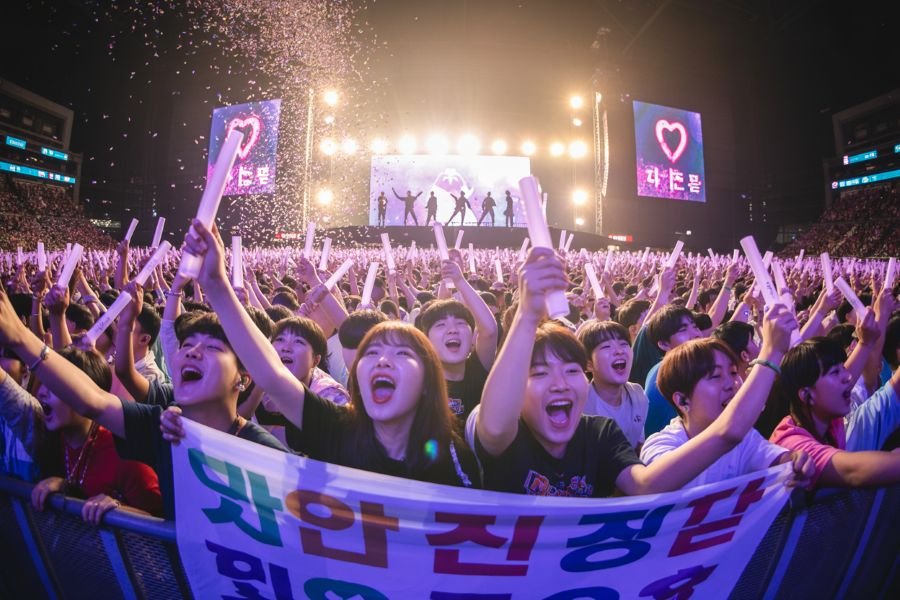


K-pop acts could soon play in China again after South Korea and China struck a trade deal that raised hopes of an end to the unofficial ban on Korean culture. Shares in South Korean entertainment companies rose sharply on Thursday 19 November after the two countries announced the deal, and the biggest K-pop agencies were among the sharpest risers.
South Korean President Lee Jae Myung and Chinese leader Xi Jinping announced the substantive conclusion of follow-up negotiations on services and investment under the Korea-China free trade agreement at a summit in Shenzhen on Wednesday. The talks had run for eight years and eight months, and the agreement was reached during the Asia-Pacific Economic Cooperation summit in the city.
China agreed to grant most-favoured-nation treatment to Korean films and games and to apply a nondiscrimination principle when prescreening Korean content. The culture ministry in Seoul said it was the first time China had included content of that kind in a trade agreement, and it expects the terms to give Korean films, games and music a more stable route into the Chinese market.
K-pop and the decade-long freeze on Korean culture
The unofficial restrictions, known in Korea as hanhallyeong, followed Seoul’s decision in 2016 to deploy the US THAAD missile defence system. China has never acknowledged a ban, but Chinese television networks, streaming platforms and cinemas shut out Korean content, and major K-pop acts were largely barred from staging large concerts on the mainland.
BIGBANG’s 2016 tour was the last large-scale K-pop tour in mainland China. A tour the year before drew about 250,000 fans across 13 Chinese cities, and no Korean group has matched that reach in China since. A show of about 1,000 seats by the boy band EPEX, approved for May 2025 in Fuzhou, was postponed, and at least 15 events with Korean stars, mostly fan meetings, have been cancelled or postponed in China since May.
Smaller signs of a thaw had appeared before the summit. Idols resumed in-person promotion in China in recent months, and NCT’s Mark appeared at a pop-up store in Guangzhou in April to promote his solo debut album. The summit turned those signs into a formal agreement, and that is what moved the share prices.
K-pop stocks rise on hopes of a China return
HYBE, the company behind BTS, advanced 13 percent on Thursday, while CJ ENM climbed 23 percent and Studio Dragon, a television drama producer, jumped 30 percent. SM Entertainment, another K-pop agency, gained 10 percent, and JYP Entertainment and YG Entertainment also rose. The rises followed the summit news.
Analysts Lee Ki-hoon and Kim Chae-hyun of Hana Securities wrote in a note that the free trade agreement had revived hopes that Beijing would ease its restrictions on Korean entertainment. They wrote that K-pop companies could see earnings rise by about 40 percent if China eventually allows concerts to resume.
Album sales point the same way. Exports of Korean albums to China fell from 51.3 million dollars in 2022 to 33.9 million dollars in 2023, then rebounded to 59.8 million dollars in 2024, according to Korea Customs Service data. In the first quarter of 2025, China became Korea’s largest album export market, with 12.96 million dollars in shipments.
K-pop return to China still needs formal steps
A full reopening is still unconfirmed. Neither side’s published summit documents explicitly authorise K-pop concerts on the mainland, and the agreement still needs to be signed and ratified by Korea’s National Assembly and the Standing Committee of China’s National People’s Congress before it takes effect.
The signs point to a market that may open in stages, with streaming and film first and live shows later. The summit gave the agencies the clearest signal in years that the freeze is easing, and the share prices on Thursday showed how much investors believe a return is worth.
The trade deal does not mention concerts by name. What it does is put Korean content into a signed trade text for the first time, and the market read that as the start of a return.