
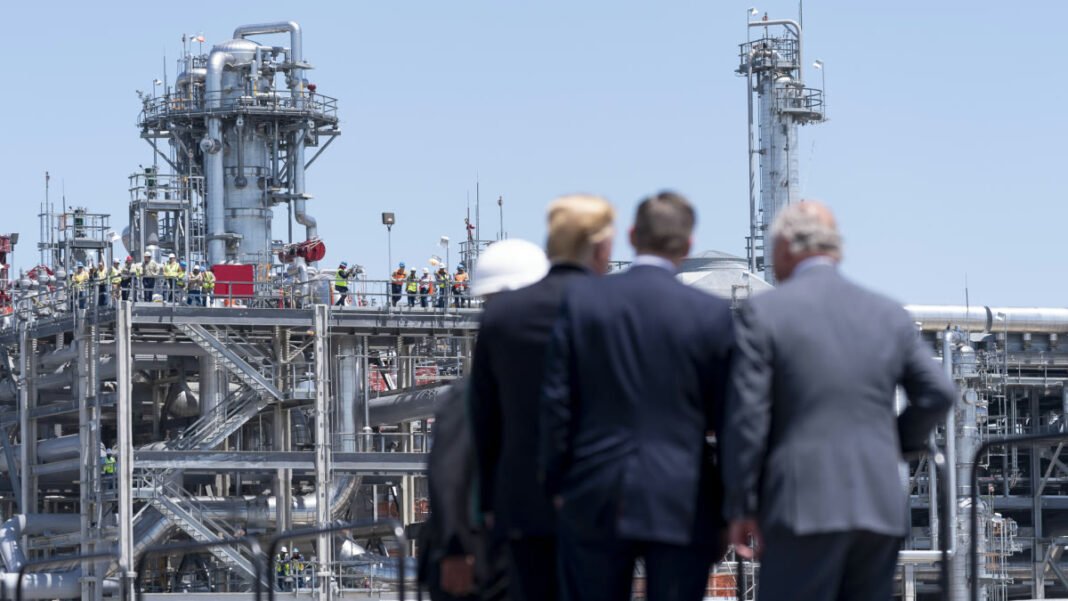


President Donald Trump is signing tens of billions of dollars in natural gas infrastructure deals from Europe to Africa, in a move meant to tie buyers to American fuel for decades. The agreements, reported by Politico from Antalya in Turkey, cover gas import terminals, pipelines and power plants that would burn US energy long after his presidency ends.
The push builds on trade deals struck since Trump returned to the White House. The European Union agreed in July 2025 to buy $750 billion of US energy through 2028, mostly liquefied natural gas, in return for lower tariffs and continued access to the US market. Indonesia agreed to $15.4 billion in energy imports, and Japan has opened talks on new long-term gas supply contracts. Australia, itself a major gas exporter, has also come under pressure to buy more American fuel.
US energy deals in Europe and Africa
The new projects are the physical side of that trade policy. A gas terminal or a gas-fired power station built today runs for 30 to 40 years, and each one becomes a steady customer for US energy producers. The United States is already the world’s largest producer of oil and gas, with about 22 percent of world oil output and 25 percent of world gas output, and the administration wants that position to last.
Administration officials present the deals as a matter of national strength. Selling more US energy abroad brings in revenue for American firms, gives Washington a lever in talks with allies, and limits the room for China to sell clean energy technology to the same countries. Trump has called climate change a “con job” in a speech at the United Nations, and his administration has cut support for wind and solar power at home while opening the way for more drilling.
The scale of the shift is large. The United States became the world’s top exporter of liquefied natural gas in 2023, passing Qatar and Australia, and export capacity is still growing along the Gulf coast. Each new terminal abroad adds to the demand for that gas, and each contract signed now fixes a price and a buyer for years ahead.
Why US energy exports matter to allies
For buyers, the appeal is security of supply. Europe has been cutting its reliance on Russian gas since the invasion of Ukraine, and the European Union has set out a step-by-step ban under which liquefied natural gas from Russia will be fully banned at the start of 2027 and pipeline gas by autumn 2027. US gas now makes up about 30 percent of Europe’s consumption, and more American liquefied natural gas is set to come online.
African countries are part of the new round of deals too. Gas discoveries off the coasts of Mozambique, Senegal and Mauritania have drawn interest from American firms, and new export terminals there would ship fuel to Europe and Asia. For governments in those countries, the projects promise jobs and export revenue. For the administration, they add another set of long-term buyers.
The deals also carry a cost that critics have been quick to point out. Infrastructure built now locks in fossil fuel use for decades and takes money that could have gone to wind, solar and storage. Christoph Nedopil, director of the Griffith Asia Institute in Australia, has argued that the policy turns a risky commodity market into a decades-long subscription for US energy producers, paid for by allies who have little choice but to sign.
What happens next for US energy exports
More agreements are expected in the months ahead, as the administration ties energy purchases to trade talks with countries across Asia and Africa. The administration has also backed US oil majors as they negotiate new production deals in Iraq, Libya, Algeria, Azerbaijan and Kazakhstan. The terminals and power stations in the new deals will take years to build, so the full effect will not be felt until well into the next decade. What is already clear is the direction of travel: Washington is using its position as the world’s largest gas producer to make US energy a fixed part of other countries’ power systems for a generation.