
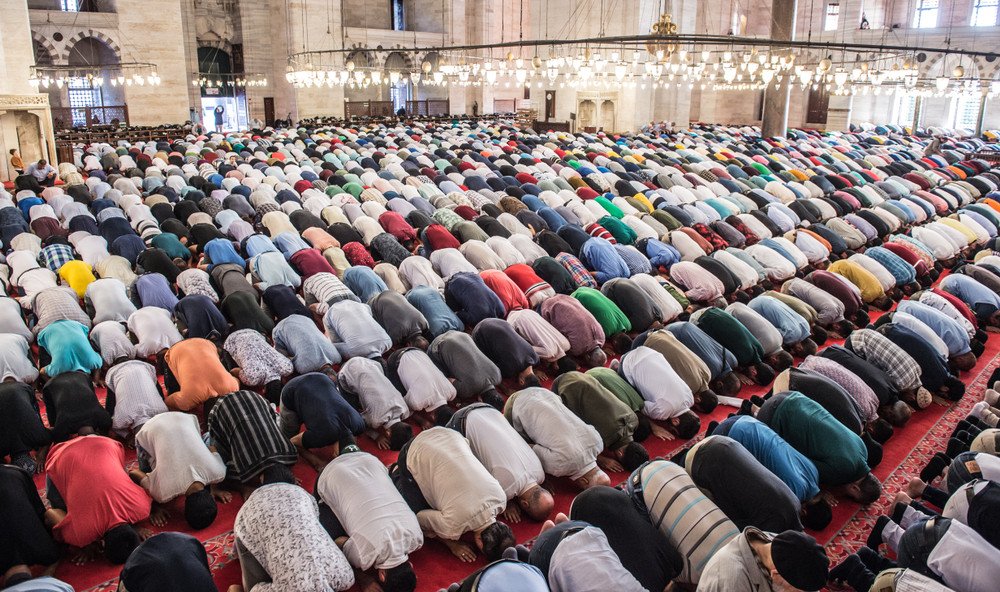


Muslims are projected to outnumber Christians worldwide by 2035, ending a lead Christianity has held for centuries. The forecast comes from the Pew Research Center, which published its report “The Future of World Religions: Population Growth Projections, 2020-2070” on Wednesday. The Muslim population stood at about 2.02 billion in 2020, against 2.27 billion Christians, and Pew expects the two lines to cross within a decade.
By 2035, Pew projects about 2.57 billion Muslims and 2.52 billion Christians. The gap then widens. By 2070, if recent trends continue, there will be more than 3.6 billion Muslims and just under 3 billion Christians, with Muslims making up about 36 percent of the world’s people, up from 26 percent in 2020. The report was produced with the Center for Advanced Studies of Population and Religion at Krakow University of Economics in Poland.
Muslim population growth and a younger age profile
Two forces drive the change: age and fertility. Muslim populations are younger on average, and the fertility rate for Muslims was 3.1 children per woman in 2020-2025, against 2.0 for non-Muslims. Pew projects that Muslim births will outnumber Muslim deaths by at least 1.6 billion between 2020 and 2070, the only major religious group with growing numbers of births in the decades ahead.
Religious switching plays almost no part. Pew expects about 9.2 million Muslims to become Christians between 2020 and 2070 and about 9 million Christians to become Muslims, flows that all but cancel each other out. The crossover is a matter of births and age, not conversion.
Where the Muslim population is growing fastest
Most of the growth sits in countries that are already Muslim-majority. Pew expects 74 percent of Muslim population growth to happen in such countries, and all 53 countries and territories that were majority-Muslim in 2020 are projected to remain so. Muslims will make up 90 percent or more of the population in most of these places.
The map of Christianity is moving too. Pew projects that more than half of the world’s Christians will live in sub-Saharan Africa by 2070, and that the Democratic Republic of Congo will replace the United States as the country with the most Christians. The study also projects that the United States will no longer have a Christian majority.
Other groups grow more slowly. Hindus, Buddhists, Jews and the religiously unaffiliated are all projected to fall behind the rise in the world’s population, and the unaffiliated share is expected to shrink as China’s population falls by an estimated 421 million. Muslims and Christians are the only groups in the study expected to keep pace with world population growth.
What the Muslim population projections do not mean
Pew is careful about what the numbers are. They are projections, not predictions, built on census and survey data from 201 countries and territories covering 99.98 percent of the world’s population, plus United Nations population figures and estimates of migration. Wars, epidemics and economic change are not built into the model. Under a test scenario in which every religious group in each country had the same fertility rate, Muslims would still pass Christians, but in 2040 rather than 2035.
Conrad Hackett, a senior demographer at Pew who co-led the project, said one common reading of the figures is wrong. “One misconception people might have is, if Muslims are the largest, it comes at the expense of Christians,” he said. “But 74 percent of Muslim population growth will happen in countries that are already Muslim-majority. And most Christian growth is in places where there are already Christian majorities.”
Both groups keep growing in absolute terms. Pew expects the Christian population to grow by about 30 percent between 2020 and 2070 and the Muslim population to grow by about 80 percent, against a 29 percent rise in the world’s population as a whole. The crossover in 2035 changes which faith counts the most followers, and the Muslim population is then projected to keep pulling ahead through 2070.