
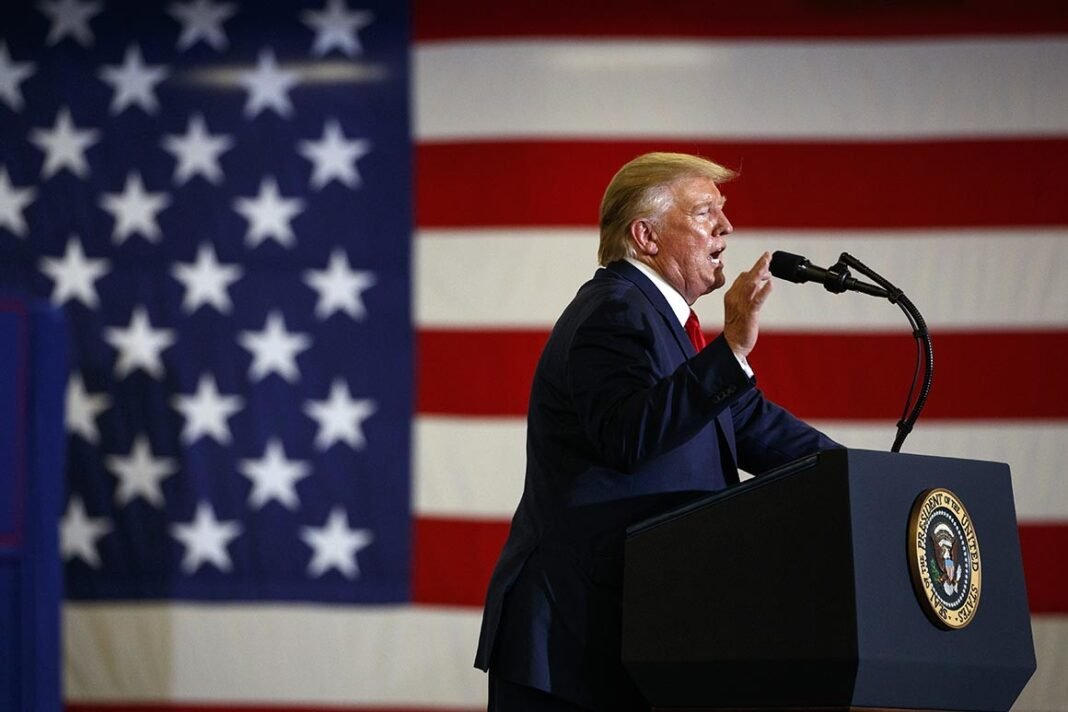


Trump has pointed to India’s 7 per cent economic growth and low interest rates to attack the United States Federal Reserve for keeping borrowing costs high. Speaking to reporters at the White House on Friday, the president said the American economy could grow by 15 to 20 per cent if the central bank cut rates.
Trump accused the Federal Reserve of being “very political” and said it raised interest rates whenever the United States announced strong economic figures, instead of lowering them to support further growth. “Interest rates are too high because we have a very political Fed. I’m not blaming the chairman, but the fact that we have a very political Fed. Whenever we announce good numbers, they raise the interest rates. They do that for a reason. It should be the opposite,” he said.
Trump calls the Fed very political
Trump argued that strong economic figures should be rewarded with cheaper credit, because a fast growing economy makes the country a better credit risk. “We do just the opposite. We do it to destroy the country. When we have these great numbers, you shouldn’t keep raising the rates. You should lower rates because we’re a better credit. We would have a GDP of 15 or 20 per cent, not 4 per cent. We’d pay off the debt very rapidly. That’s the way it should work. But we do it in reverse,” he said.
Drawing the comparison with India, Trump said: “If you look at India, they have low interest rates and they have a 7 per cent GDP. We’d have a 14%, 15%, maybe even a 20% GDP. It’s really a sad thing when you do so great and then they raise the interest rate. The fact is, we’ve blown through it.”
India held up as the model
Trump went on to argue that the United States should have the lowest interest rates in the world, given its place in the global economy and its part in the economic success of other countries. “We’re the country that makes other countries successful. Some of them are considered financial elite, but they are not. They are only elite because of us. So we should have the lowest,” he said.
The remarks were made during a White House news conference on Friday alongside Vice President JD Vance and Secretary of State Marco Rubio, and they continue a long run of criticism of the Federal Reserve’s monetary policy. Trump has repeatedly pressed the central bank to cut rates, while the bank sets policy on its own reading of inflation and employment.
The Federal Reserve operates independently of the White House, and its chair and governors are not bound to follow the president’s wishes on rates. The dispute is not new. The president has criticised the Federal Reserve through much of his time in office, while the bank has kept setting policy on its own reading of inflation and employment. The White House news conference was the latest round in that dispute, and it put the question of who sets borrowing costs back in public view.
Trump says lower rates would cut debt fast
Trump also claimed that every single percentage point in interest rates represents $650 billion, and that cheaper borrowing would let the government pay down the national debt rapidly. The claim rests on his view that faster growth would follow lower rates, a link the Federal Reserve has not accepted.
Inflation in the United States remains above the Federal Reserve’s 2 per cent target. Figures cited in the reports put annual personal consumption expenditures inflation at 3.6 per cent in September, with core inflation, which leaves out food and energy prices, at 3.1 per cent. The central bank works to a dual mandate of controlling inflation and keeping employment at its maximum, and its decisions are guided by its own assessment of those two goals rather than by growth targets set in the White House. Trump has shown no sign of easing his criticism. Its decisions rest on its own reading of inflation and employment, not on growth targets set elsewhere.