
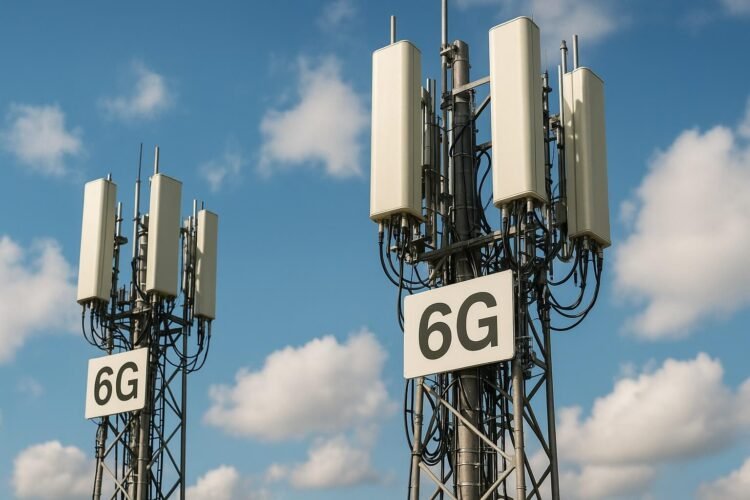


India has joined the United States and 24 other countries in a global initiative to shape the development of sixth-generation, or 6G, wireless networks. The United States Department of Commerce announced India’s participation after a meeting between Jitin Prasada, minister of state for commerce and industry, and Howard Lutnick, the United States secretary of commerce, on the sidelines of the G20 Innovation Ministerial in Chapel Hill, North Carolina.
India has endorsed the Call to Action for 6G Leadership and Security, a shared commitment by like-minded governments to shape the next generation of wireless technology around openness, interoperability, security, resilience, resource efficiency and innovation-led competition. The endorsement was announced on the sidelines of the G20 Innovation Ministerial, held in North Carolina on 1 and 2 September 2026 under the United States’ G20 Presidency.
Union communications minister Jyotiraditya M. Scindia announced the endorsement on social media on 9 September. “Bharat For 6G! An absolute delight to announce India’s endorsement of the Call to Action for 6G Leadership and Security, joining 24 like-minded nations in advancing an open, interoperable, secure and resilient next-generation network,” he wrote.
What the 6G call to action asks for
The Call to Action sets out a phased set of steps for the governments taking part. Within one month, each government is to name expert points of contact for 6G, name the agency responsible for managing contact with the group, and draw up a first list of industry and academic stakeholders.
Within three months, governments are to work with the telecom sector to map the emerging picture for secure and interoperable networks, find the barriers to leadership, meet to compare findings, and start identifying the economic, political and financial resources that could support competitiveness in the field.
Within six months, they are to draw up expert-level plans for secure, resilient and sustainable 6G supply chains over the long term, and consider how leadership and security in the field should appear in national and regional strategies. Within twelve months, the participants are to meet in person in 2027 to review progress, share lessons and set priorities for the following year with industry stakeholders.
The initiative also covers joint work on research and development, cooperation between trade and development finance agencies to support secure 5G and next-generation networks in global markets, checks on the cybersecurity risks of telecom investment, more openness about supply chain developments, and work with industry to shape global 6G standards, including strong security standards, in standards bodies.
India’s 6G ambitions at home
India’s participation builds on work already under way at home, including the Bharat 6G Vision, the alliance of the same name and the country’s indigenous 4G and 5G technology stack. The government has said India aims to contribute 10 percent of global standards and patents in the field, as part of a push to move from adopting technology to setting standards.
The Department of Telecommunications will take forward India’s engagement under the Call to Action and coordinate follow-up work with government agencies, industry, academia and other stakeholders. India reaffirmed its commitment to building strategic partnerships in artificial intelligence, semiconductors, digital public infrastructure, robotics and other emerging technologies.
Ministers also agreed a consensus Innovation Ministerial Statement at the G20 meeting, covering pro-innovation policy, technology for prosperity, technical workforce development, intellectual property policy for artificial intelligence, standards, and industrial innovation and supply-chain investment. India also held talks on the sidelines with the European Commission, France, Germany and the African Union. The Indian delegation was led by Prasada, who is minister of state for electronics and information technology as well as commerce and industry.
Who else signed on
India joins other governments that have affirmed the Call to Action, including Canada, Costa Rica, Czechia, Denmark, Estonia, France, Germany, Greece, Honduras, Italy, Japan, Latvia, Norway, Paraguay, the Republic of Korea, Romania, Sweden, the United Kingdom and the United States.
The Call to Action states that taking part does not bind or limit any government’s authority to pursue its own independent position in industry-led standards bodies, and that each participant’s next steps will vary with its own priorities, resources and capabilities. It also cautions against duplicating the technical work already under way in industry-led standardisation forums.