
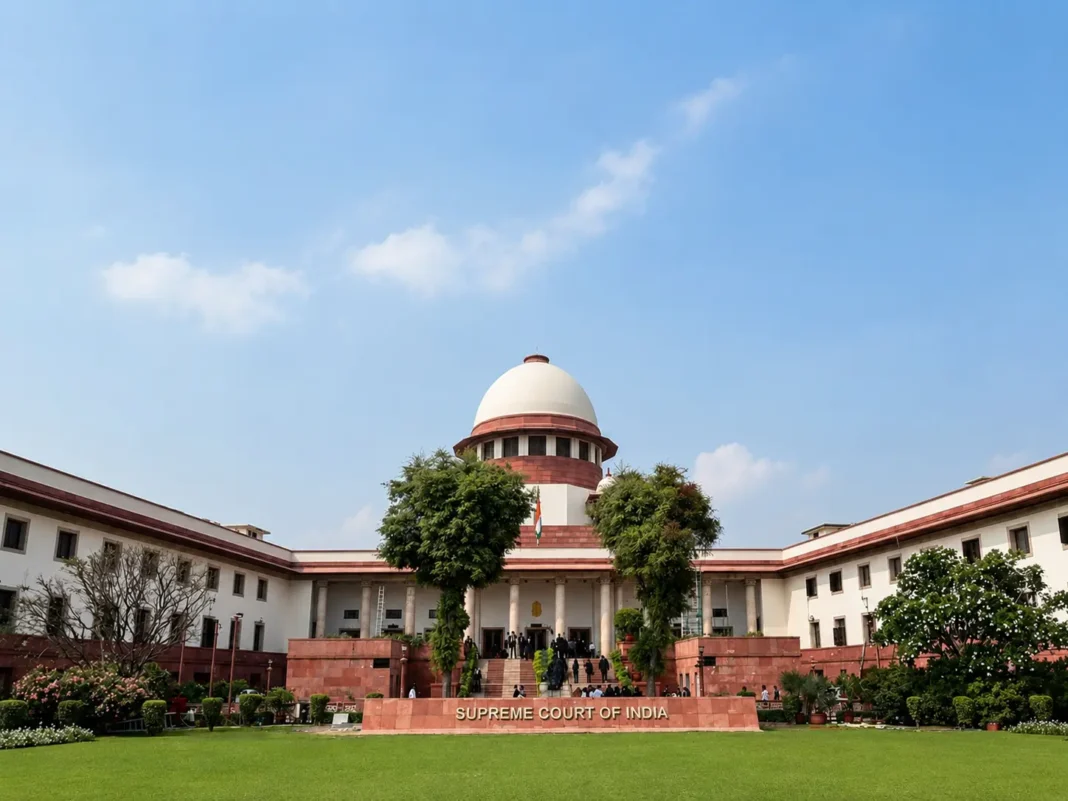


The Supreme Court on Friday asked the Centre for its response on whether India needs a law on marriages between close blood relatives, while making plain that it cannot order Parliament to pass one. A bench of Chief Justice Surya Kant and Justices Joymalya Bagchi and V Mohana issued notice to the Union government for the limited purpose of drawing its attention to the issue.
“We are issuing notice for the limited purpose of impressing upon the Union of India to consider the desirability of bringing a suitable legislation, or to ensure wide publicity through different channels, including a proper curriculum,” the Supreme Court bench said. “We can issue notice for the limited purpose of impressing upon the Union of India to consider the need for a suitable legislation. We will not direct them. We will only sensitise them,” it added.
Supreme Court says lawmaking rests with Parliament
The Supreme Court observed that regulating such marriages through social reform legislation falls exclusively within the domain of the legislature, and that the court cannot regulate consanguineous marriages, the term for marriages between people closely related by blood. The notice asks the Centre to consider whether a suitable law is desirable, or whether wider awareness of the health risks would serve the purpose instead.
The case came before the Supreme Court on a public interest petition filed by Charvi S, a 20-year-old law student from Bengaluru who studies at the National Law School of India University. The petition was filed through advocate Anjuman Tripathy. Charvi S has 40 per cent visual impairment, and she describes herself as the offspring of a first cousin marriage conducted in line with an age-old practice in her community.
The petition and the health risks cited
The petition says recent medical studies show that marriages between close relatives increase homozygosity, which raises the chance of recessive genetic conditions, congenital malformations, sensory impairments, developmental disabilities and infant deaths in children born from such unions. Counsel for the petitioner told the Supreme Court that data put the prevalence of such marriages as high as 28 per cent in southern states, and that the practice was increasing.
The plea challenges provisions of the Hindu Marriage Act, 1955, and the Special Marriage Act, 1954, which permit certain marriages within prohibited degrees of relationship where custom or tradition allows them. It asks the court to declare those exceptions unconstitutional, or to read Sections 5(iv) and 5(v) of the Hindu Marriage Act so that marriages within prohibited or sapinda relationships carry prior public health safeguards, including counselling, disclosure of health risks, medically advised screening and certification.
The petition also argues that without such safeguards, the practices sit beyond the authority granted by Articles 14 and 21 of the Constitution. It seeks premarital genetic counselling and voluntary genetic screening in areas where such marriages are more common, along with nationwide awareness campaigns. The plea makes clear that the measures should not criminalise marriages that have already taken place or affect their legal status.
Supreme Court points to awareness and curricula
During the hearing, the Supreme Court bench said the issue calls for public awareness, because marriage is a matter of personal choice and a person should be able to take an informed decision. Justice Bagchi observed that people should be equipped to make an informed decision about such marriages, and referred to earlier rulings recognising the right to marry a person who is HIV positive with full knowledge of the condition.
The Supreme Court also referred to the duty under Article 51A(h) of the Constitution to develop a scientific temper. Counsel suggested involving Anganwadi centres and panchayats in awareness work, and the bench said schools and colleges could play a part by carrying the relevant scientific information in their curricula.
The Supreme Court has not passed any order banning consanguineous marriages, and its notice is limited to seeking the Centre’s view on legislation or awareness measures. The matter will now proceed on that limited question, and the Centre’s response is awaited.