
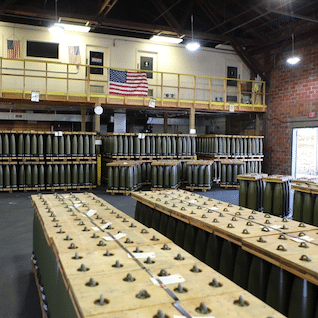


The United States Army intends to detonate more than four tonnes of lead azide at a military base in Iowa, defying a federal appeals court’s order suspending its permit to do so. The service now targets Wednesday, November 25, for two controlled explosions at the Iowa ammunition plant near Middletown, after moving the date three times in a week.
The stockpile contains roughly 9,773.5 pounds of lead azide across 68 barrels, with lead accounting for approximately 6,900 pounds of its chemical mass. The material has been stored for more than two decades at the plant, and the service says it has grown unstable. Justice Department lawyers have warned that sub-freezing temperatures could trigger an uncontrolled explosion.
The controversy centers on a deteriorating stockpile of explosives that the service has known about for years. Staff at the Iowa ammunition plant found several dozen barrels of degraded lead azide in March, and crystallization of the material created an unstable and dangerous situation. It assembled specialists in munitions chemistry, engineering, and environmental safety to come up with a plan, and it chose controlled detonation.
Army lead azide plan and the court pause
The Environmental Protection Agency granted an emergency permit on November 13 that authorized the service to move forward with the explosions, originally scheduled for November 20. Environmental groups, including the Sierra Club and the Iowa Environmental Council, sued to halt the operation, and the United States Court of Appeals for the Eighth Circuit granted a pause on Thursday, November 19, staying the permit until the court rules on the emergency motion.
In a Saturday court filing, the Justice Department maintained that the service could still proceed with the two controlled blasts under an emergency exemption. “The emergency exception does not depend on the Emergency Permit and is therefore not affected by, nor contradictory to, the terms of this Court’s administrative stay,” the Justice Department said in its filing. The government said the service intends to act by November 24, 2026, and on Sunday evening officials said it would target Wednesday “to allow for optimal weather conditions and all mitigation measures to be emplaced.”
Earthjustice, which represents the plaintiffs, has argued that the move would sidestep the court’s authority. “Anyone can claim an emergency at any point and do whatever they want. I don’t think people can or should accept that,” said Thien Chau, a lawyer with Earthjustice. “This emergency is of the Army’s own making,” the groups said in a statement. “The Army has not publicly provided details about why the lead azide was not disposed of before it became so dangerous.”
Army lead azide plume and the risk to residents
The plaintiffs pointed out that nearby residents were only given a week’s notice and that the blasts could send lead dust as far as 100 miles. On November 15, officials released two plume maps outlining the potential spread of lead contamination across a swath of eastern Iowa, though projections hinge on real-time wind conditions. The advisory states: “The detonation will result in an air plume with some lead-containing particles which will disperse in the air and deposit on the ground. Lead is toxic to humans and animals.”
Nearly 400 people live in Middletown, but thousands more in surrounding areas could be affected by material that disperses in the air and lands on the ground. The Iowa Department of Health and Human Services said in a fact sheet that two controlled explosions were scheduled for around noon on Monday, before the Army moved the date to Wednesday. Iowa officials issued guidance telling residents to stay indoors for 24 to 48 hours, shelter livestock, and check the Army’s plume maps.
The Army advised people to avoid the affected area during the detonation and urged anyone who could not leave beforehand to stay indoors, close windows and doors, and shut off heating and cooling systems that bring in outside air. Residents should wet-clean surfaces children may touch to remove any lead dust once the exposure period has ended, the Army said. Lead can interfere with neurological development in children, affecting their brains.
Army lead azide decision still contested
Acting Secretary Adam Telle said in a statement on Thursday that officials had determined with the Environmental Protection Agency that a controlled detonation to dispose of the degraded lead was the option that posed the lowest risk to the public. The barrels are set to be detonated in place at the Iowa facility, and vibrations from the two planned blasts were expected to be quick, but they could break old windows.