
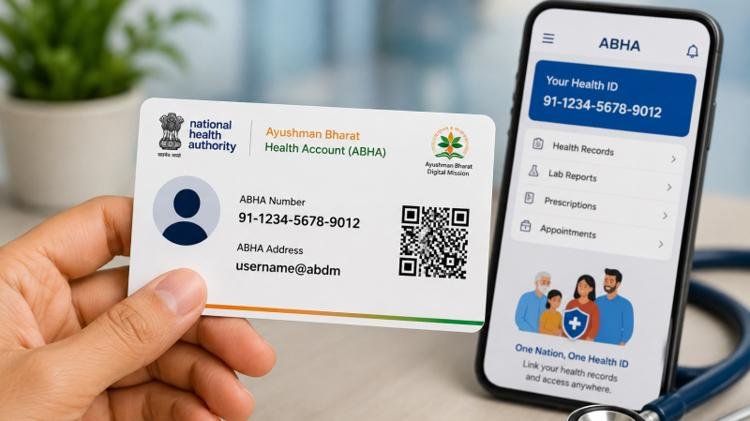


Union Health Secretary Punya Salila Srivastava has called on India to use its digital health infrastructure to share health records and cancer screening data between hospitals, so that a patient’s care is not broken each time they move to a new facility. Digital health records India has built under the Ayushman Bharat Digital Mission now number about 100 crore linked records, with around 99 crore Ayushman Bharat Health Account (ABHA) IDs created.
Srivastava was speaking at the National Cancer Grid (NCG) Annual Meeting 2026 in Mumbai on 21 November, where she launched NCG VISHWAS, an AI-enabled patient education initiative. She said digital health records India holds should be linked with ABHA IDs, so that screening records of cancer patients follow them from one facility to the next.
Digital health records India can link to cancer screening
Digital health records India has created can follow a patient from a primary health centre to a district hospital and on to a tertiary centre, including hospitals empanelled under the Ayushman Bharat Pradhan Mantri Jan Arogya Yojana. Srivastava said that, with the patient’s consent, health records should be accessible to healthcare providers at different levels of care, and that data shared with consent could be used to advance cancer care and research.
The figures show how far digital health records India has come. More than 153 crore cancer screenings have been conducted so far under national health programmes at 1.87 lakh Ayushman Arogya Mandirs, including 37.1 crore screenings for oral cancer, 17.4 crore for breast cancer and 9.7 crore for cervical cancer. People above the age of 30 are screened for common non-communicable diseases, including the three cancers, at the Mandirs.
What NCG VISHWAS will do
NCG VISHWAS, short for Videos to Support Health, Wellness, Awareness and Self-care, covers breast, cervical and oral cancers in Hindi, Marathi, Tamil and English. The videos cover prevention, diagnosis, treatment and long-term care, and will be shared through the National Cancer Grid’s network of hospitals and healthcare partners. The videos sit alongside the digital health records India is linking to screening data, and Srivastava said they could also reach patients through ASHA and Anganwadi workers, community platforms, and the ABDM and Swasth Bharat portals.
Dr C S Pramesh, convener of the National Cancer Grid, said the initiative combines the grid’s clinical expertise with technology and artificial intelligence to make reliable, clinician-reviewed information available to patients and families in languages they understand. He said: “Our aim is to empower patients and caregivers with accurate, easy-to-understand information at every stage of their cancer journey.”
Digital health records India needs for continuity of care
Srivastava said the National Health Mission’s continuum of care runs from primary to tertiary levels, and that comprehensive primary healthcare services expanded in 2018 from six to twelve packages, adding screening for oral, breast and cervical cancers. Screening and follow-up are recorded on the national programme portal, diagnosis is largely confirmed at district hospitals, and treatment is provided through medical colleges and the PM-JAY scheme. That chain rests on digital health records India can share with consent.
She also spoke about affordability, pointing to trade margin rationalisation for cancer medicines and financial support under PM-JAY for vulnerable patients. About Rs 27,000 crore has been provided towards cancer care under the scheme. She called for all AIIMS institutions with oncology facilities to join the National Cancer Grid, and for member hospitals to partner with the Pan-AIIMS Research Consortium, set up with ICMR support, so that data shared with consent can support cancer research. The money follows the patient, and digital health records India has linked will carry the screening history with them.
On awareness, Srivastava pointed to the Swasth Nari Sashakt Parivar Abhiyaan, which ran in September last year and drew 11 crore footfalls, and said awareness work continues through monthly Ayushman Arogya Shivirs in the states. She said the NCG VISHWAS videos can strengthen those efforts by reaching patients directly. The NCG Annual Meeting 2026, held over two days in Mumbai, brought together more than 300 cancer centre leaders, policymakers, patient groups, technology developers and industry leaders, and the digital health records India is building will support that work.
The National Cancer Grid is a network of more than 400 cancer centres, research institutions and patient groups working to improve cancer care through standardised protocols, quality assurance, capacity building and collaborative research. Dr Sharmila Pimple, professor and head of preventive oncology at Tata Memorial Centre, Mumbai, described VISHWAS as “a trusted education video companion” that should be integrated “across the entire cancer care continuum from prevention to palliation”.