
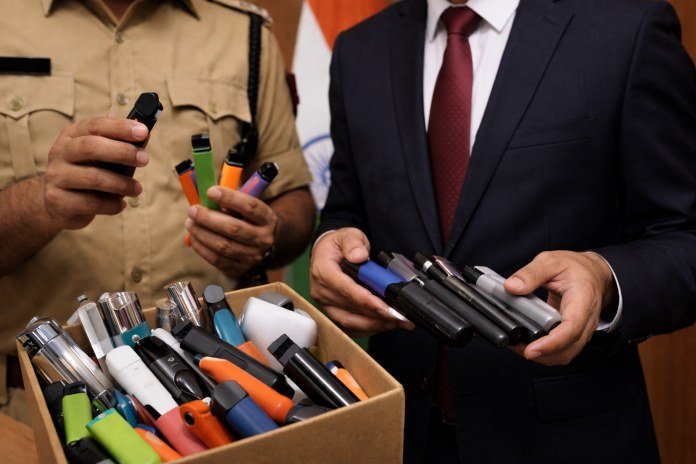


The 2019 law made vaping illegal in India, banning the production, manufacture, import, export, transport, sale, distribution, storage and advertisement of e-cigarettes. The ban covers every form of electronic nicotine delivery system, including heat-not-burn products and e-hookahs, and it applies to online sales and advertising as well as shops.
A first offence under the Prohibition of Electronic Cigarettes Act, 2019, carries imprisonment of up to one year or a fine of up to Rs 1 lakh, or both. A second offence carries imprisonment of up to three years and a fine of up to Rs 5 lakh. Storing stocks of e-cigarettes is a separate offence, punishable with imprisonment of up to six months or a fine of up to Rs 50,000, or both.
E-cigarettes are battery-operated devices that heat a substance, which may contain nicotine and other chemicals, to create vapour for inhalation. They are often shaped like cigarettes, cigars or hookahs, but also take the form of pens and USB memory sticks. Unlike traditional cigarettes, they do not contain tobacco.
Vaping illegal in India: how the ban came about
The Union Cabinet, chaired by Prime Minister Narendra Modi, approved an ordinance on 18 September 2019 that made vaping illegal in India, and Parliament then made the ban law. The decision followed an advisory from the health ministry in August 2018, which asked states to consider banning the products, and a white paper from the Indian Council of Medical Research that recommended a complete ban on the evidence available at the time.
The health ministry’s case rested on the harm the devices can do. Its paper said the available evidence showed e-cigarettes and similar products were hazardous for active as well as passive users, and that pure nicotine, the main ingredient, is highly addictive and poisonous, with the potential to cause death even in small quantities. The World Health Organization had also urged member countries to act, and India is a signatory to the WHO Framework Convention on Tobacco Control. That evidence is the reason the 2019 law made vaping illegal in India.
Why the ban targets young users
Ministers and health officials warned that flavoured vapes in bright packaging were reaching young people and children, and that the products could act as a gateway to nicotine use and then to conventional cigarettes. The ordinance said the use of e-cigarettes had acquired epidemic proportions in developed countries, especially among youth and children. A Global Adult Tobacco Survey in 2016-17 found about 3 per cent of Indian adults were aware of e-cigarettes, and 0.02 per cent used them. Those numbers were part of the case for the law that made vaping illegal in India.
Sellers have marketed vapes as safer than cigarettes and as a way to quit smoking. The health ministry said such claims of safety were false, and that the efficacy and safety of e-cigarettes as a quitting aid had not been established. None of these products are licensed in India, and the law that made vaping illegal in India covers them all.
Vaping illegal in India: what smokers can use instead
E-cigarettes are not an approved way to quit smoking in India, and the WHO does not endorse them as cessation aids. Proven options include nicotine replacement therapy, counselling and the National Tobacco Quitline on 1800-112-356, which offers free counselling. Medical guidance says quitting at any age improves breathing and lowers risk, and that support makes it easier.
Enforcement rests with the police, and a sub-inspector has been designated as the authorised officer to act under the law. People who held stocks of e-cigarettes when the ordinance began were told to declare them and deposit them with the nearest police station. The ban was part of the government’s 100-day agenda, and trade bodies and users opposed it, saying it removed a safer option for smokers. The ordinance that made vaping illegal in India took effect at once.
The law remains in force: the 2019 Act made vaping illegal in India, and the ban still covers production, sale, import, storage and advertising.