
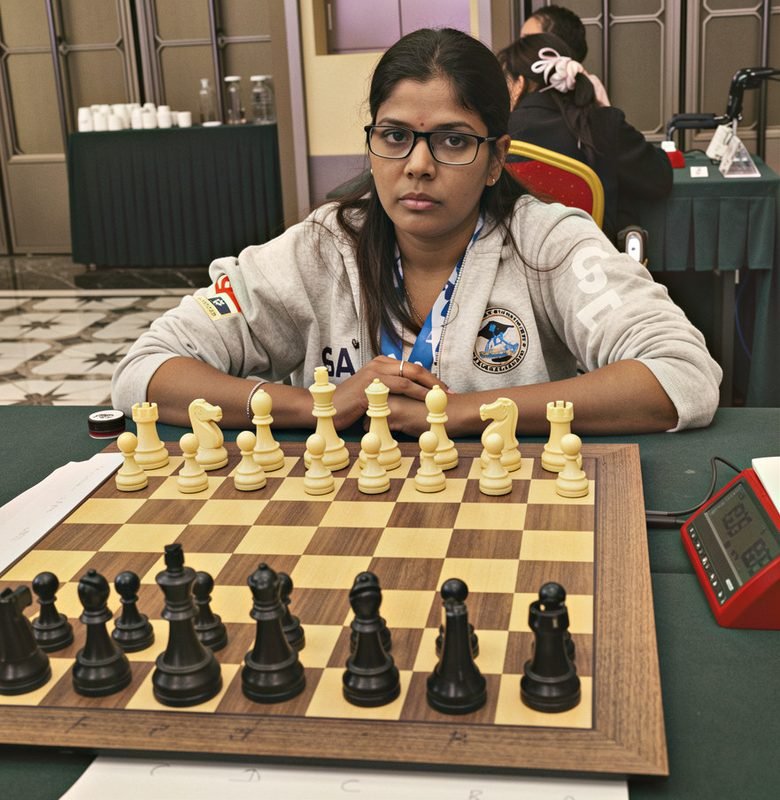


Ezhilarasi G began playing serious chess at the age of 39. Four years later, the 43-year-old from Tamil Nadu has won three medals for India at an Asian championship. The Ezhilarasi chess Asian medals came at the 4th Asian Chess Championship for Players with Disabilities in Bishkek, Kyrgyzstan: silver in women’s rapid chess and bronze in women’s blitz and women’s standard chess.
Ezhilarasi, who lives in Bengaluru, was one of nine players who represented India at the championship, held from 29 October to 8 November 2026. The Ezhilarasi chess Asian medals were won in rapid, blitz and standard play. She was the only woman representing Karnataka and the only woman above 40 in the Indian team. India finished the championship with 14 medals: five gold, five silver and four bronze.
The Ezhilarasi chess Asian medals were decided across three formats. Her scores in Bishkek were 4 points from 5 games in rapid chess, 4 from 7 in blitz and 4 from 9 in standard chess. The rapid silver came behind Russia’s Svetlana Lobova, who won all five of her games. In the blitz, Lobova took gold with 6 from 7.
How the Ezhilarasi chess Asian medals began
Ezhilarasi is from Nathamalai village in Cuddalore district, Tamil Nadu. Polio at the age of three left her with a physical disability affecting both her legs, and she had to stop formal education after Class 8. From the age of 14 until around 30, she spent most of her time at home, playing chess with her brother without knowing the game could offer anything beyond a pastime.
She later left home and worked with non-governmental organisations, learning embroidery and handicrafts and then teaching those skills to people with disabilities. While working with an NGO in Chennai, she met her husband, Adarsh Edamana, at 31. They married in 2016 and settled in Bengaluru. Her husband, she said, has always been her biggest strength.
Her serious chess journey began at 39, during the COVID-19 lockdown, when she started playing again at home and decided to learn the game properly. Her first coach, Karthik, trained her at home for around three months. She then suffered a fracture in her right hand in an accident, but she kept playing. Through the Chess Federation for Physically Disabled, she reached competition, and in December 2022 she played her first national-level event at Tumakuru.
The road to Bishkek
The road to the Ezhilarasi chess Asian medals ran through Tumakuru, where she met Anand Babu VL, secretary of the Chess Federation for Physically Disabled, who encouraged her to play tournaments and selection events. She also met coach Dinakaran B, who has trained her ever since. In 2024, she played the Tata Steel 4th All India Specially Abled FIDE Rated Chess Championship in Jharkhand and finished first in the unrated category with 5.5 points.
That result took her to the 2nd Asian Chess Championship for Players with Disabilities 2024, also in Bishkek, where she scored 6 points from 9 rounds and finished fourth in the women’s championship. The Ezhilarasi chess Asian medals were still two years away. She played more national and international events without the results she wanted, but she kept working on her game. In May 2026, she finished second in the wheelchair women category at the Chief Minister Trophy, the 6th CFPD National Chess Championship in Indore, Madhya Pradesh, held from 27 to 30 May.
The silver medal in Indore led to her selection by the Sports Authority of India to represent the country. The Ezhilarasi chess Asian medals in Bishkek followed five months later.
What the Ezhilarasi chess Asian medals mean
“I began my serious chess journey at 39, and today, at 43, I have represented India and won three medals at an Asian Championship,” Ezhilarasi said. “For me, chess is no longer just a game I played with my brother; it has become a journey that has changed my life.”
The Ezhilarasi chess Asian medals came despite money worries. After COVID, her husband lost his job, and the family found it hard to manage household expenses and support her chess career. Money limits kept her from playing as many tournaments as she wanted. At present, she teaches chess to a few children at home, which gives her a living. She keeps training for the competitions ahead.
Her aim now is to keep improving, play more international competitions and win gold medals for India. She also hopes her story encourages other women and people with disabilities to take up their own pursuits, whatever their age or circumstances. “I believe it is never too late to start something new, believe in yourself, and achieve what once seemed impossible,” she said. The Ezhilarasi chess Asian medals are the record of how far that belief has taken her so far.