
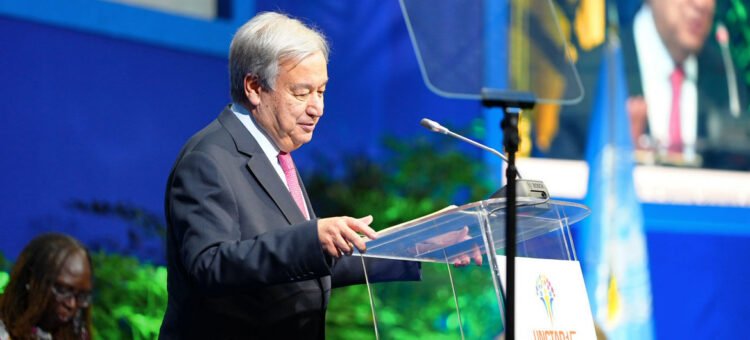


United Nations Secretary-General Antonio Guterres has called on the world's governments to agree within a year on a shared framework for AI oversight, warning that the technology is shifting power faster than existing institutions can handle. He made the appeal on Monday at the close of the Bridgetown Special Summit on AI Safety in Barbados.
"Today I call for member states to coordinate efforts and to develop within the next year a globally inclusive and principles-based multilateral framework for AI risk management, backed by independent and credible oversight," Guterres said. The summit was co-hosted by the UN and the government of Barbados.
Why Guterres wants AI oversight now
Guterres said AI is advancing at extraordinary speed, and that AI oversight has not kept pace. "It is transforming how we work, learn, and communicate. It is opening new possibilities in health, education, science, and development," he said. He added that the risks are also becoming clearer as systems grow more capable and more autonomous.
He pointed to new cybersecurity risks, new possibilities for manipulation and misuse, and systems behaving in ways that even their developers did not always anticipate. He said the future of AI cannot be decided by a few, for everyone else, and that many countries still lack the tools, knowledge and capacity to assess the systems entering their markets.
The summit in Bridgetown brought together member states, technology companies and civil society groups to discuss how AI should be governed. Barbados Prime Minister Mia Mottley co-hosted the gathering, which the UN organised as part of a wider push to set global rules for the technology. Guterres has raised the issue repeatedly in recent years, and his call in Barbados was his most specific to date, with a one-year deadline attached.
What the AI oversight framework would cover
The AI oversight framework Guterres proposed would be a multilateral agreement on managing AI risks, with independent oversight behind it. As a starting point, he suggested countries agree on shared safety measures, a testing regime and basic requirements for independent oversight.
He also proposed a Global Fund for AI Capacity Building to help poorer countries test whether AI systems work safely in their own languages and settings. The fund would close a gap in AI oversight he described in his remarks: "that gap must be closed," he said, referring to the difference between countries that can assess AI systems and those that cannot.
AI oversight and the shift of power
Guterres warned that the technology is driving what he called "the biggest transfer of power in the history of humankind." He said power was shifting from states and governing institutions to a small number of companies and persons, and that institutions built after the Second World War were not equipped to deal with it.
"When one looks at different other institutions of global governance, they correspond to the reality of the world in 1945," he said. He added that it was clear institutions need to be reformed to adapt to the realities of today's world.
The UN has already taken smaller steps toward AI governance. A high-level advisory body on AI reported to Guterres in 2024, and the General Assembly adopted a resolution on AI in the same year. Guterres said those steps were not enough on their own, and that countries needed a shared framework with teeth.
A call aimed at his successor
Guterres is approaching the end of his term, which ends in December, and he has become more vocal about safety measures around advanced technology. He said he would urge his successor, who is expected to take office in the New Year, to make effective AI oversight a priority.
He warned that properly controlling AI is necessary for humanity to keep control of the future of the world as the technology develops. A binding global agreement still looks distant, and the AI oversight framework he proposed would depend on member states agreeing to coordinate their efforts over the next twelve months.