
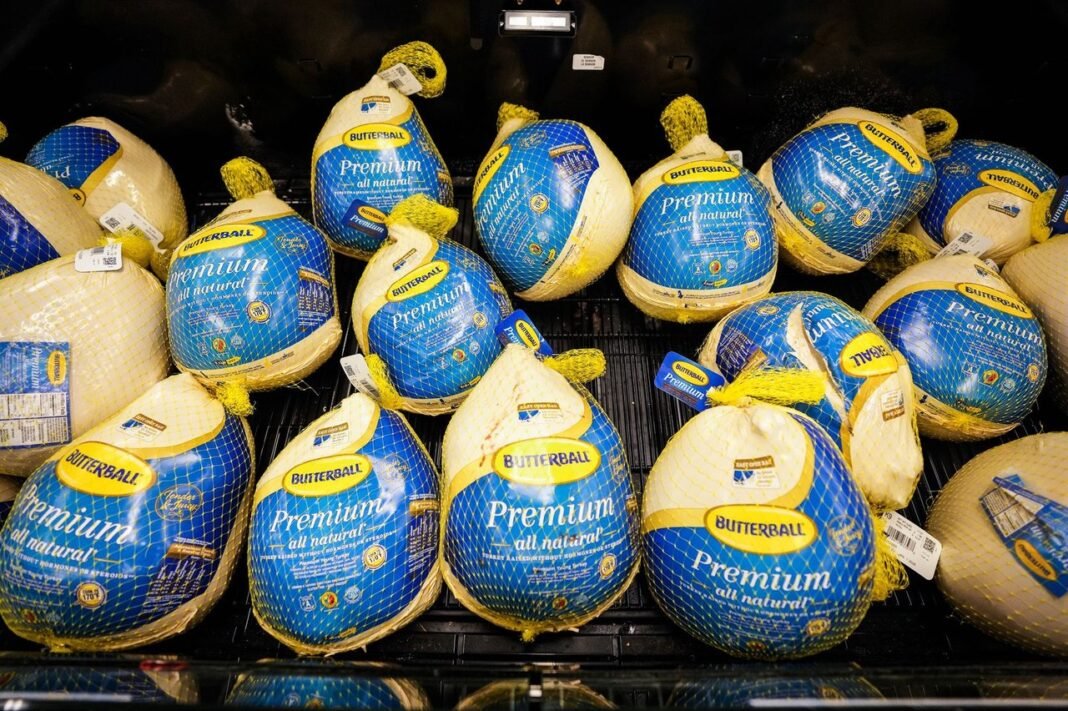


Butterball salmonella findings have put the country’s biggest turkey producer under scrutiny two days before Thanksgiving. Inspectors found salmonella in just under 43 percent of ground or chopped turkey samples taken over the past year at four Butterball plants, according to an investigation published on November 25 by The Guardian and SourceMaterial. No recall followed, no fine was issued, and no illnesses have been reported.
The investigation analyzed sampling data from the U.S. Department of Agriculture’s Food Safety and Inspection Service (FSIS) for fiscal years 2025 and 2026. The data was provided by Slingshot Investigates, the investigative arm of animal rights group Project Slingshot, and verified by SourceMaterial. It found Butterball salmonella contamination rates well above the industry average, and well above the federal standard for ground turkey.
At the Mount Olive plant in North Carolina, the largest turkey slaughterhouse in the country, FSIS inspectors found salmonella in 16 of 45 ground or chopped turkey samples tested, or 36 percent. The USDA performance standard for ground turkey is 13.5 percent, or no more than seven positive samples in 52 over a rolling 52-week window. The Butterball salmonella rate across its four plants was more than three times that standard, and its biggest rival ran at about half of it.
Butterball salmonella and the USDA standard
The federal standard carries no penalty when a plant misses it. A slaughterhouse that exceeds the limit does not face a fine and does not have to recall product. FSIS places the plant in Category 3 and posts it on the agency’s website, and asks the plant to explain how it is addressing the problem. The current poultry standards were set in February 2016, and the rule for comminuted turkey has stayed at 13.5 percent since then.
That gap between the standard and any consequence is at the center of the story. Butterball salmonella levels were high enough to put its plants over the federal line, yet the system asks for an explanation rather than imposing a sanction. The data also showed no contamination in Butterball’s whole birds or in its ready-to-eat cooked products, which is the part of the findings the company has stressed in its response.
The Butterball salmonella samples also raised questions about antibiotic resistance. About 65 percent of the positive isolates from Butterball’s ground turkey were resistant to one or more antibiotics. Across all of the company’s slaughterhouses, two-thirds of samples taken from birds’ intestines that contained salmonella and campylobacter, another germ that can sicken people, showed strains resistant to at least one antibiotic.
Butterball salmonella findings and the company’s response
In its response to the Butterball salmonella findings, the company questioned how the testing is done. Alice Johnson, the company’s senior vice president for food safety, said FSIS should measure how much salmonella is in a sample, rather than whether it is there at all. A company spokesperson said food safety is critically important at Butterball and that the company works diligently to ensure consumers can feel confident in the products they prepare and serve to family and friends.
The company also said it is taking part in a pilot program with FSIS that is evaluating the cause of foodborne illness, and it pointed out that none of its pre-cooked products contained salmonella. Butterball is the largest turkey producer in the United States, and its products reach millions of tables at Thanksgiving, which is why the timing of the report drew so much attention.
What shoppers should know about Butterball salmonella
There is no Butterball recall in effect. A check of active federal records on November 25 confirmed no active recalls or public health alerts covering any Butterball product, whole turkey or ground turkey, and no whole Thanksgiving turkey from any major brand is under recall. The Butterball salmonella investigation itself does not constitute a recall, and a high test result in raw ground turkey is not the same as a finding that every package carries the same risk.
Butterball has faced a recall before. In March 2019, the company recalled about 78,164 pounds of raw ground turkey from Mount Olive after salmonella Schwarzengrund matching sick people in Wisconsin was found in an unopened package of its product in one of their homes. That outbreak spanned two states, and the recall pulled the affected turkey from shelves.
For shoppers, the federal advice has not changed. The USDA says turkey should be cooked to a safe minimum internal temperature of 165 degrees Fahrenheit, measured with a food thermometer in the thickest part of the breast, the innermost part of the thigh and the innermost part of the wing. Proper cooking kills salmonella, and the agency’s guidance applies to all raw turkey, whatever brand is on the package.