
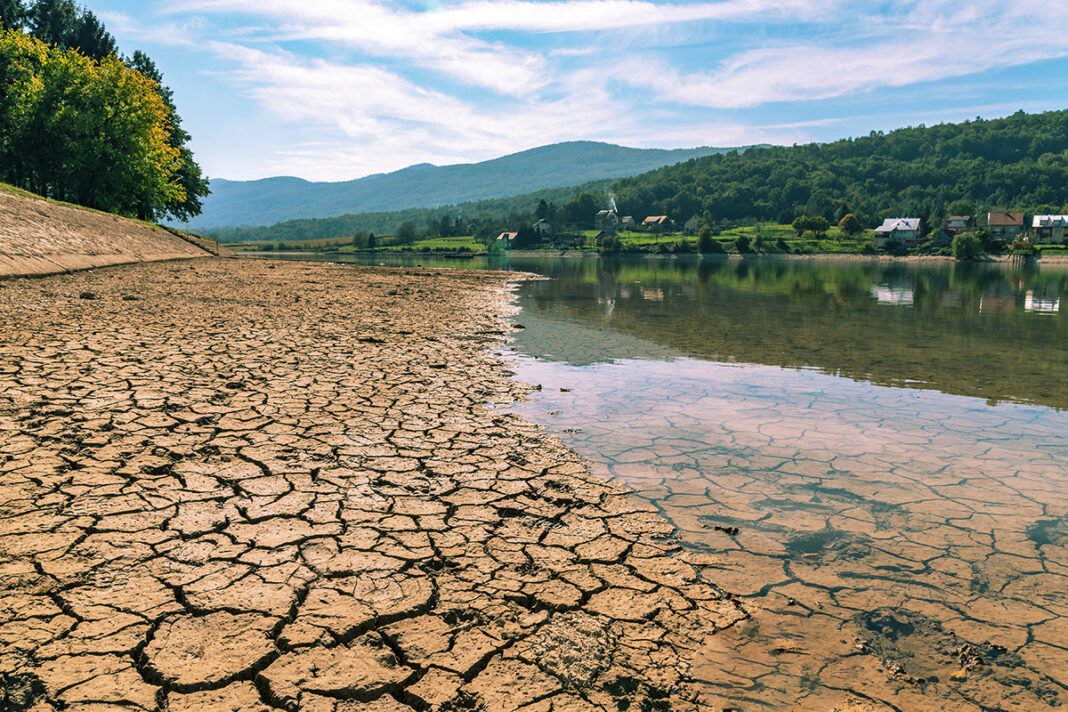


Rivers lakes water levels fell sharply around the world in 2023 and 2024, the two hottest years on record, an international study has found. Global river flows dropped to about 5.7 percent below normal, while the water stored in lakes and reservoirs fell by 9.5 percent.
The analysis, published in the journal Science, was a collaboration led by the Chinese Academy of Sciences. It found that rivers lakes water levels fell sharply during the two years, in the largest synchronised decline in surface water since at least 1991.
To measure rivers lakes water levels, the researchers combined river flow measurements from 150 of the world's major river basins with satellite data tracking more than 1.2 million lakes and reservoirs between 1991 and 2025.
Rivers lakes water levels: what the study measured
The study, titled "Abrupt surface water decline during 2023-2024 record warming", was led by Yongqiang Zhang of the Chinese Academy of Sciences, with Günter Blöschl of TU Wien as senior author.
The fall in rivers lakes water levels came to about 2,040 cubic kilometres a year in river flow, a drop of 5.7 percent, and about 640 cubic kilometres in the active storage of lakes and reservoirs, a drop of 9.5 percent. The figures were measured against the 1991-2020 average.
Dr Sulagna Mishra, one of the study's authors, said: "The findings highlight an important paradox of climate change: a warmer atmosphere does not necessarily mean more water is available on land. Although global precipitation increased during this period, much of the additional rainfall occurred over the oceans, while many land regions experienced significant deficits."
Rivers lakes water levels fell most in South America
The effects were most pronounced in South America, where rivers lakes water levels fell sharply: river flows dropped by 17.8 percent and water in lakes and reservoirs fell by 16.5 percent, even as some areas experienced extreme rainfall and flooding. South America accounted for 70 percent of the global decline in river flow.
The Amazon basin had its lowest flow in four decades. The Rio Negro at Manaus, in Brazil, fell to its lowest level since records began in October 2023, then broke that record again in October 2024. In the Brazilian Amazon in the autumn of 2023, more than 200 pink river dolphins died in Lago Tefé as extreme drought combined with water temperatures above 40 degrees Celsius.
The human effects were severe. Brazil's Santo Antônio hydropower plant on the Madeira River suspended operations, and Ecuador imposed blackouts as drought depleted its hydropower reservoirs.
Rivers lakes water levels and the paradox of a wetter sky
The researchers traced the decline to an unusual combination of El Niño in the Pacific and simultaneous warming in the tropical North Atlantic. The two together altered large-scale atmospheric circulation, drawing moisture away from South America. During El Niño peaks, the tropical Atlantic now warms about 1.2 degrees Celsius more for every 1 degree of global warming, even though El Niño itself is not getting stronger.
As the planet warms, the water cycle grows more extreme: a warmer atmosphere pulls more moisture out of soils, rivers and lakes, and hotter land speeds up evaporation. That moisture then falls as heavy rain elsewhere, often over oceans, causing sharper swings between drought and flood. That meant that during 2023-24, rivers lakes water levels fell even in places hit by severe flooding.
Dr Yi He, an associate professor in hydrology and climate change research at the University of East Anglia, said: "Parts of South America experienced severe flooding in 2023-24, yet the continent's rivers carried much less water than usual over those two years. A river can flood during a downpour and still run low for much of the year."
Prof Christian Dunn, chair of the British Ecological Society's policy committee, said: "What's particularly worrying about these findings is just how quickly our freshwater resources can decline, even in parts of the world we traditionally think of as being wet. And, as this study shows, just because we're experiencing floods doesn't mean we're water secure."
Prof Richard Allan, a climate scientist at the University of Reading, said the fall confirmed that the swings between wet and dry extremes already being felt could now be seen in water systems across the planet's land surface. He said: "This climate whiplash and its impacts on people will continue to worsen until we stabilise the climate by cutting greenhouse gas emissions."
By 2025, rivers lakes water levels had moved back toward their long-term baselines, the researchers found, even though 2025 was the third-hottest year on record. The authors said the 2023-24 decline came from a specific convergence of climate anomalies, amplified by ongoing warming.