
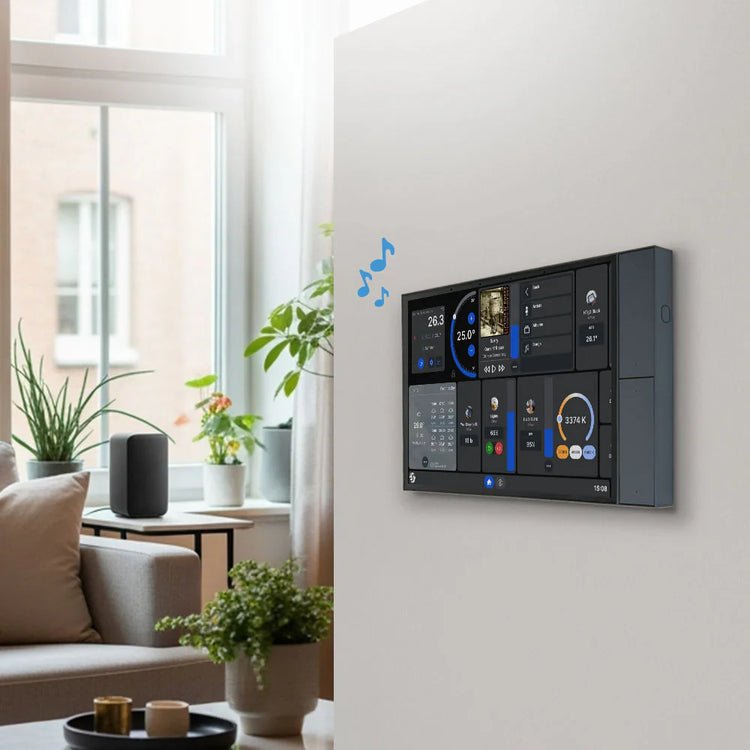


Apple has entered the smart display race with the new Apple HomeView display, a $299 device the company unveiled alongside a refreshed HomePod mini and Apple TV 4K. The 7-inch square touchscreen sits on a HomePod-style speaker base with a stainless steel hinge, and a wall-mounted option is also available. With the Apple HomeView display, the company is taking direct aim at Amazon’s Echo Show and Google’s Nest Hub, product lines that have dominated the category for years.
The design sets the Apple HomeView display apart immediately. While the Echo Show 11 and Nest Hub Max use rectangular widescreen panels wrapped in plastic or fabric, Apple chose a square 7-inch Liquid Retina touchscreen that shows simple glanceable information from across the room and adds detail as someone steps closer. The display adjusts in brightness from 500 nits down to 0.3 nits with True Tone, working as a subtle clock at night and a clear control hub by day.
How the Apple HomeView Display Recognises You
The standout feature of the Apple HomeView display is facial recognition. Powered by Apple Intelligence and an upgraded Siri, it recognises up to six faces and dynamically shifts personal data — messages, calendars, notes, and preferred apps — based on who is standing in front of it. Neither the Echo Show nor the Nest Hub offers this depth of per-user personalisation tied to iPhone and iPad data, and Apple says the recognition happens on device with straightforward privacy controls.
For smart home control, the Apple HomeView display doubles as a full home hub. It functions as a Matter controller and Thread Border Router for Apple HomeKit accessories, letting owners manage lights, locks, thermostats, and blinds by touch or voice. The Home Camera face can stream up to nine camera feeds at once, while the Home Modular face keeps favourite accessories a tap away. Setup requires only holding a nearby iPhone, continuing Apple’s frictionless tradition.
Audio is handled by two custom full-range drivers, a down-firing woofer, and two passive radiators in the base, with Spatial Audio support. CNET’s reviewer found the sound significantly more impressive than expected, though not quite at the level of a full-size HomePod. The Echo Show 11 counters with two full-range drivers and a woofer, while the Nest Hub Max packs two 10-watt tweeters and a 30-watt woofer — so all three can comfortably fill a standard room.
Staying connected is another pillar of the device. FaceTime with Center Stage, Messages by voice or keyboard, Intercom to other HomeViews and HomePods, Find My, and Live Activities all run natively. Entertainment centres on Apple Music with lyrics, Apple Podcasts, Apple News, and Apple TV, plus Handoff from iPhone and multiroom audio with HomePods.
Where the Apple HomeView Display Falls Short
The biggest question mark around the Apple HomeView display is third-party app and streaming support. Apple Music is a given, but Apple has not detailed which other services will run on it. The Echo Show supports Amazon Music, Apple Music, Spotify, Tidal, Pandora, SiriusXM, and Deezer; the Nest Hub similarly supports YouTube Music, Spotify, Pandora, Amazon Music, and more. Buyers who rely on services outside Apple’s ecosystem should confirm compatibility before committing.
Video streaming tells a similar story. The device is heavily focused on Apple TV, and Apple has said little about which other streaming apps will be available. The Echo Show and Nest Hub both offer far broader video libraries. For owners who mostly watch on a television anyway, this may not matter — but a 7-inch panel already positions the newcomer more as a kitchen clock or photo frame than a viewing screen.
Price is the other consideration. At $299, the HomeView costs more than the $219.99 Echo Show 11 and well above the $99.99 Nest Hub, while offering a smaller screen than either. Google has not refreshed its Nest Hub since 2021, which gives Apple the newest hardware in the category — but Amazon’s Alexa-powered Echo Show 8 and 11, launched last fall, remain the benchmark for third-party integrations.
Should You Buy the Apple HomeView Display?
The answer depends on the household. For iPhone-centric homes already invested in Apple HomeKit, Apple Music, and FaceTime, the Apple HomeView display is the most seamless smart display available, with personalisation and design neither rival matches. For mixed-platform homes or streaming-service switchers, the Echo Show and Nest Hub remain the safer, cheaper bets with far broader app support.
Apple’s entry will not dethrone Amazon or Google overnight, but it raises the bar for what a smart display can know about the person using it. Whether that intelligence is worth the premium — and the ecosystem lock-in — is the question every buyer will have to answer for themselves.