
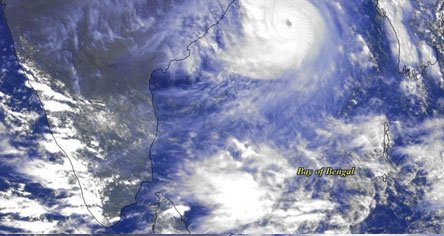


Cyclone Murasu gathered strength over the Bay of Bengal on Sunday, and the India Meteorological Department (IMD) said it would cross the south Andhra Pradesh coast as a severe cyclonic storm on the morning of November 3. The system was forecast to pass between Nellore and Narsapur, with sustained winds of 100 to 110 kmph and gusts reaching 120 kmph. Coastal administrations and disaster response forces were placed on high alert as Cyclone Murasu moved west-northwest toward land.
Cyclone Murasu track and landfall forecast
The IMD said Cyclone Murasu formed after a depression over the southeast Bay of Bengal moved west-northwest and deepened, first into a deep depression and then into a cyclonic storm by 11:30 am on November 1. At that stage it lay centred near latitude 11.5 degrees north and longitude 86.4 degrees east, about 560 km east-southeast of Chennai, 660 km south-southeast of Visakhapatnam and 630 km east-southeast of Nellore. The department expected Cyclone Murasu to strengthen into a severe cyclonic storm over the west-central Bay of Bengal on November 2, then curve toward the coast and cross it between late on November 2 and the early hours of November 3.
A pre-cyclone watch, described by the IMD as a Yellow Message, was in force for the Andhra Pradesh coast. The department said the storm was very likely to reach the west-central Bay of Bengal near the south Andhra Pradesh coast by the early hours of November 3 and cross it as a severe cyclonic storm. Forecasters cautioned that the exact landfall point and intensity would be refined in later bulletins, since small shifts in track can change which districts face the strongest winds and heaviest rain.
Cyclone Murasu rainfall and coastal alerts
Heavy to extremely heavy rain was forecast over coastal Andhra Pradesh on November 2 and 3, with Nellore, Prakasam, Guntur, Krishna, Bapatla and parts of West Godavari among the districts named in IMD-linked bulletins. The Andhra Pradesh State Disaster Management Authority said several districts were likely to receive heavy to extremely heavy rain on Monday and Tuesday. District administrations in parts of Tamil Nadu and Andhra Pradesh announced holidays for schools and colleges, according to live updates from The Hindu, and an orange alert was in place in six Telangana districts with a yellow alert in five more.
Fishermen were advised not to venture into the west-central, southeast and central Bay of Bengal until Wednesday, as sea conditions were expected to turn rough to very rough. The IMD also warned of strong winds and heavy rain around the system as it moved closer to the coast. Residents of low-lying coastal areas were asked to follow official advisories and avoid the sea until the system had passed.
How Cyclone Murasu got its name and what comes next
The name Murasu was contributed by India and means drum in Tamil. Cyclone names in the region come from a list shared by countries around the Indian Ocean, and each system takes the next name in turn once it reaches cyclonic storm strength. The IMD issues its bulletins from the Regional Specialised Meteorological Centre in New Delhi, and it asked coastal residents to keep watching official updates as Cyclone Murasu moved closer to land.
The IMD’s cyclone alert also covered the adjoining north Tamil Nadu coast, and schools in Chennai were shut as the system approached, according to India Today. The warning zone therefore stretched beyond the expected landfall point, since strong winds and heavy rain were forecast along a wider stretch of the southeastern coastline. Coastal residents in both states were asked to stay indoors during the worst of the weather and to keep clear of beaches and harbours until the storm had passed.
After landfall, the system was forecast to move further inland while gradually weakening, though heavy rain was still expected over the coastal districts in its path. Authorities said they would keep monitoring Cyclone Murasu through its landfall window, with fresh bulletins on its position, wind speed and rainfall as it approached the Andhra Pradesh coast.