
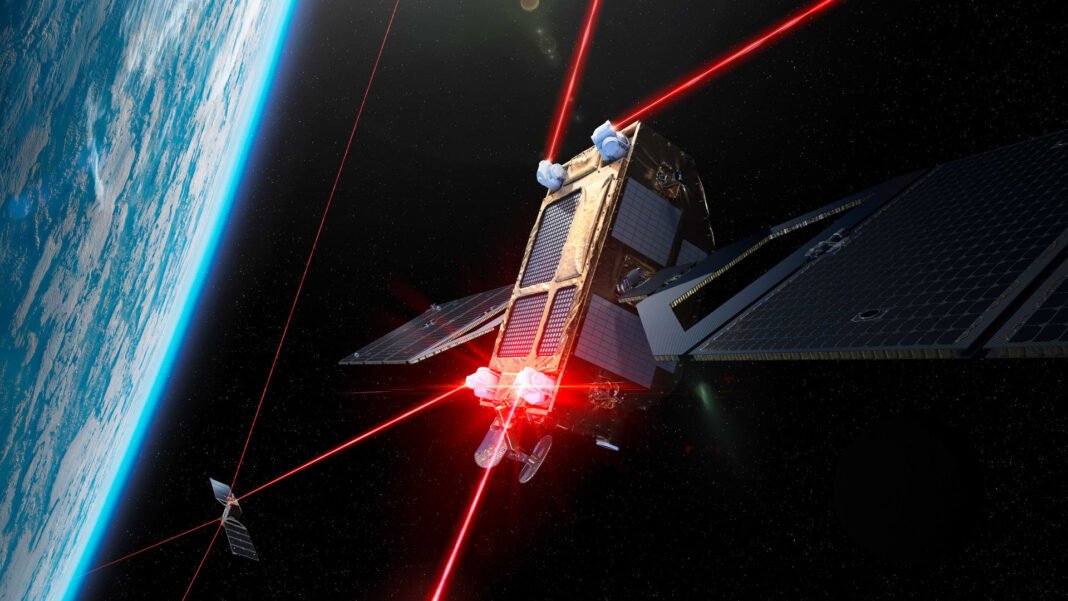


The Space Development Agency has awarded SpaceX a $9.9 million contract to study whether the company’s Starlink laser links can work on the Pentagon’s missile warning and tracking satellites. The award, announced in the Department of War’s contracts list on November 10, 2026, covers a risk reduction study, delivery of representative hardware and support for integrating the terminal into missile warning and tracking systems. The SpaceX laser contract runs through October 7, 2027.
What the SpaceX laser contract covers
The terminal at the center of the study is called Plaser, short for SpaceX’s Plug and Play Laser. It is the optical terminal that carries laser links between Starlink satellites, letting them pass data to one another by light instead of radio. SpaceX President Gwynne Shotwell announced the commercial offering in March 2024.
The Space Development Agency wants to know whether that terminal can connect its Tracking Layer satellites, which carry infrared sensors that detect and follow ballistic and hypersonic missiles. Those satellites use optical terminals to send data through the agency’s Transport Layer mesh network to ground stations and weapon systems. The SpaceX laser contract will look at hardware, software and connectivity, an agency spokesperson told Breaking Defense.
The contract was awarded on November 9 and is worth $9,921,992, with options that could raise the total to $12,666,379. The full $9.9 million comes from fiscal 2026 research, development, test and evaluation funds and was obligated at the time of award. Work will be performed in Hawthorne, California, and Redmond, Washington.
A small study beside a large program
The study is small next to SpaceX’s other military space work. In May 2026 the U.S. Space Force awarded the company a $2.29 billion fixed-price agreement to build the backbone of its Space Data Network, a low Earth orbit constellation meant to carry data from missile warning and tracking sensors to interceptors for the Golden Dome missile defense effort. The SpaceX laser contract is a separate, much smaller award inside that wider program.
The agency bought the study through its Systems, Technologies, and Emerging Capabilities broad agency announcement, an open solicitation that accepts proposals through the year, so the number of competing bids is not known. The SpaceX laser contract notice does not say which satellites the Plaser terminal would fly on, or whether a production order would follow the study.
The SpaceX laser contract and Golden Dome
The study sits inside the Trump administration’s Golden Dome missile defense initiative, which aims to build a layered shield against ballistic, hypersonic and cruise missile threats. The Space Development Agency’s satellites are meant to form the sensing layer of that shield, spotting launches from low Earth orbit and passing the warning down the chain. The SpaceX laser contract tests one link in that chain: the optical connection between the satellites that see the missile and the network that carries the warning.
Lockheed Martin won a separate award in July for a containerized 500-kilowatt laser weapon aimed at cruise missiles and drone swarms, also under Golden Dome, with a combined initial value of $86 million shared with nLIGHT Defense. The two awards show the program reaching for lasers at both ends of missile defense: one to carry the warning, the other to shoot the threat down.
Why laser links matter for missile tracking
The Space Development Agency’s Proliferated Warfighter Space Architecture relies on hundreds of small satellites in low Earth orbit that pass data to one another by light rather than radio. Laser links can move large volumes of data at high speed with low latency, which matters when a sensor has seconds to report a missile launch. That is the capability the SpaceX laser contract is meant to test.
The Plaser study is a first step, the agency spokesperson said, and it does not commit the Pentagon to buying the terminal. SpaceX has released few public specifications for Plaser, and the SpaceX laser contract announcement does not say whether the study will test the terminal against the agency’s own standard for optical terminals. AL.com described SpaceX as a trillion-dollar company in its report on the award, and the contract number is FA240127C0001.