
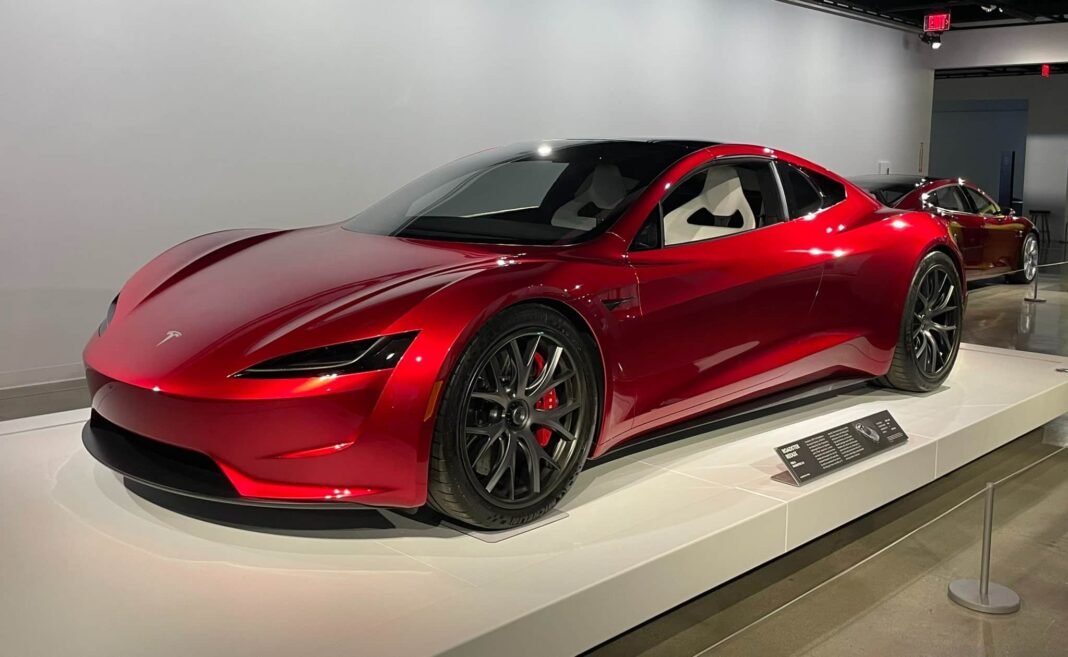


Tesla has finally unveiled its redesigned second-generation Roadster, nearly nine years after first showing a prototype of the electric sports car, in a spectacular Texas event that saw the vehicle launch off a ramp and perform a midair flip. The Tesla Roadster demonstration, staged outside Waco on Thursday evening, used compressed-air thrusters developed in collaboration with SpaceX to send the car spinning through the air before it landed back on the pavement.
In one sequence, the Roadster drove up an inverted ramp, spun in the air and eased itself back down. In another, it lifted off the ground and cleared a lineup of Tesla vehicles — including a Cybercab, a Cybertruck, a Semi, a Model Y and a Model 3 — while in motion. Tesla engineering vice president Lars Moravy said the car uses ten nozzles connected to 600 litres of compressed air to lift and spin the vehicle, with a rechargeable air tank. The Tesla Roadster has been one of the most delayed products in the company’s history, and the flying stunt was clearly designed to make up for lost time.
Chief executive Elon Musk, who called the event the “greatest product demo of all time” beforehand, described the car as “the best of the last of the human-driven cars”. “This will be the actual car that’s on the roads,” Musk said on stage. “It literally is just going to puff itself up, and be able to do these manoeuvres whenever you’d like.”
Tesla Roadster: three trims and a 2028 production date
Musk said Tesla will finally build the long-delayed vehicle in 2028, but did not name a price. The company will offer three trims. The “Performance” trim is described as road ready, seats two, and has active aerodynamics. The “Thrust” trim is race ready, seats two and has rear-mounted cold-gas thrusters enabling acceleration from 0 to 60 mph in under one second. The “Rocket” trim is air ready, seats one and has ten cold-gas thrusters positioned around the car. All three trims will have a 300-mile range and top speeds exceeding 230 mph.
Tesla is taking reservations, charging 50,000 dollars for the Performance trim and 250,000 dollars for the Thrust trim, with the Rocket trim invite only. The company first showed a Tesla Roadster prototype in 2017 with a 200,000-dollar price tag and promised deliveries by 2020 — a deadline it missed by years.
Why the Tesla Roadster matters
The unveiling had been a long time coming. Tesla originally scheduled a demonstration for October 1 but postponed it on September 28 after severe weather was forecast in Texas — the open-air show required clear skies. The eventual event, held at 7:55 pm Central time, centred on a remotely operated vehicle performing a short hover using SpaceX cold-gas thrusters, a scaled-down version of the flying capability Musk has teased for the Tesla Roadster for years. The car’s path to production has been marked by at least seven missed dates since the 2017 prototype.
Musk told podcaster Joe Rogan in October 2025 that the demonstration would be “unforgettable”. On the morning of the event, he wrote on X that the new Tesla Roadster was “beyond movies, beyond imagination, beyond human, yet still made by humans on Earth”. Whether the production car can deliver on the spectacle of the reveal remains to be seen, but the Tesla Roadster has already achieved what its maker wanted: the whole world watched.
Musk has played down the car’s importance to Tesla’s finances, calling it a “small potato situation” in 2023. But analysts say it carries symbolic weight. Morningstar analyst Seth Goldstein said Tesla currently lacks a halo car, and the new model “will be Tesla’s new halo car”. Goldstein expects sales of around 2,000 a year — a fraction of the 1.6 million vehicles Tesla sold last year.
The original Roadster, sold from 2008 to 2012 and built on a Lotus Elise chassis, was Tesla’s first electric vehicle and helped change perceptions of what an EV could be. The reveal of its successor comes as Tesla shifts its focus towards artificial intelligence-led self-driving technology and robotics. For the company, the Tesla Roadster is less about sales than about proving it can still deliver spectacle — and the midair flip suggests it can.