
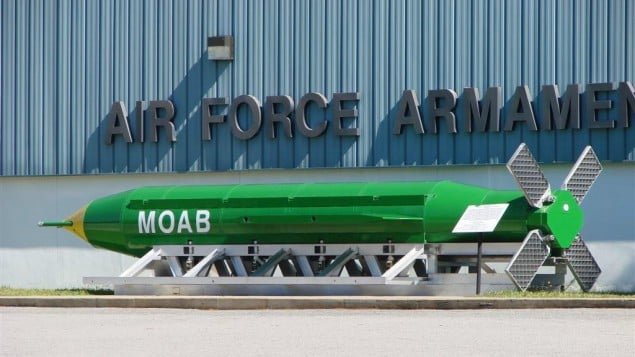


The United States military has drawn up plans for new strikes on Iran that include the use of the GBU-43/B Massive Ordnance Air Blast, the largest non-nuclear bomb in the American arsenal, according to reports. The “mother of all bombs” could be deployed against Iranian nuclear and energy infrastructure if President Donald Trump orders a resumption of combat operations, CNN and CBS News reported, citing officials familiar with the planning.
Trump has directed officials to draw up options for further attacks, including strikes on a significant portion of Iran’s energy infrastructure. According to CNN, plans to strike the suspected underground nuclear facility known as Pickaxe Mountain also specify the use of the “mother of all bombs”, the weapon formally known as the Massive Ordnance Air Blast, or MOAB. Deployment of the “mother of all bombs” against Iran would mark a significant escalation of the current conflict.
What the “mother of all bombs” is
The MOAB weighs about 9.8 tonnes and is the largest non-nuclear weapon in the US arsenal. It detonates in the air before striking the ground, delivering an enormous blast across a wide area. The bomb was used in combat for the first time in April 2017, during Trump’s first term, against an Islamic State cave complex in Afghanistan. It was developed during the 2003 Iraq war, partly to exert psychological pressure on enemy forces through its sheer destructive power.
Military planners are also reported to have discussed declaring victory after further strikes and rapidly withdrawing American forces from the Middle East. One source said the language used suggested the strikes could take place before troops are withdrawn from the area of responsibility of US Central Command.
“Mother of all bombs” plans come amid midterm pressure
The reports come as Trump faces pressure to end a conflict that has stretched for more than six months and grown unpopular with American voters ahead of November’s midterm elections. Last week, Trump said the US would not attack Iran before the midterms, while also speaking of “productive conversations” with Tehran, without providing details.
A Pentagon official told CBS News: “The Department of War plans for a wide range of operational scenarios to execute presidential and secretary-level direction and to ensure mission success in any operational environment.” A White House spokesperson said: “We do not comment on sensitive military plans that may or may not exist. President Trump keeps all options on the table to ensure that Iran can never have a nuclear weapon.”
Planning documents of this kind are prepared routinely by the Pentagon, and their existence does not indicate that a decision to strike has been made. Still, the reported inclusion of the “mother of all bombs” in the Iran options has drawn attention in Washington and Tehran alike, with both sides weighing what a resumption of strikes would mean for a conflict that has already reshaped the region.
Officials stressed that the inclusion of the “mother of all bombs” in military planning does not mean Trump has authorised its use. Analysts note that actually dropping the “mother of all bombs” on Iranian targets would carry enormous diplomatic and humanitarian consequences.
The MOAB is distinct from the bunker-busting munitions the US has previously used against Iran. In June 2025, American B-2 bombers dropped GBU-57 bunker-busters on Iranian uranium enrichment sites — weapons designed to burrow deep underground before exploding. The “mother of all bombs”, by contrast, is designed for surface-level, wide-area destruction, vaporising targets across a huge radius. Military experts say the choice between the two weapons depends on whether the target is buried or spread across the surface.
Trump has said he would not use nuclear weapons against Iran, leaving conventional options such as the MOAB as the most destructive tools available to US planners. The president has long expressed pride in the weapon, which was first used on his orders in 2017. Whether the current planning leads to actual strikes remains uncertain: officials caution that contingency plans are routinely prepared for a wide range of scenarios, and many are never executed. The wider regional conflict began with US and Israeli strikes on Iran in February, and Washington and Tehran remain far from a negotiated settlement.