
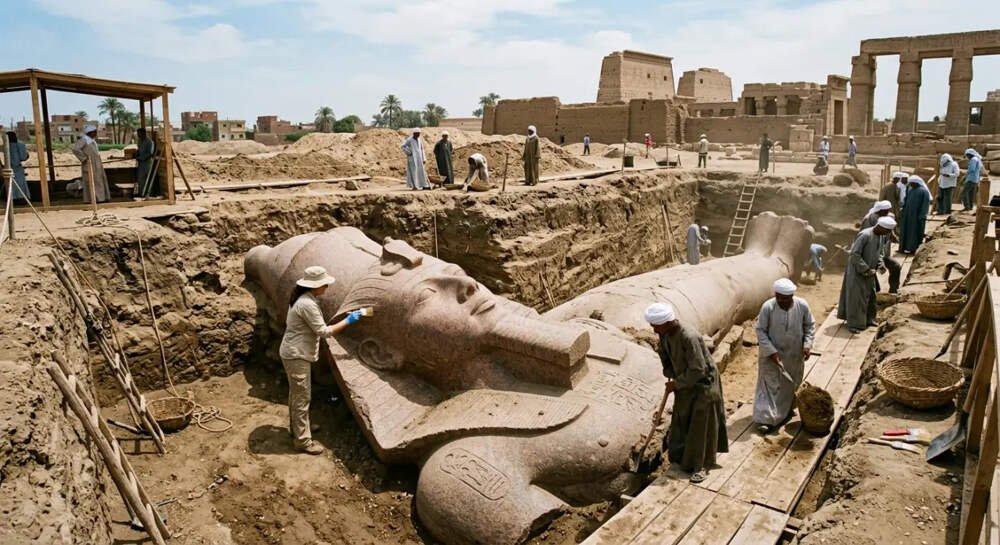


An Egyptian farmer tilling his land has accidentally uncovered two colossal Ramses II statues, after a single carved stone he found in his field led archaeologists to one of the most striking discoveries in the Nile Delta in years. The farmer reported the inscribed block to local antiquities officials, triggering an emergency excavation by Egypt’s Supreme Council of Antiquities.
The dig took place in Behbeit El Hagar, a village in the Gharbia province north of Cairo, where the farmer came across the stone block while working land in front of his home. Inspectors confirmed the block was ancient, and a specialist team launched a rescue excavation at the site.
What they found astonished even seasoned archaeologists. The first major find was the colossal head of a statue of Ramses II, measuring about 1.6 meters — more than five feet — from top to bottom. The king is shown wearing the double crown symbolizing the unification of Upper and Lower Egypt, and a surviving fragment of the statue’s back pillar carries his Horus name, “Hor Ka Nakht Mery Maat.”
The sheer scale of the Ramses II statues points to a monument built to project divine kingship. Colossal royal statues were political statements as much as religious ones, designed to overwhelm all who stood before them.
How the Ramses II Statues Were Discovered
The discovery began with one resident’s decision to report an unusual stone rather than ignore it. That call brought Egypt’s antiquities inspectors to the field, and their confirmation set the rescue dig in motion — a race to record and protect the finds before they could be lost.
From the size of the recovered head, archaeologists estimate the complete monument, including its base, originally stood about 8.5 meters tall — nearly 28 feet, taller than a two-story house. It is among the largest Ramses II statues found in the Delta in recent memory.
The excavation did not stop with one enormous head. Nearby, the team uncovered a substantial section of a second royal statue measuring about 2.4 meters — just under eight feet. Its legs and base are missing and the upper part of its striped royal headdress is damaged, but the face remains clearly visible and in good condition.
What the New Ramses II Statues Reveal
Researchers believe the second statue also depicts Ramses II: its facial features closely resemble those of the larger monument. About a meter away, the team found a 1.3-meter block of pink granite bearing fragments of royal titles — “Nesu Beti,” meaning King of Upper and Lower Egypt, and “Sa Ra,” meaning Son of Ra.
Ramses II, born around 1303 B.C., is regarded as one of the most powerful rulers of Egypt’s New Kingdom and is often associated with the unnamed pharaoh of the biblical Book of Exodus — though scholars note that identification remains debated. He ruled from about 1279 to 1213 B.C., more than 3,000 years ago.
The pink granite block’s inscriptions helped confirm the royal connection. Titles like King of Upper and Lower Egypt were reserved for the pharaoh alone, leaving little doubt about the monuments’ regal origins.
The finds are still being studied, and excavations are continuing. Archaeologists say further work could establish how the two monuments relate to each other and to the site’s ancient buildings — and whether more of the buried complex waits underground.
Behbeit El Hagar: Home of the Ramses II Statues
The village where the Ramses II statues surfaced is already famous among Egyptologists. Behbeit El Hagar is known for the remains of a major temple dedicated to Isis, as well as granite architectural blocks scattered across the area — evidence of the region’s importance in ancient Egypt.
These Ramses II statues add a remarkable chapter to that history — and they began with one farmer who chose to report a stone rather than leave it unnoticed.
Egypt’s Ministry of Tourism and Antiquities has hailed the find as a testament to the country’s living heritage — proof that the sands of the Delta still guard royal monuments, and that the story of the Ramses II statues is still being written.