
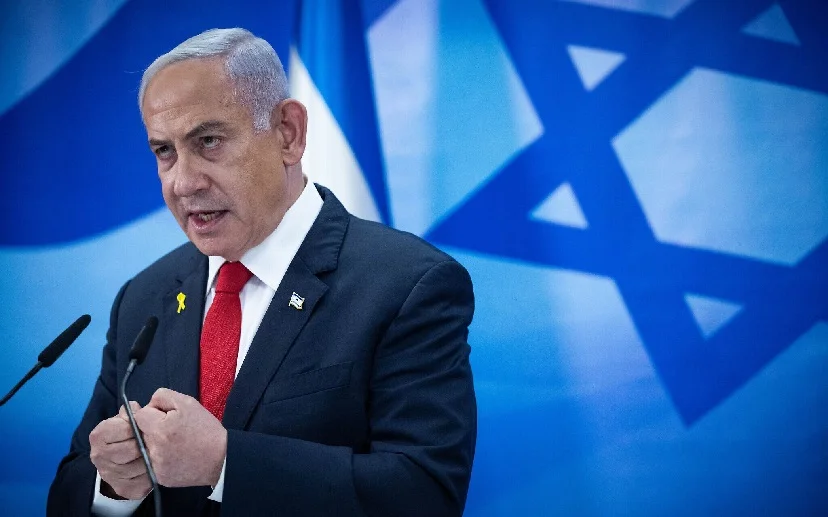


TEL AVIV — Israeli Prime Minister Benjamin Netanyahu has called for Israel to strengthen ties with India and other countries to prepare for the possibility of a future US president who could be hostile towards the country, warning that Washington’s political direction could change within two years. Speaking on Sunday while presenting his security doctrine, nine days before Israel’s October 27 election, Netanyahu said Israel must use the remaining years of US President Donald Trump’s tenure to strengthen its position in Washington while building alternative alliances.
“In two years, a President, man or woman, could come to power who is very hostile to Israel,” Netanyahu said. “How would you deal with that? How would you operate in relation to the United States? And beyond that, what solutions would be necessary?”
“First, we must do everything we can during these two years, and during the following two years, in the American arena, through good times and bad,” he said. “The second thing is to create other alliances. That is what I am working on now with many countries in our region and outside it. India is not a small country, and there are many others.”
Netanyahu’s India Pivot
Netanyahu has repeatedly cited Israel’s relationship with India and Prime Minister Narendra Modi as evidence that his country is not isolated internationally. In May, he described the relationship as “unique” and called India a “huge power”, saying there was “crazy love” for Israel in the country. His latest remarks place India at the centre of a strategy to reduce Israel’s vulnerability to a shift in American policy, particularly one that could threaten its military assistance and strategic relationship with Washington.
He also pointed to political developments in Latin America as an opportunity to expand Israel’s international partnerships, citing the possibility of a major political change in Brazil. “There is a major shift in Latin America, and there could be an enormous change in Brazil in just a few days,” Netanyahu said. “We must expand our pool of alliances and develop capabilities that make us valuable to everyone.”
Netanyahu’s Warning and the Election Clock
The remarks came hours before Trump publicly endorsed Netanyahu’s re-election bid, praising him as a “great wartime prime minister” and a partner in the fight against Iran. The timing underlined the paradox at the heart of Netanyahu’s message: even as he benefits from a warm relationship with the current US president, he is warning Israelis to prepare for a potentially dramatic shift in American policy.
Opposition figure Gadi Eisenkot criticised Netanyahu’s security doctrine, accusing him of using fear to influence public opinion ahead of the election. With nine days to go before the October 27 vote, Netanyahu’s pivot to India and beyond is both a strategic argument and a campaign message — that Israel’s security depends on diversifying its alliances rather than relying solely on its longstanding partnership with Washington.
The Doctrine Behind Netanyahu’s India Call
Netanyahu’s remarks were framed as a security doctrine, not merely campaign rhetoric. His central argument is that Israel must simultaneously deepen its position in Washington during Trump’s remaining years and build a wider pool of alliances that can cushion the country against a future administration less sympathetic to Israeli interests. The doctrine explicitly names India as a priority partner and Latin America as a second frontier, reflecting a view that the next decade’s diplomacy will be decided as much in New Delhi and Brasília as in Washington.
The India dimension has been years in the making. Defence and technology cooperation between the two countries has grown steadily, and Netanyahu has frequently invoked his personal rapport with Modi to counter claims that Israel is diplomatically isolated. His description in May of “crazy love” for Israel in India was characteristic of a leader who treats public goodwill as a strategic asset. Whether Sunday’s doctrine translates into concrete new agreements with India will be watched closely in New Delhi, where the government has balanced its Israel relationship alongside its longstanding ties with the Palestinians and the Arab world.
For now, the immediate audience is Israeli voters. But the doctrine’s logic — that a small country cannot afford to depend on a single great-power patron — has implications well beyond October 27, whatever government emerges from the polls.