
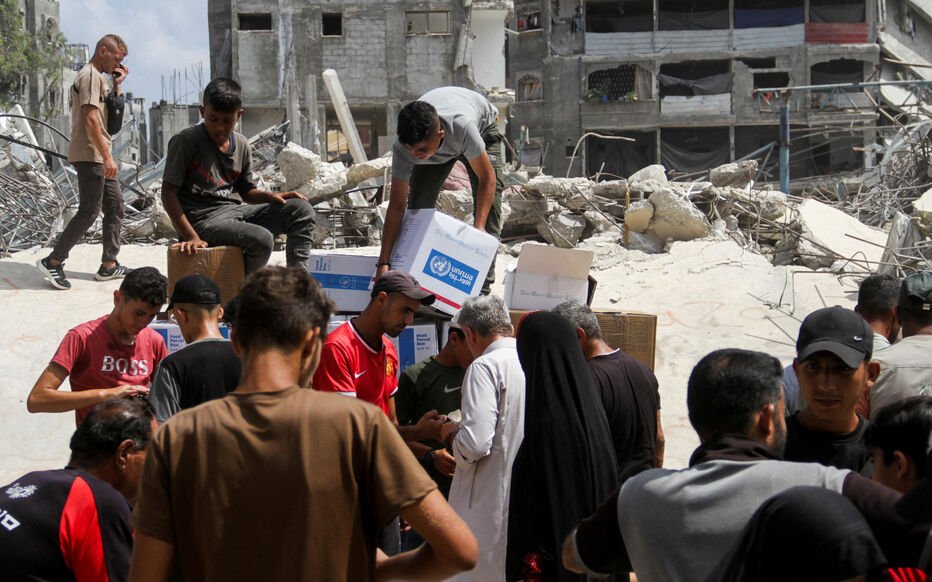


Gaza aid cuts announced by the United Nations World Food Programme will strip monthly food assistance from 500,000 Palestinians in Gaza, the agency said Monday, blaming a funding shortfall for reductions that arrive just as winter approaches a territory where two-thirds of the population already struggles to eat.
The cuts will bring the number of people receiving food or cash assistance from the WFP down from 1.6 million to 1.1 million, reducing the agency’s reach by nearly a third despite continued acute humanitarian needs. Country director Shaun Hughes told AFP that the reductions were being introduced this month, a decision driven not by access problems but by empty coffers.
This has been a lifeline, Hughes said at the agency’s office in east Jerusalem. But now, rather than being able to sustain and scale up that assistance, we are actually having to reduce it. And that is not because we do not have humanitarian access to deliver food; that is because we do not have funding.
How deep the Gaza aid cuts go
The headline number only partly captures the scale of the retrenchment. Food rations have been halved, and cash assistance has been reduced for 75,000 families. The number of daily hot meals provided to people unable to cook has fallen from 250,000 to 150,000, while families in hard-to-reach areas, including near the so-called Yellow Line marking areas under Israeli military control, will receive meals every other day instead of daily.
According to the latest assessments, 1.4 million people, or two-thirds of Gaza’s population, remain acutely food insecure and need humanitarian assistance to survive, including roughly 200,000 people in emergency conditions. The agency said its efforts had helped mitigate the effects of a famine in Gaza last year, an evaluation disputed by Israel, and warned that conditions have not improved to the point where aid can be withdrawn.
The WFP said it urgently needs $450 million over the next six months to maintain critical operations in Gaza and the Israeli-occupied West Bank. Without that money, the agency warned, the progress made since last year’s famine could unravel.
Why the Gaza aid cuts are landing now
Acting Executive Director Carl Skau visited a WFP-funded soup kitchen in Deir Al-Balah in central Gaza on October 18, a day before the cuts were announced. Speaking to Reuters, he described life in the territory as brutal a year into the US-brokered ceasefire agreement. There is no proper shelter, he said. There are no basic services. There is no safety, no security. These cuts are happening just as we are facing the fourth winter. You know, I have been through the winters here, absolutely brutal.
Last year’s ceasefire calls for the eventual reconstruction of Gaza, but little progress has been made toward implementing a deal that includes terms for Hamas to disarm and for Israel to withdraw its troops. The political stalemate has left humanitarian agencies carrying a burden that diplomacy was supposed to lighten.
Skau urged donors not to look away. We tell the world now is not the time to look away, he said. This is the time to step up to sustain this support, to protect the progress that has been made, but also to push for early recovery.
What the Gaza aid cuts mean for the winter
The timing could hardly be worse. Winter in Gaza means cold, flooding and collapsing shelter for hundreds of thousands of displaced people, and food insecurity compounds every other hardship. Families that lose monthly assistance will join those already surviving on reduced rations and intermittent hot meals, with the coldest months still ahead.
Humanitarian agencies have warned for months that funding fatigue is setting in among donors even as needs remain severe. The WFP’s announcement makes that abstract warning concrete: half a million people, a number larger than the population of many cities, losing the monthly support that stood between them and hunger.
Whether donors respond with the $450 million the agency says it needs will determine whether the cuts are a temporary retrenchment or the start of a longer unraveling. For now, the message from Gaza’s soup kitchens is the same one Hughes delivered in Jerusalem: the lifeline is fraying, and winter is coming.