
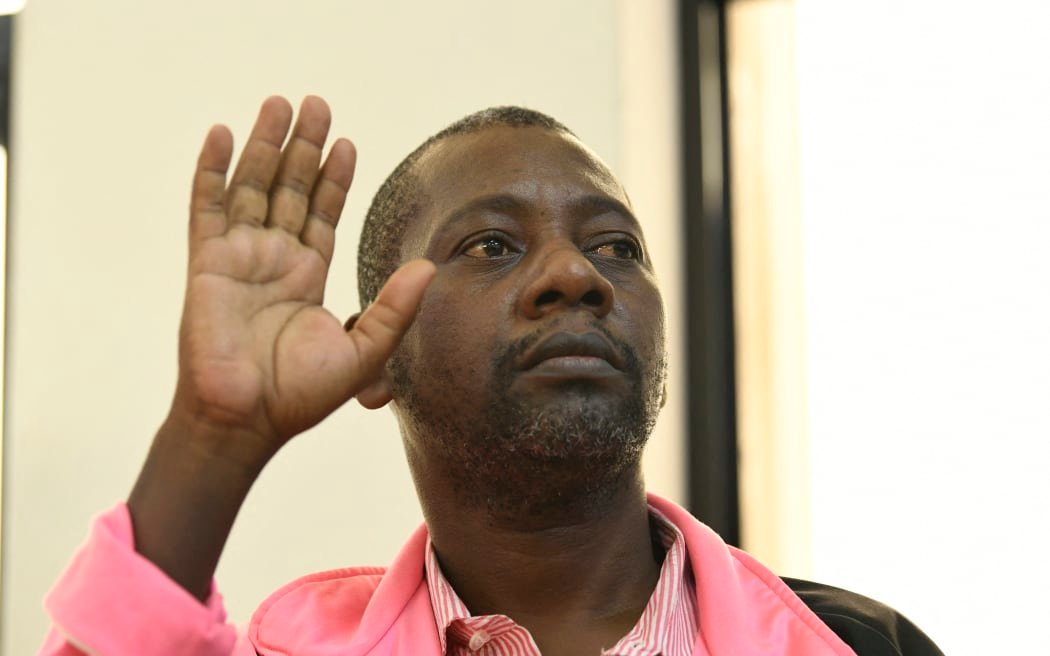


Kenya cult conviction delivered long-awaited justice on Monday when a court in Mombasa found doomsday preacher Paul Mackenzie guilty of murdering 191 people, all but one of them children, after ordering followers of his Good News International Church to starve themselves to death to meet Jesus.
Delivering an eight-hour judgment, Justice Diana Kavedza ruled that Mackenzie, 53, oversaw an organized system that used religious teachings to compel followers to fast until they died. The trial covered 191 deaths for which formal identifications could be made, while investigations into more than 200 other victims continue. Twenty-eight other leaders of the church were also convicted of murder alongside him.
More than three years ago, mass graves were uncovered in the Shakahola forest on the 800-acre Chakama Ranch in coastal Kilifi County, where Mackenzie had lured followers from across Kenya with the promise of cheap farmland. More than 400 bodies were eventually exhumed from shallow graves there, nearly half of them children and babies, some only weeks old, with their hands and feet tied. The site was a secretive compound patrolled by armed guards who enforced fasting and killed those who tried to escape.
How the Kenya cult conviction case unfolded
The court found that the directive to fast to death was implemented by targeting children first. Guards were deployed to prevent followers from escaping, and those who attempted to eat or flee were beaten. One co-accused told the court that Mackenzie had instructed his followers that anyone who resisted the directive to fast must be forced to go to heaven through violence. The judge noted that burials in the forest were called weddings, and that those who died were celebrated as having wedded with Jesus.
Mackenzie also told his followers to shun education and health care, which he branded satanic. In her ruling, Justice Kavedza said medical treatment was presented as an instrument of Satan. His followers believed he was Jesus’s mouthpiece, the judge found, a hold that made the organized starvation possible.
Seventeen men were recruited from a nearby town to exhume the shallow graves, some paid as little as $8 a day. One gravedigger described finding every grave containing at least three bodies, and recalled discovering 12 children’s bodies arranged in a line inside one grave, stacked one on top of another like clothes. Children were found with their hands and legs tied and their bodies wrapped in bedsheets.
Who the Kenya cult conviction holds accountable
Mackenzie, a former taxi driver, founded his church in 2003 and built a following through increasingly apocalyptic sermons broadcast on the church’s television station. He told followers to cut themselves off from schools and hospitals and urged them to fast to death. In a video recorded weeks before his 2023 arrest, he said he had followed a voice that told him he had finished the work.
He was arrested and charged with murder alongside his wife and dozens of followers. Some followers later became prosecution witnesses. All the defendants had pleaded not guilty, repeatedly insisting that nobody was forced to die. The trial began in 2023, and last year the Court of Appeal allowed prosecutors to proceed with 191 murder charges after a lower court had directed them to reduce the counts.
For families of the victims, the verdict offers a measure of closure. William Ponda Ngala, whose mother, older brother and two nephews died, said the conviction offers hope that it will serve as a lesson to other religious leaders who might exploit their followers in the future.
What the Kenya cult conviction means next
A mitigation hearing will be held on October 30, with sentencing scheduled for November 6. It is speculated that the death penalty may be imposed, although no executions have been carried out in Kenya in decades. The sentencing decision will be watched closely as one of the most consequential in the country’s judicial history.
The case has also forced a national reckoning over how fringe religious movements operate beyond the reach of authorities. Mackenzie’s followers lived in mud huts on the ranch, away from the scrutiny of local communities, and cult members visited nearby towns only to buy supplies and fetch water. Lawmakers and faith leaders have debated new oversight measures ever since the graves were discovered.
For now, the verdict closes the central chapter of a tragedy that shocked the world. More than 400 dead, most of them starved on the orders of a man they believed spoke for God, and a courtroom in Mombasa that finally called it murder.