
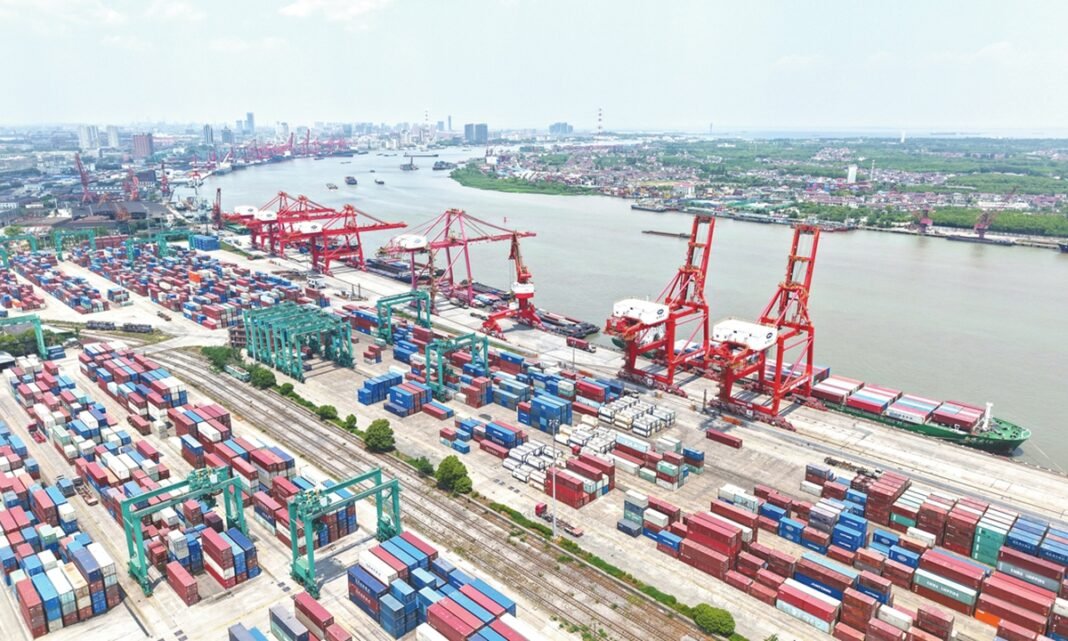


China Q3 exports powered the country’s economy to faster growth in the July-September quarter, with Beijing reporting on Monday, October 19, 2026, that gross domestic product expanded 4.5% from a year earlier. The figure, fueled by robust exports, moved China closer to meeting its official annual growth target as the year nears its end.
The better-than-expected official data accelerated from the 4.3% year-on-year growth recorded in the April-June quarter, which was the slowest expansion in more than three years. For the whole year, Chinese leaders have set a growth target of 4.5% to 5%, down from last year’s 5% expansion.
Earlier this month, the International Monetary Fund trimmed its forecast for China’s 2026 economic growth to 4.5%, just meeting the lower end of Beijing’s goal. According to preliminary estimates from the National Bureau of Statistics, China’s GDP reached 107.1071 trillion yuan in the first three quarters of 2026, registering growth of 4.6% year-on-year at constant prices.
The export engine is running hot. China logged 36% growth in exports last month and has already accumulated a $938 billion trade surplus between January and September. With strong exports one of the few bright spots, China is on track to surpass last year’s record $1.2 trillion trade surplus globally, a milestone that is sharpening trade tensions with partners who see their own industries under pressure.
China Q3 exports mask deep domestic weakness
The headline figure tells only part of the story. “The headline official growth figure is becoming an increasingly poor indicator of how the broader economy is performing,” said Max Zenglein, Asia Pacific senior economist at The Conference Board, because it masks “widening disparities across industries, regions, and households.”
China’s domestic demand has weakened, weighed on by a yearslong downturn in its property market that has squeezed household wealth and driven up savings. Beijing faces difficult trade-offs, Zenglein said, and managing domestic imbalances may prove more challenging than dealing with external pressures.
Investment remains a weak spot. Fixed-asset investment, excluding rural households, fell 7.2% year-on-year in the first three quarters. Investment in infrastructure declined 4.2%, while real estate development investment dropped 20.6%, underscoring how far the property sector has fallen from its role as a growth engine.
Industrial production held firmer. The value added of industrial enterprises above the designated size rose 5.3% in the first nine months, while manufacturing grew 5.7%. Equipment manufacturing expanded 10.2% and high-tech manufacturing increased 14.3%, with production of 3D printing devices, lithium-ion batteries, and industrial robots up sharply.
China Q3 exports sharpen global trade tensions
The China Q3 exports boom is landing at a delicate moment. Trading partners are feeling increased urgency in balancing their trade deficits with China, and the surge of lower-cost Chinese manufactured imports is raising fears among domestic industries in the United States, Europe, and across Asia.
For many of China’s trade partners, the worry is that the export surge reflects overcapacity being pushed abroad rather than healthy global demand. Governments from Washington to Brussels have been weighing new trade defenses, and the record surplus figures give those debates fresh urgency heading into next year.
Whether China can hit the upper end of its 4.5% to 5% target will depend on whether exports can keep compensating for the hollowed-out domestic economy. Economists will be watching the final quarter closely for any sign that Beijing’s efforts to revive household spending are gaining traction.
The China Q3 exports story is, in the end, a tale of two economies: one roaring abroad, the other still searching for its footing at home. How long the export engine can carry the load alone is the question that will define China’s economic narrative into 2027.