


Flapping Airplanes, a year-old artificial intelligence lab with no commercial product, has raised $1 billion in the Flapping Airplanes Series A round at a reported $6 billion valuation. The company announced the financing on Wednesday, Oct. 21, 2026.
The Flapping Airplanes Series A was co-led by Index Ventures and Lux Capital. Earlier backers Sequoia, GV and Kleiner Perkins also took part, and Valor, Atreides, A* and Nvidia count themselves among the investors, TechCrunch reported. Bloomberg first reported the round. Index partner Mark Xu is joining the company’s board as part of the deal.
The financing is a bet on people and an idea, not on revenue. The San Francisco lab has released nothing for sale and has no revenue, with what Index described as a couple dozen employees. Its valuation has roughly quadrupled in nine months: the lab launched in January 2026 with a $180 million seed round from GV, Sequoia and Index at a $1.5 billion valuation.
Inside the Flapping Airplanes Series A round
The Flapping Airplanes Series A brings total funding to about $1.18 billion. That puts the round in the top 1% by amount of 3,497 comparable early-stage US deep tech rounds, according to Dealroom data. For a company with no product, the size of the check shows how much investors are willing to pay for a research team they believe in.
The Flapping Airplanes Series A is one of the larger early financings this month, alongside deals like the Legora legal AI raise. The Flapping Airplanes Series A also fits a growing pattern in the industry. Research-first startups, sometimes called neolabs, are raising frontier-lab money before they have a product, alongside names like Safe Superintelligence and Thinking Machines Lab. Investors are betting that efficiency, not just bigger data centers, will shape the next phase of AI.
Flapping Airplanes was founded in late 2025 by Aidan Smith and brothers Asher and Ben Spector. Smith is a former founder and Thiel fellow who worked at the brain implant company Neuralink during college. Asher Spector earned a PhD in statistics at Stanford. Ben Spector was a computer science PhD student at Stanford and founded Prod, a student-run startup accelerator, while at MIT. Sequoia partner David Cahn, an investor in the company, has described the founders as people building the “young person’s AGI lab.”
What the Flapping Airplanes Series A money buys
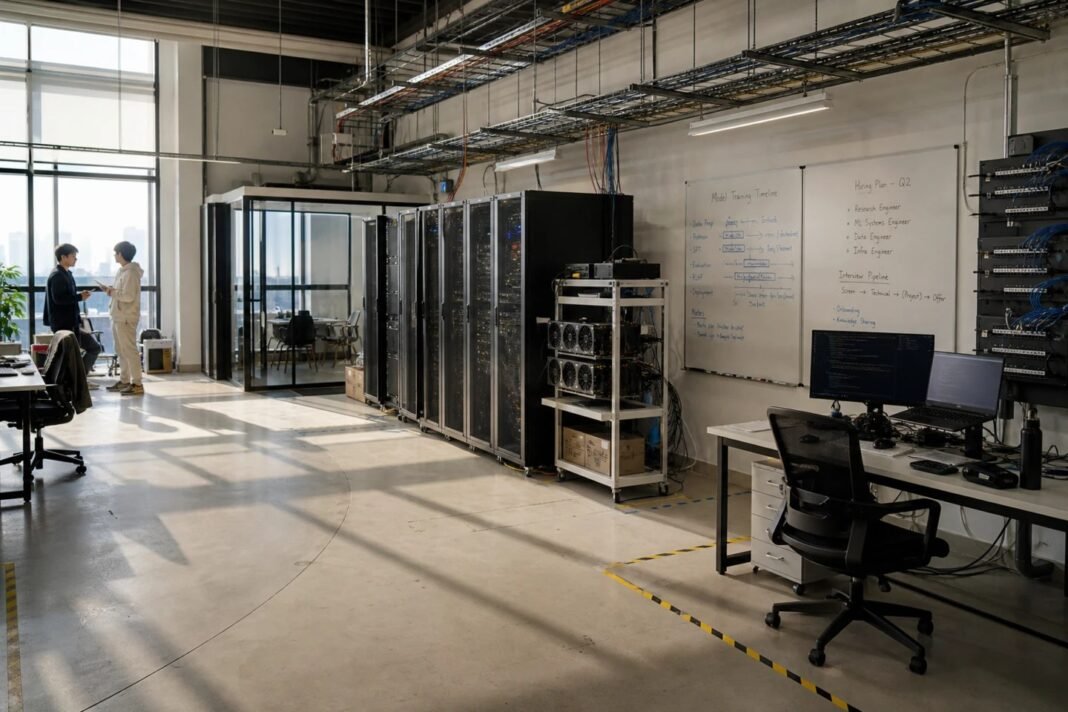
The founders describe their work as “the world’s most complete megakernel framework. It can perform entire training runs, serve inference, play video games, and even do all three simultaneously in a single kernel.” A kernel is a program that runs on a GPU, and a megakernel bundles many tasks into one program.
The idea is to train powerful AI models with far less data and computing power than today’s systems use. According to the founders, a single megakernel can handle a full training run, serve inference and even play a video game at the same time. Index says this removes wasted time between steps so each chip does more useful work.
Asher Spector told TechCrunch that “a model that’s a million times more data efficient is probably a million times easier to put into the economy.” He told Bloomberg the lab plans to sell its technology eventually to make AI cheaper for other companies. Aidan Smith has said, according to Bloomberg, that the company is writing its own code to run Nvidia’s GPUs more efficiently. Index wrote that “if the future of AI depends on getting more from less, we can’t think of a better team to shape it.”
A bet on doing more with less
The Flapping Airplanes Series A lands as investors start asking how long the data-center spending boom can last. The lab’s pitch is efficiency: getting more out of each chip just as the industry questions whether the current pace of spending is sustainable. The risk is just as clear. At $6 billion with no revenue, the valuation rests entirely on research that has yet to be proven outside the lab.
For now, the Flapping Airplanes Series A money gives the lab room to hire and keep building. Whether the megakernel approach works at scale will decide if the $6 billion price tag looks smart or steep.