
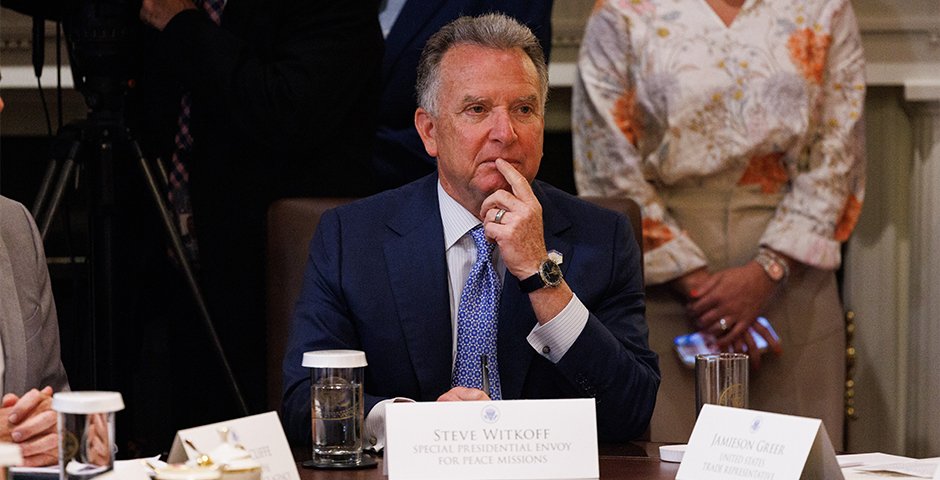


U.S. special envoy Steve Witkoff arrived in St. Petersburg on Wednesday for the Witkoff Putin talks on Moscow’s full-scale invasion of Ukraine, a day after meeting Ukrainian President Volodymyr Zelensky in Oslo.
The visit, part of a U.S. effort to push for an end to the war, came as Washington and Kyiv tried to repair a bitter public feud. Secretary of State Marco Rubio described the Oslo talks as “positive” and said Witkoff would carry the results into the Witkoff Putin meeting.
“He’ll now, armed with those ideas, be able to go to Saint Petersburg and share them with the Russian side, and let’s see if we can make some progress,” Rubio said during a visit to India.
Putin aide Yuri Ushakov said the Russian president would host Witkoff at the Constantine Palace in the first half of the day on Wednesday for the Witkoff Putin talks. Kremlin envoy Kirill Dmitriev, who greeted Witkoff at Pulkovo Airport, was to take part. “Negotiations on a settlement in Ukraine are, naturally, an integral part of today’s agenda,” Ushakov told reporters.
The meeting was also to include Jared Kushner, President Donald Trump’s son-in-law, participating virtually, a U.S. official told AFP. Kushner had joined the Oslo meeting with Zelensky remotely on Tuesday, and his virtual role in the Witkoff Putin talks continues that involvement.
What the Oslo talks covered before the Witkoff Putin meeting
The Oslo agenda was wide. It covered “Article 5-like” security guarantees for Ukraine, a post-war economic recovery blueprint, energy ceasefire proposals and a wider European security architecture.
Finnish President Alexander Stubb, Norwegian Prime Minister Jonas Gahr Store and senior European and British security representatives joined the talks, which U.S. officials described as “constructive” and “very productive.” Those points now go to the Witkoff Putin talks, where Ukraine will not be present.
After the Oslo sessions, Zelensky thanked Washington on Tuesday for the resumption of U.S. intelligence sharing on Russian strikes. “We are thankful that intelligence works,” Zelensky told reporters in Oslo, describing the early warnings as “very, very important for our people, for children, adults, civilians” when ballistic missiles were about to strike.
Witkoff planned to return to Oslo after his trip to Russia, Store said. “I think we may have entered a phase now where the Russians are also looking for opportunities for diplomacy,” Store told Norwegian broadcaster NRK on Wednesday morning.
A public feud preceded the Witkoff Putin talks
The diplomatic push followed days of open friction between Kyiv and Washington. The tensions grew after Trump struck a diesel-supply deal with Putin and called for Zelensky to be replaced after Ukraine refused to stop hitting Russian oil refineries.
Trump also waived sanctions on Russia’s war effort, and Ukraine accused the United States of withholding intelligence and delaying the delivery of interceptor missiles. Zelensky told U.S. senators on Monday that the Pentagon was delaying delivery of missiles already paid for by European countries while the shipment awaited Defense Secretary Pete Hegseth’s signature. Several European countries were ready to transfer Patriot interceptor missiles from their own stockpiles but were waiting for U.S. approval, he said.
A dispute also flared over Starshield, the U.S. military satellite system Ukraine uses for battlefield communications. Ukraine reported reduced speeds on the system. The Wall Street Journal reported Tuesday that Elon Musk, whose company SpaceX developed it, ordered the slowdown. Trump denied ordering it, and Rubio said in Mumbai that Washington had no prior knowledge of the slowdown.
Trump has kept up pressure on Ukraine, saying at the White House that he wanted Zelensky to “make a deal” with Russia, which is ramping up its strikes as winter approaches. Trump, who called for Zelensky to resign last week, also criticized the Ukrainian president for not accepting terms he said he had offered during a televised row in the Oval Office in February 2025. That history formed the backdrop for the Witkoff Putin talks.
Trump asks for release of an American prisoner
Trump said Tuesday that he had asked Putin to release Stephen Hubbard, an American captured by Russian forces in Ukraine years earlier, though it was not clear whether it would come up in the Witkoff Putin talks.
“I’ve been talking to him at length. I’ve asked him to release him. Let’s see what happens,” Trump told journalists in Washington.
The Witkoff Putin talks are the latest step in U.S.-led peace efforts more than four and a half years after Russia’s invasion. Efforts by the Trump administration since early last year to end the war have made no significant progress, and there was no suggestion of an imminent breakthrough. Russia and Ukraine remain far apart on the terms of a settlement, with their armies locked on the battlefield and daily long-range strikes continuing.