
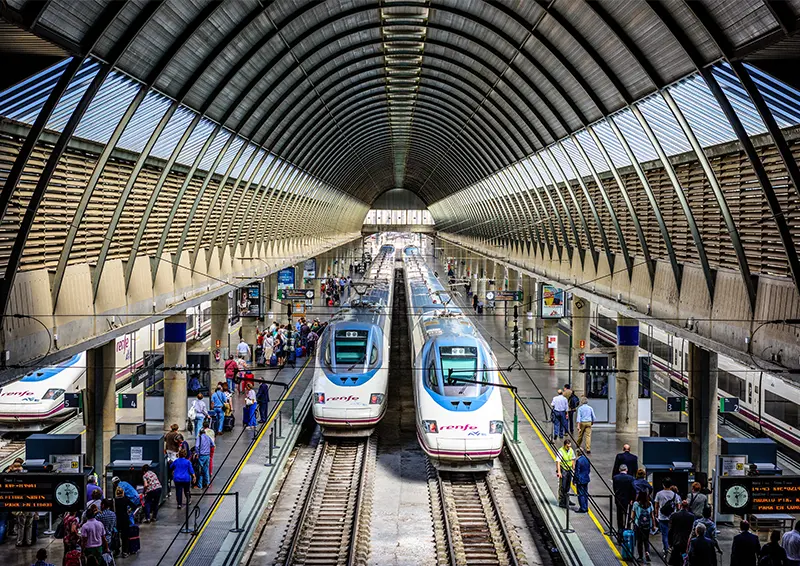


The Spain train crash in the central province of Toledo killed at least 68 people on Wednesday morning, when a high-speed train travelling from Madrid to Seville struck the rear of a stationary train. Another 58 people were receiving treatment in hospitals, the regional government of Castilla-La Mancha said, while rescue workers searched mangled carriages through the day for survivors and bodies. It was the second deadly high-speed rail collision in Spain this year.
The Spain train crash happened near Urda, about 100 miles south of Madrid. A train run by the state-owned company Renfe hit a train run by the private operator Iryo that had stopped on the tracks. The Iryo train was carrying 147 passengers, and the Renfe train was carrying 397 passengers. The force of the impact derailed two carriages at the tail of the Iryo train and the front of the Renfe train, and several carriages fell down an embankment. One carriage caught fire.
Survivors of the Spain train crash described passengers being thrown into the air, trapped in the wreckage and smashing windows to escape. Samy Paul, a British tourist rescued from the Renfe train, told the Associated Press that carriages ahead of him were smashed. Spain’s Civil Guard said it would need DNA samples from relatives to identify some of the victims, and emergency crews worked through the night under floodlights to cut open carriages.
What caused the Spain train crash
Spain’s transport minister, Oscar Puente, said a computer failure had stopped several trains on the stretch of track. A 24-hour control centre in Madrid then took over operations, and operators there made what Puente called an “inexplicable” decision to instruct the Renfe train to proceed again at normal speed, without speed restrictions, even though the Iryo train was stopped ahead. Reuters reported that the Renfe service had been authorised to continue despite an active red signal.
Audio recordings between controllers in Madrid and train drivers appear to show that one high-speed train was given clearance to move while another up ahead had stalled. Iryo said its train was struck from behind. Puente said the sequence began with a failure in a computer system that halted traffic, followed by a wrong choice to restart the Renfe train. Officials said the full chain of events behind the Spain train crash would be examined, and Sanchez said the government would act on any failures that emerged.
Spain train crash prompts national mourning
Prime Minister Pedro Sanchez visited the crash site and said the whole country was grieving. “Lives have been shattered, families have been torn apart, the pain is immense,” he said. His government declared three days of national mourning. Sanchez also called for stronger safety measures to restore confidence in a high-speed rail system that was once a source of national pride, saying it was unacceptable for Spain to suffer two high-speed rail accidents in the same year.
Spain train crash follows January disaster
Spain was already reeling from a high-speed rail disaster further south on the same line near Cordoba in January, which killed 46 people. That crash also involved high-speed trains run by the same two companies, Renfe and Iryo, nine months earlier. The October crash is Europe’s deadliest rail disaster since 2013, when 80 people died after a train derailed in north-west Spain.
The Spain train crash and the January disaster have put the safety record of Spain’s high-speed network under close scrutiny. Sanchez said the reasons for the two crashes appeared unconnected, but he promised that investigators would establish what happened in each case. The Civil Guard investigation at Urda continued on Thursday, with some victims still to be formally identified.