
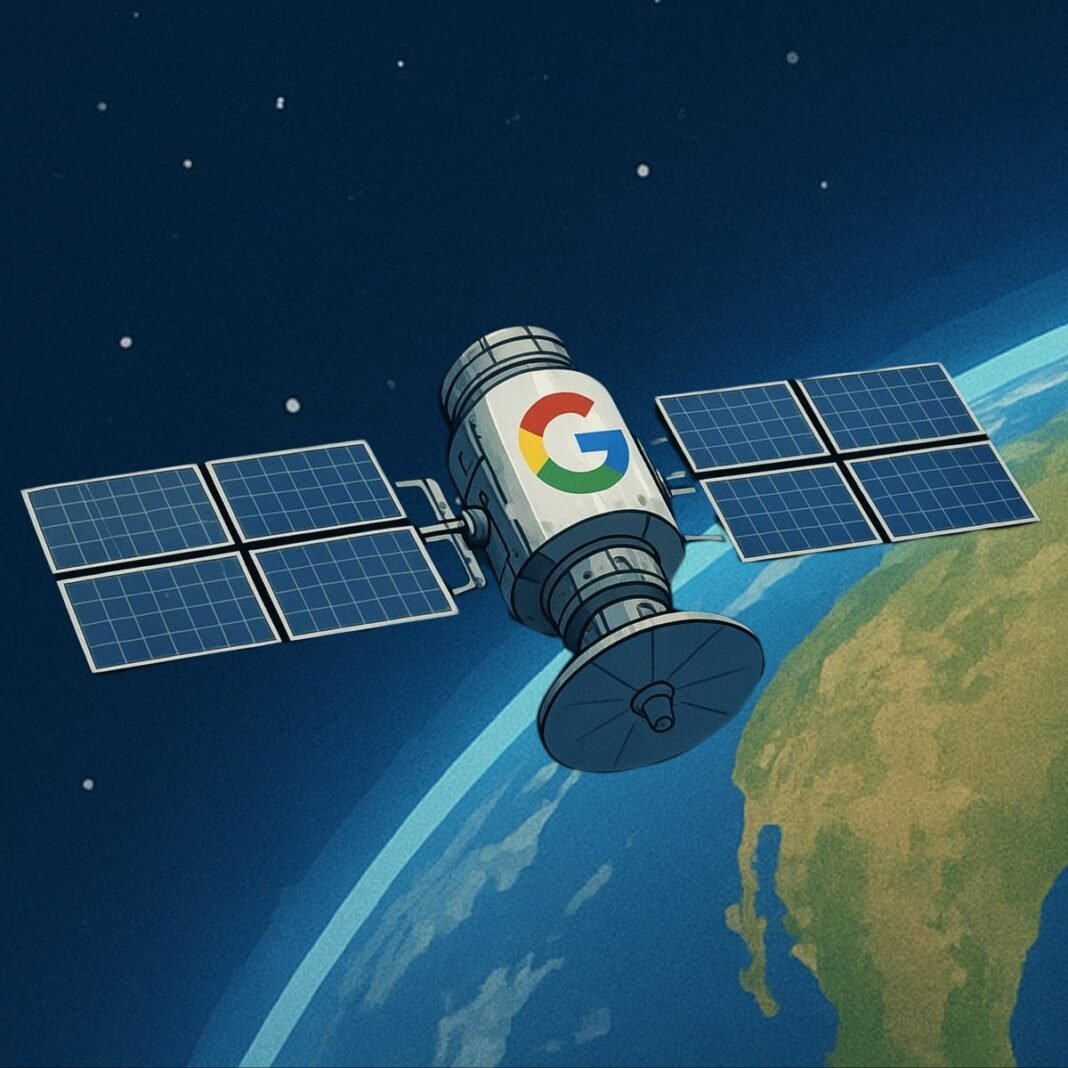


Google’s Project Suncatcher satellite has sent back its first AI response from orbit, a short haiku written by its Gemma 4 model. Google announced the result on 30 October 2026, four weeks after the satellite launched on 1 October aboard a SpaceX Falcon 9 rocket. The satellite shared that ride with more than 100 other spacecraft on the Transporter-18 mission. Google calls the result a “Hello World” milestone, the first AI response from a data center class Tensor Processing Unit, or TPU, in orbit.
The test was simple on purpose. Engineers sent a prompt to Gemma 4, the open model loaded on the satellite before launch, asking it to write a haiku about being in space. As the satellite passed over Svalbard in Norway, it sent back three lines: “Blue marble below / Data streams in silent grace / Starlight feeds my core.” Google then tested prompts that asked the model to report telemetry, or technical status data, from the payload. A Google spokesperson told TechCrunch that the satellite is operating nominally, which in space terms means it is working as planned.
Suncatcher is a research project, not a product. Google outlined it in November 2025 as a long-term test of whether solar-powered satellites carrying its TPU chips could run machine learning work in orbit. The idea is that satellites in sunlight for much of their orbit could use solar power that would otherwise be wasted on Earth, where data centers need cooling, water and grid power. The haiku does not prove that case. It proves that a TPU survived launch, powered up in orbit, ran a small model and sent an answer back to Earth.
Suncatcher satellite and its four TPUs
The prototype satellite was built in partnership with Planet, the satellite imaging company. After launch, the team spent about three weeks on commissioning, the careful process of powering up systems one at a time and checking that each one works. The team powered up the host computer and the TPU trays, ran early machine learning tests, and then reached the first full prompt and answer. Travis Beals, Google’s senior director for Paradigms of Intelligence, wrote the post that announced the result.
The Suncatcher spacecraft carries four Google TPUs, the chips Google designs to run its AI models. Power is the main limit on what the satellite can do. It generates up to 1 kilowatt of electricity, and TechCrunch reports that only one TPU can run at a time, for about 20 minutes per session. A 20-minute window is enough for a haiku, but it is far from the continuous operation a data center provides.
Suncatcher radiation and thermal tests next
Suncatcher’s next tests will look at how the TPUs handle thermal stress and radiation in low Earth orbit. Radiation is a particular problem for computer hardware in space. High-energy particles can flip a bit in memory, changing a stored value without setting off the usual checks. That kind of error can corrupt a calculation quietly, which is worse than a clear failure that engineers can spot and fix. Earth tests suggested that inference work, running a trained model, could tolerate radiation better than training, building a model.
Orbital testing will show whether that Earth-based result holds up under continuous exposure. A chip that works for a few minutes in a lab beam may behave differently after weeks in orbit, where radiation arrives from all directions and temperature swings with each pass in and out of sunlight. The Suncatcher team will run repeated tests over time, watching for errors, slowdowns or changes in power use. If the TPUs hold up, Google will have evidence that its chips can be trusted for longer orbital work. If they do not, the team will need to add shielding or error correction, both of which add weight and cost.
Suncatcher twin satellites planned for 2027
Suncatcher plans to launch two more satellites in 2027, described in its post as twin interconnected satellites. Those spacecraft will test higher power generation and optical links between satellites, which would let processors coordinate work across an orbital network. Google’s 2025 research post said two prototype satellites were slated by early 2027, and the new post gives 2027 without a month.
For now, Suncatcher remains an experiment with a clear next step and no product date. The haiku from orbit is a neat result, and it is easy to share, but its value is as a boot test. It shows that the hardware works in space at a basic level. The thermal and radiation tests that follow will decide whether Google keeps spending on the idea, and the twin satellites in 2027 will decide whether orbital chips can work together. Until those tests report back, the project is a promising test, not a data center in the sky.