
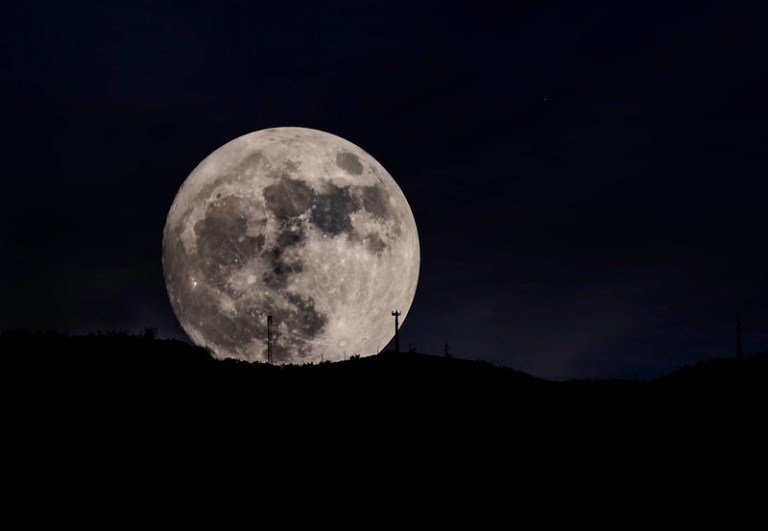


November supermoon is the first of a run of three supermoons, with the biggest and brightest arriving on November 24. The November supermoon is part of NASA’s November skywatching guide, which also lists a close pairing of Mars and Jupiter, Taurid and Leonid meteors, and a milestone for the Voyager spacecraft.
A supermoon happens when a full moon coincides with the moon’s closest approach to Earth in its orbit, making it appear slightly larger and brighter than a typical full moon. The November supermoon on November 24 will be the largest of the three, and it will be followed by supermoons in December and January.
“The November supermoon is a great opportunity for skywatchers to get outside and enjoy the night sky,” NASA said in its November guide. “The moon will be at its closest to Earth, and it will appear larger and brighter than usual.”
What else to see in November
Alongside the November supermoon, the month offers several other skywatching highlights. Mars and Jupiter will appear close together in the morning sky, a pairing that will be visible to the naked eye. The Taurid meteor shower, which peaks in early November, will produce a handful of bright fireballs, while the Leonid meteor shower, which peaks in mid-November, is known for fast-moving meteors.
NASA’s guide also notes a milestone for the Voyager spacecraft, which launched in 1977 and continues to send back data from interstellar space. Voyager 1 is now more than 15 billion miles from Earth, making it the most distant human-made object.
How to watch the November supermoon
The November supermoon will be visible across the United States on the night of November 24, weather permitting. No special equipment is needed to enjoy the supermoon, though binoculars or a small telescope will reveal more detail on the lunar surface.
For the best view, NASA recommends finding a dark location away from city lights and allowing your eyes to adjust to the darkness for about 20 minutes. The moon will rise in the east shortly after sunset and will be visible throughout the night.
What is a supermoon
The term supermoon was coined by astrologer Richard Nolle in 1979 to describe a full moon that occurs when the moon is within 90% of its closest approach to Earth. While supermoons are not rare, occurring three to four times a year, they remain popular with skywatchers because of their slightly larger and brighter appearance.
The November supermoon is the first of three in a row, with the December supermoon on December 24 and the January supermoon on January 23 completing the run. Each will be slightly smaller than the one before as the moon’s orbit carries it farther from Earth.