
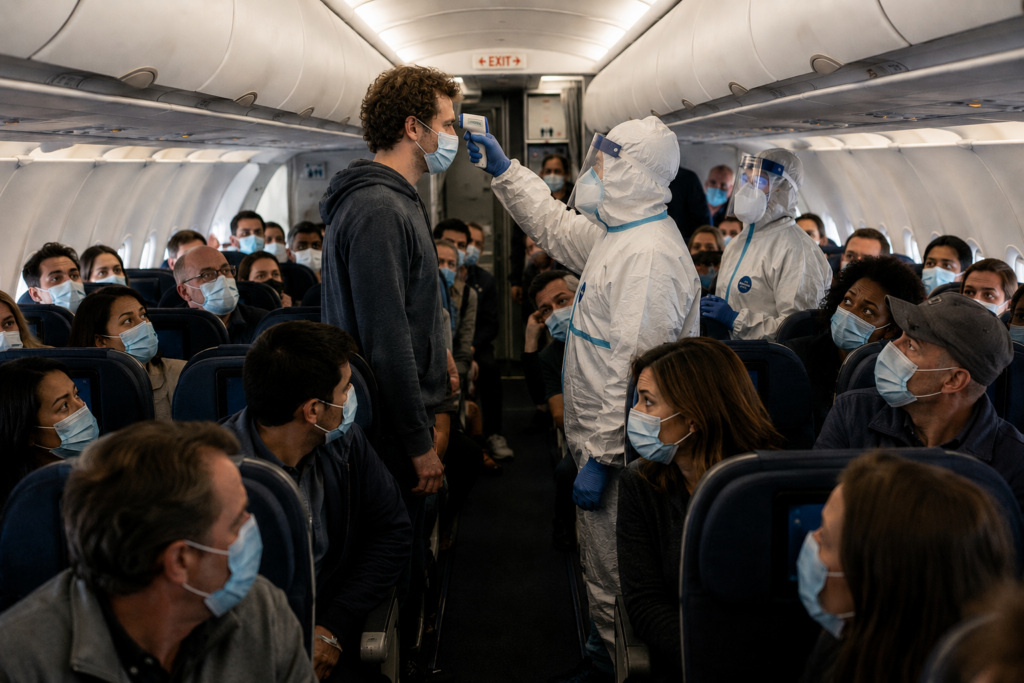


A new health declaration takes effect at 11:59 p.m. Eastern on November 3, 2026, for every passenger boarding an international flight to the United States, under an order from the Centers for Disease Control and Prevention. Each traveler must attest that they have not been in the Democratic Republic of the Congo in the previous 21 days. The order is part of the United States response to an Ebola outbreak in the Congo, and it applies to American citizens returning home as well as foreign visitors.
The health declaration rule reaches all flights departing foreign countries for the United States at or after the deadline. It does not apply to land or sea arrivals, and it does not replace passports, visas or ESTA authorization. Airlines must collect the declarations before boarding and keep them for at least 42 days after arrival, so the paperwork becomes part of the check in process rather than a form handed out on the plane.
What the health declaration requires
The health declaration asks each passenger to confirm they were not present in the Congo in the 21 days before boarding. Transiting through a Congolese airport counts as being there, so a short connection still triggers the rule. Anyone who was in the Congo generally cannot board until Day 22, counting the day they left as Day 0. Narrow exemptions exist for medical and humanitarian travel.
Passengers who refuse to sign are denied boarding, and knowingly false statements can carry criminal penalties. The health declaration order is scheduled to run through December 18 unless it is changed sooner. Travelers who were in Uganda or South Sudan within 21 days face a separate condition: they must enter through Dulles, Atlanta or John F. Kennedy airport.
Why airlines object to the health declaration
Airlines have pushed back. Reuters reported that the International Air Transport Association wrote to the CDC on October 27 asking it to reconsider, and Airlines for America asked for a delay, calling the rule overly stringent, costly and burdensome. The groups said check in systems and staff training cannot be ready in time, and they asked for exemptions for crew and military charters.
The scale of the affected travel is small. Reuters noted that fewer than 25,000 of about 130 million air passengers screened in 2025 had a Congo connection. Airlines argue that a blanket attestation for every international passenger is a heavy tool for a narrow exposure, while the CDC order treats the declaration as a way to identify possible Ebola exposure before boarding.
Airlines also say the health declaration adds work at a point in the journey where delays spread fast. Check in staff must confirm each passenger has signed, store the form, and resolve cases where a traveler transited through a Congolese airport without leaving it. The health declaration therefore changes staffing and training at foreign airports, not just the paperwork passengers see.
What happens to denied passengers
A Department of Transportation notice dated October 28 says airlines will not be penalized for denying boarding under the rule. Denied passengers can rebook within 90 days at the original fare or take a refund or voucher, according to that notice. The protection matters for travelers whose plans change at the airport, since a denied boarding under the order is not treated as a normal refusal by the carrier.
For most travelers, the practical effect is a new line at check in rather than a new visa. Passengers should arrive with extra time, since airlines must verify the declaration before boarding and cannot collect it after the flight departs. Anyone who has been in the Congo, Uganda or South Sudan in the past three weeks should check the entry airport rule and the Day 22 count before heading to the airport.
Travelers who are unsure whether a past trip counts should count back 21 days from their flight and treat any transit through a Congolese airport as presence in the Congo. The health declaration leaves little room for doubt at the gate, since a refusal to sign means denied boarding and a false statement risks criminal penalties. Checking the dates at home costs minutes, while sorting them out at check in can cost a flight.