
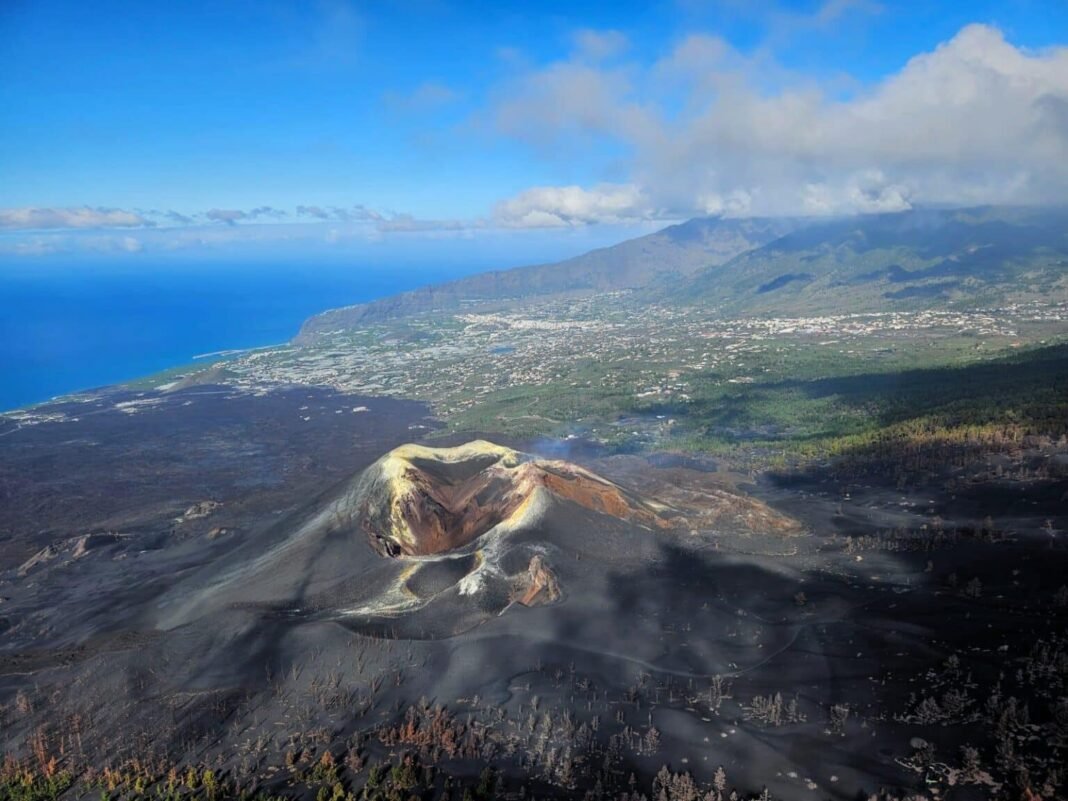


A scientist has warned that a collapse of an unstable volcano in Spain could send a megatsunami across the Atlantic Ocean to the US East Coast within nine hours. Volcanologist Professor Bill McGuire has been monitoring Cumbre Vieja, a volcano on the island of La Palma in the Canary Islands, and he set out the warning in an article published in BBC Science Focus.
The concern centres on a large wall of rock, known as a flank, on the side of the volcano. The flank is slowly inching toward the sea, and McGuire said that if it broke away and fell into the Atlantic it would displace a huge volume of water. “Based on extensive studies, I expect this part of the flank will eventually crash into the North Atlantic, launching a megatsunami in the process,” he wrote.
What a megatsunami could do to the East Coast
In the worst case set out in McGuire’s computer simulations, waves up to 65 feet high could reach the Eastern Seaboard within nine hours of the flank collapsing. The wave would cross the Atlantic at jetliner speeds once it was set in motion, leaving coastal cities little time to react.
McGuire described the event in stark terms. “I have no doubt this will be a cataclysmic event, but have no idea when it will happen, it could easily be centuries or even millennia down the line,” he said. The warning was reported by the New York Post on 6 November, and it has revived a debate that has run among scientists for more than 20 years.
Why other scientists question the megatsunami claim
Other scientists stress that no such disaster is close at hand. The collapse itself may not happen for centuries or even millennia, and there is no predicted date for it. A megatsunami of the kind McGuire describes would need a single, massive section of the island to slide into the sea at high speed, and later research suggests such collapses tend to happen in smaller stages.
The idea goes back to a study published in 2001, which said a catastrophic collapse on La Palma could send waves as high as 80 feet toward the eastern shores of North and South America. The US Geological Survey has since reviewed the claim and said the original model rested on an assumption that does not match what geologists have since learned about how volcanic islands collapse.
Newer simulations reviewed by the survey suggest that even a worst-case collapse would more likely produce waves on the East Coast of about 3 to 7 feet, rather than the 65 feet in McGuire’s extreme scenario. The survey also notes that collapses of Canary Island volcanoes are rare, occurring over timescales of hundreds of thousands of years.
The gap between the two estimates comes down to how the flank would fail. McGuire’s megatsunami scenario assumes one huge block sliding into the sea in a single movement, which would push the most water at once. The survey’s reading of past collapses points to a slower failure in pieces, which would spread the same volume of rock over a longer time and produce a far smaller wave.
Signs that would come before a megatsunami
The US Geological Survey said a collapse of that scale should be preceded by clear signs of flank instability, including more earthquakes and visible changes in the shape of the ground. La Palma last erupted in 2021, and slope stability studies have found the structure of the island to be stable. The volcano would have to grow a great deal before a collapse became likely.
McGuire’s warning and the survey’s review agree on one point: the danger, if it ever comes, lies far in the future. The two sides differ on how large the wave would be and on how the flank would fail, and that difference is what keeps the megatsunami debate alive.
For now, no warning has been issued for the East Coast, and no evacuation or preparation order is in force. The megatsunami remains a scenario in computer models, not an event that scientists expect to see in the coming years.