
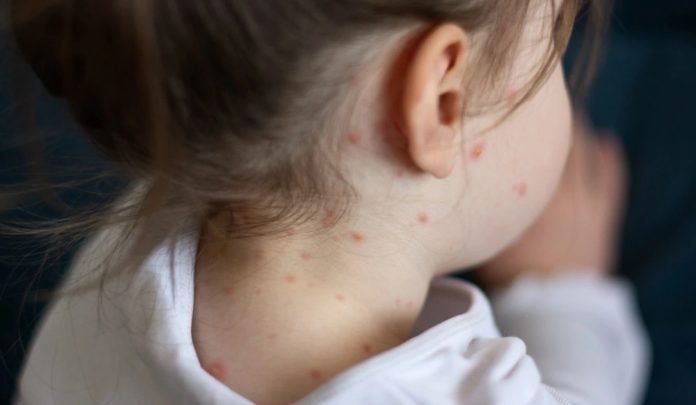


The United States is about to lose its measles elimination status, a standing it has held since 2000, after a quarter century in which the virus did not spread without interruption inside the country. A commission of the Pan American Health Organization meets in Washington from November 10 to 13 to review whether the country still meets the standard for elimination. The decision rests on genetics, not on how many people get sick.
Elimination means no continuous domestic transmission for 12 months or more, backed by a surveillance system able to tell an imported case from a homegrown one. The analysis period starts on January 20, 2025, when an outbreak began in West Texas. Whole-genome sequencing has traced a single chain of the D8-9171 strain from those early Texas cases through outbreaks in Utah, South Carolina, and at least four other states, according to an independent analysis of more than 1,800 sequences by ProPublica.
The case count has made the loss of measles elimination status hard to dispute. The Centers for Disease Control and Prevention has confirmed 5,182 measles cases in 2026, the highest annual total since 1991. Only five states, Arkansas, Hawaii, Mississippi, Nevada, and New Hampshire, have reported no cases this year. Canada lost its own elimination status in November 2025 after a year of continuous transmission.
Measles elimination status review set for next week
The review was first planned for April, then moved to November at the request of United States health officials, who said they needed more time to finish genomic analysis. The commission does not announce a ruling on measles elimination status on its own. It sends its recommendations to the Pan American Health Organization’s director, who formally tells national authorities of the classification, so a public announcement may come days after the meeting ends.
Several infectious disease specialists say the ruling is now a formality. Dr. Amesh Adalja of the Johns Hopkins Center for Health Security said the United States has effectively lost measles elimination status already, and that the November review will make it formal. Dr. Paul Offit, an infectious disease specialist at Children’s Hospital of Philadelphia, said measles is now endemic in the United States. “I think we’re going to see measles again next year, and the year after that, and the year after that, until we get on top of vaccinating our populace,” Offit said.
Losing measles elimination status would change how the disease is classed in the United States, from an imported illness to one that spreads on its own inside the country. It would also take at least a year to win back, since a country must show 12 straight months without endemic spread, with data on vaccination, surveillance, and outbreak response to back it up.
Misinformation about vaccines has fed the slide toward losing measles elimination status. NBC News reported that false claims about the measles vaccine have spread alongside the outbreaks, and vaccination coverage has slipped in the states where cases have run highest. Kindergarten coverage for the measles, mumps and rubella vaccine stood at 92.4 percent in the 2025-2026 school year, below the 95 percent level needed to stop the virus spreading in a community.
Measles elimination status nearly lost before
The country came close to the same outcome in 2019, when a large outbreak centered in New York reached almost 1,300 cases and spread to 30 other states. That chain was broken before it reached 12 months of continuous transmission, and measles elimination status survived. The current chain has run far longer, starting in January 2025 and still going when the CDC published its latest count on November 6.
The commission’s meeting is the sixth annual session to review measles and rubella elimination across the region. Sources told CIDRAP News that the outcome for the United States is largely symbolic, since the virus has already spread without a break for well over a year. The formal loss of measles elimination status would still mark the end of a public health achievement that dates to 2000, when the country became the first large nation in the Americas to stop the virus spreading at home.