
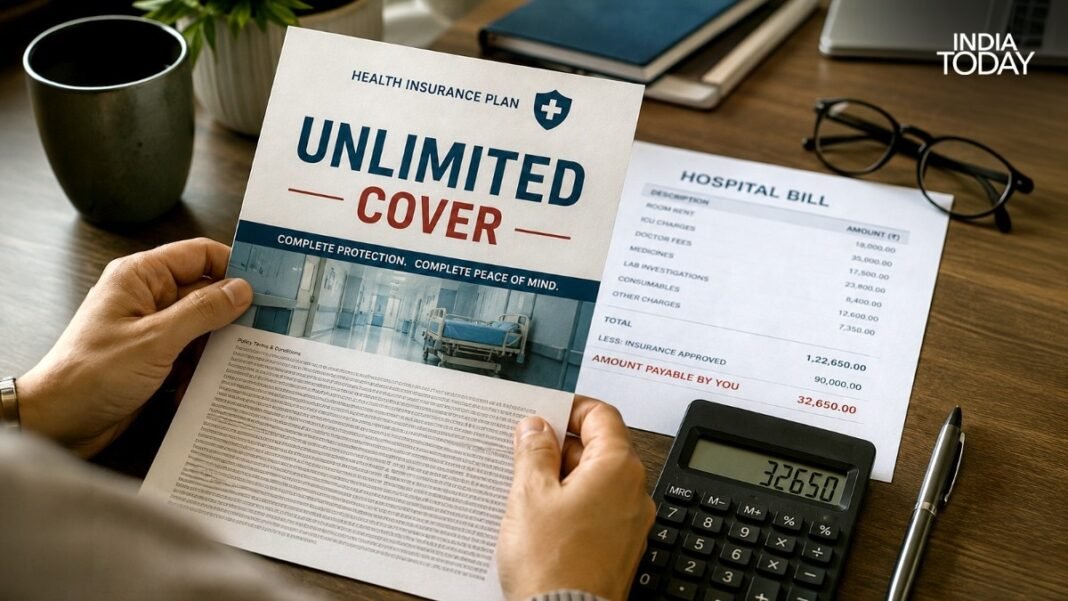


Government health spending in India has tripled in a decade, while the share of the health bill that households pay directly has fallen to 42.7%, the lowest in the series, according to the National Health Accounts Estimates for India 2023-24. Released by the Union Ministry of Health and Family Welfare on Sunday 15 November 2026, the estimates show government health expenditure rising from about Rs 1.30 lakh crore in 2013-14 to Rs 4.14 lakh crore in 2023-24. Over the same ten years, the share of total health spending paid out of pocket by families fell from 64.2% to 42.7%, a drop of 21.5 percentage points.
The figures describe who pays for health care in India, not how good the care is. They track the health bill as money flows from governments, insurers and households to hospitals, clinics and chemists. The latest round is the eleventh in the series, prepared by the National Health Accounts Technical Secretariat at the National Health Systems Resource Centre, and it follows the System of Health Accounts 2011 framework used around the world.
For families, the change is real but unfinished. In 2013-14, nearly two out of every three rupees spent on health care came straight from a patient’s pocket. Ten years later, the share is down to about 43 in every 100 rupees. The burden is easing, but households still meet more than two-fifths of the country’s health bill directly.
Who pays the health bill now
The state now carries a much larger share of the load. Per person, government spending on health rose from Rs 1,042 in 2013-14 to Rs 2,959 in 2023-24, an increase of nearly 2.8 times, and the government’s share of total health spending rose by 14.9 percentage points across the decade. Primary care took a large part of the new money, reaching about Rs 1.53 lakh crore in 2023-24 as Ayushman Arogya Mandirs spread everyday care closer to home.
Social security spending on health, which includes Ayushman Bharat PM-JAY, rose from 6% to 11% of total health expenditure over the decade. PM-JAY, launched on 23 September 2018 and run by the National Health Authority, offers cashless cover of Rs 5 lakh per family per year for secondary and tertiary hospitalisation. Private health insurance also grew, from 9.2% of total health spending in 2022-23 to 10.2% in 2023-24.
The ministry said the estimates point to a significant change in how health care is financed in India. A decade ago, a hospital admission could wipe out a family’s savings. Today, a larger share of the bill is picked up by the government or by insurance and social security schemes.
How the health bill has shifted
The fall in the out-of-pocket share of the health bill has been steady rather than sudden. It stood at 43.4% in 2022-23 before easing to 42.7% in 2023-24, and the ten-year fall of 21.5 points is the lowest out-of-pocket share recorded in the series.
Out-of-pocket spending is the part of the health bill with the sharpest consequences: money families pay directly for treatment, medicines and tests, with no insurance or reimbursement to soften it. Oommen C. Kurian, head of the Health Initiative at the Observer Research Foundation, cited research showing that out-of-pocket health spending pushes 3% to 7% of households below the poverty line every year, with rural families and poorer states hit hardest.
That risk explains why the government has put so much weight on pooled cover. When the cost of a hospital stay is shared through a scheme such as PM-JAY, a family is less likely to borrow, sell assets or skip treatment.
What the numbers leave out
The estimates of the health bill carry limits. They describe the system as it was in 2023-24, two years ago, so they cannot show whether the trend has held since. They also say nothing about the quality of care: a lower out-of-pocket share is good news, but it does not by itself mean that treatment has improved, or that the extra government money reaches the clinics where people actually go.
At 42.7%, households still pay more than two-fifths of the country’s health bill directly. For poor households, even a smaller share can mean borrowing or selling assets when a serious illness strikes, and the costs of medicines and tests outside hospital stays still fall largely on families.
The state is paying a bigger share of India’s health bill than it did ten years ago, and the amount households must find from their own pockets is shrinking. The next round of accounts will show whether the progress holds, and whether the money reaches the clinics where it is needed most.