
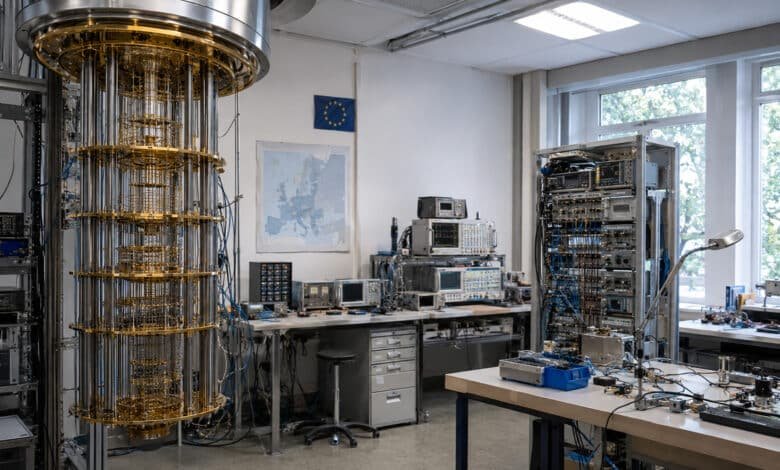


Brussels plans to favour European companies in the race for quantum technology, under a draft law reserving strategic projects and public contracts for EU-controlled suppliers. The draft of the Quantum Act, seen by The Quantum Insider and reported on 10 November, would also open the door to firms from countries with reciprocal agreements with the EU. The European Commission was scheduled to put the proposal forward on 18 November, and the final text may still change.
The Quantum Act would put European quantum research, manufacturing and sales inside one framework. Participation in designated strategic infrastructure and industrial projects would generally be limited to EU-controlled companies, and public procurement of quantum products, systems and services would follow the same rule. Suppliers from outside the bloc could take part where a strategic partnership allows reciprocal participation, subject to safeguards on security and intellectual property.
The Quantum Act sets out targets for the technology itself. It aims for about 100 error-corrected logical qubits per system by 2030 or soon after, rising to thousands per platform by 2035. Logical qubits use error correction to protect quantum information, which allows longer and more reliable calculations. Progress would be judged on more than qubit counts, with the draft listing logical error rates, operation quality and duration, scalability, availability, energy use and performance on real tasks.
Quantum Act targets for networks and timing
For networking, the draft targets interoperable metropolitan quantum networks by 2030, with pilot facilities spanning up to about 50 kilometres. It also calls for a cross-border quantum timing network by 2030. Selected quantum medical imaging systems would move toward multi-site clinical validation around 2030, and a federated European Quantum Internet remains a goal for 2040 and beyond.
The Quantum Act would also introduce quantum-safe purchasing rules for critical sectors. Procurement procedures starting six months after the regulation entered into force would generally require purchases of infrastructure, equipment and systems in designated critical sectors to be ready for post-quantum cryptography and to support crypto-agility. Member states would report their transition preparedness within six months of entry into force and each year after that.
Quantum Act plans for factories and funding
Industrial capacity gets its own timeline. The draft calls for stronger pilot production and chip design until 2030, then a shift toward industrial-scale production and commercially viable foundries during 2030 to 2035. Priority areas include quantum foundries, chip fabrication and packaging, control electronics, cryogenics, lasers, detectors and precision equipment.
Money is the missing piece. The Quantum Act sets no overall spending allocation, and funding would depend on the successor to Horizon Europe, the proposed European Competitiveness Fund, and money from member states and private investors. A Quantum Strategy Board of member states would advise the Commission, and a European Quantum Alliance would bring in industry.
The Quantum Act follows the Quantum Europe Strategy, adopted on 2 July 2025, which aims to make Europe a global leader in quantum by 2030. The strategy said Europe leads the world in quantum research but lags in turning that research into products. The EU accounts for more than 21 percent of global publications on quantum, ahead of the United States and China, according to the Centre for European Policy Analysis, but it holds only 11.2 percent of quantum patents, against 29 percent for the United States and 26.3 percent for China.
The money gap is wider still. The EU has only 19.2 percent of venture capital deal value in quantum, far behind the United States at 55 percent. Research done in Europe has also fed American firms: IonQ, one of the largest quantum companies in the United States, bought the British firm Oxford Ionics and the Swiss firm ID Quantique in 2025. The field as a whole could be worth up to 2.7 trillion dollars globally by 2035, according to McKinsey.
The Quantum Act also has a security argument behind it. Paul Timmers, a visiting professor at KU Leuven, said it mattered that EU-made quantum technology was installed in the bloc’s IRIS-squared satellite programme. “You would not want to supply your diplomats with quantum communication that comes from China,” he said. Riccardo Bosticco, a researcher at the Centre for Security, Diplomacy, and Strategy in Brussels, said the EU had more advantages in quantum than it ever had in AI, because quantum computing does not depend on the computing power that built the American hyperscalers.
Whether the Act delivers depends on details still to be settled. Critics argue that Europe’s real gap lies in capital rather than research, and without a dedicated budget the targets depend on negotiations over the next EU budget cycle. The Commission’s own strategy put the sector’s global value above 155 billion euros by 2040, and the Quantum Act is the law meant to turn that research base into companies that can sell.