
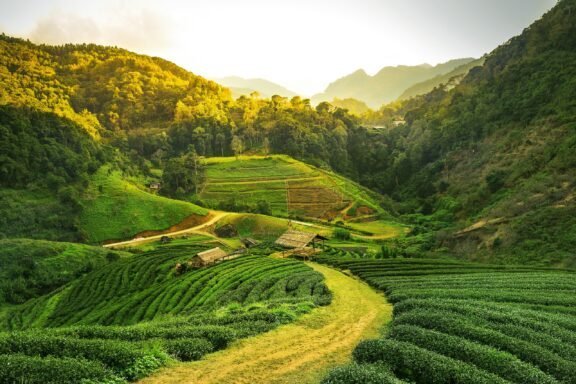


Artificial intelligence is set to be the next big brew for the tea industry, and the AI tea industry push now under way pairs satellites with a century of tea research. Tea Board India has entered into a tripartite agreement with the National Remote Sensing Centre of ISRO and the National Institute of Technology, Rourkela, for a research project called CHAAYANKAN, short for Comprehensive AI-based Geospatial Data Analytics for Tea Plantation Monitoring. The agreement was exchanged on 27 August 2026, and the project runs from April 2026 to March 2029, covering the major tea-growing regions of the country.
The AI tea industry project will use AI and machine learning to analyse plantation data from satellites, drones and weather information. Its key aims include automatic mapping of tea-growing areas, detecting crop stress, forecasting pests and diseases, and estimating green-leaf yields. The work will initially focus on Assam, West Bengal, Kerala and Tamil Nadu, and it is meant to improve tea productivity and give policymakers better data. The Tea Board is also pushing smart plantations that use AI, drones, GPS and Internet of Things technologies, alongside auction reforms to improve price realisation for producers.
The second part of the AI tea industry story is a tool for growers themselves. The Tea Research Association has launched TocklAI, a specialised artificial intelligence model for the global tea industry, which converts more than 100 years of research from Assam’s Tocklai Tea Research Institute into an accessible digital tool. Officials launched the system at the association’s 62nd annual general meeting at the Tollygunge Club in Kolkata. TocklAI uses a retrieval-augmented generation system to pull answers from verified archives, and growers can query it on pest management, soil health, plant nutrition and climate adaptation.
AI tea industry and the TocklAI launch
The AI tea industry tool is led by Tea Research Association secretary Joydeep Phukan, and it digitises 2,000 scientific publications, with completion expected to take 18 months. Union Minister Pabitra Margherita launched TocklAI, and association chairman Suneel Singh Sikand said the tool should protect the industry as exports faced a 16% decline between January and July 2026. Total tea exports reached 270 million kg, worth over 8,300 crore rupees, in 2025-26. The research behind TocklAI comes from the Tocklai institute, the world’s oldest tea research station, and the model answers from that archive rather than from the open web.
The Tea Board is pairing the technology push with changes to how tea is sold. Deputy chairperson C. Murugan told the Tea Research Association meeting that the board is working to expand auction centres, encourage greater buyer participation and promote smart plantations. The board has opened auction centres in Dibrugarh and Jorhat in Assam, plans to open another in Agartala by the end of October 2026, and is working to reopen the Jalpaiguri centre. The board’s 2024-25 annual report recorded 103.22 million kg of dust-grade tea sold at an average of 231.31 rupees per kg up to Sale 13 of 2025, against 86.33 million kg at 181.80 rupees per kg in the comparable previous-year period.
The AI tea industry push also draws on work already under way in the sector. The Assam Company India Limited has worked with the American agri-tech company SmartFarms on a Farm to Cup system, using AI, blockchain and big data to trace tea from the leaf to the cup, with DNA barcoding and RFID tags so a drinker can reward the farmer who plucked the leaf. The AI tea industry is therefore not starting from zero: growers, companies and researchers have been testing these tools for years, and the new projects give them national scale.
AI tea industry and what growers gain
The AI tea industry push matters most to small growers, who form the bulk of the sector and have the least access to agronomy advice. A grower who can ask a phone about a pest on the leaves, or about soil nutrition before the rains, gets an answer drawn from a century of trials at Tocklai, rather than from guesswork. CHAAYANKAN adds the view from above: satellite maps of plantations, early warnings of crop stress, and yield estimates that help the Tea Board plan. The AI tea industry story is therefore two tools at once, one looking down from orbit and one answering questions in the field, and both are aimed at the same crop.