
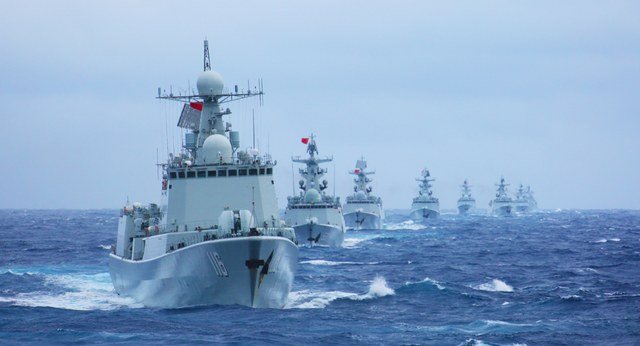


China carried out a large, unannounced military exercise across the western Pacific and around Taiwan in early November, and officials in Taipei have described the China Pacific drills as a campaign of silent intimidation.
A senior Taiwan security official, speaking on condition of anonymity because of the sensitivity of the matter, said China’s military and coast guard had at one point massed more than 100 vessels in the region early this month. The China Pacific drills included simulated attacks on other militaries and cities, including Taiwan’s.
The official said the naval deployment in the China Pacific drills was larger than Justice Mission 2025, China’s last formally named drills targeting Taiwan nearly a year ago and one of the largest Chinese naval deployments to date.
“It is a silent exercise, and in effect, silent intimidation,” the official said. The official compared the approach to a robber who hides a gun in a coat pocket and points it at a bank teller, scaring the teller into handing over money without setting off an alarm.
More than 100 vessels in the China Pacific drills
The drills involved coordinated naval forces from China’s eastern, northern and southern theatre commands, a scale that suggested Beijing was rehearsing a Taiwan blockade scenario and broader operations across the western Pacific, the Taiwan official said.
That scale also suggested China was working to integrate its regional fleets into a single far-seas operational force, the official said. A foreign intelligence source said the silent drills without a name appeared deliberate, allowing Beijing to apply military pressure while avoiding a diplomatic backlash.
During the drills, a Chinese submarine also launched an intercontinental ballistic missile from the Yellow Sea into the Chinese mainland, the official said. Taiwan’s defence ministry referred Reuters to comments made by minister Wellington Koo this week, saying China was carrying out area denial drills in the western Pacific involving an aircraft carrier and other naval formations.
The scale of the deployment has decreased this week, with around 70 vessels operating within the first island chain by Friday, according to two Taiwan security officials. Taiwan National Security Council Secretary-General Joseph Wu posted details of the latest deployments on X late on Thursday, saying the groups of the northern, eastern and southern theatre commands and the Liaoning carrier strike group remained operating in waters east of the Philippines. He added that Chinese air force activity also remained high near Taiwan.
A speech from Xi and a summit in Shenzhen
Chinese President Xi Jinping on Thursday gave a major policy speech about Taiwan, urging peaceful reunification, though he made no mention of using force. China has never renounced the use of force to bring Taiwan under its control.
Beijing is hosting the APEC leaders’ summit in Shenzhen next week, where US President Donald Trump and Xi are expected to meet for the third time this year. Taiwan also attends APEC. The Taiwan official said the China Pacific drills were aimed at pressuring Taiwan and other governments before major international meetings.
China’s defence ministry did not respond to a request for comment. China has said its carrier is on routine exercises that are not directed at any country.
China views democratically governed Taiwan as its own territory. The China Pacific drills were part of the military pressure it has applied over the past five years. Taipei has condemned the pressure, and concern has grown in Western capitals about the potential for conflict.
The message from Beijing after the China Pacific drills
China’s widely read state-backed paper the Global Times said on Friday that if Taiwan’s ruling party persists in seeking independence by relying on external forces or military means, and drags the residents of Taiwan onto its war chariot, they will inevitably face a harsh reckoning.
The latter part of the year, when the weather is typically calmer, is when China normally carries out drills, the foreign intelligence source told Reuters. The source said the timing of the China Pacific drills fitted that pattern.
The exercise ended without a public announcement from Beijing and without a formal name. Officials in Taipei said that silence was deliberate, and that the China Pacific drills allowed Beijing to apply pressure without a formal declaration of military action.