
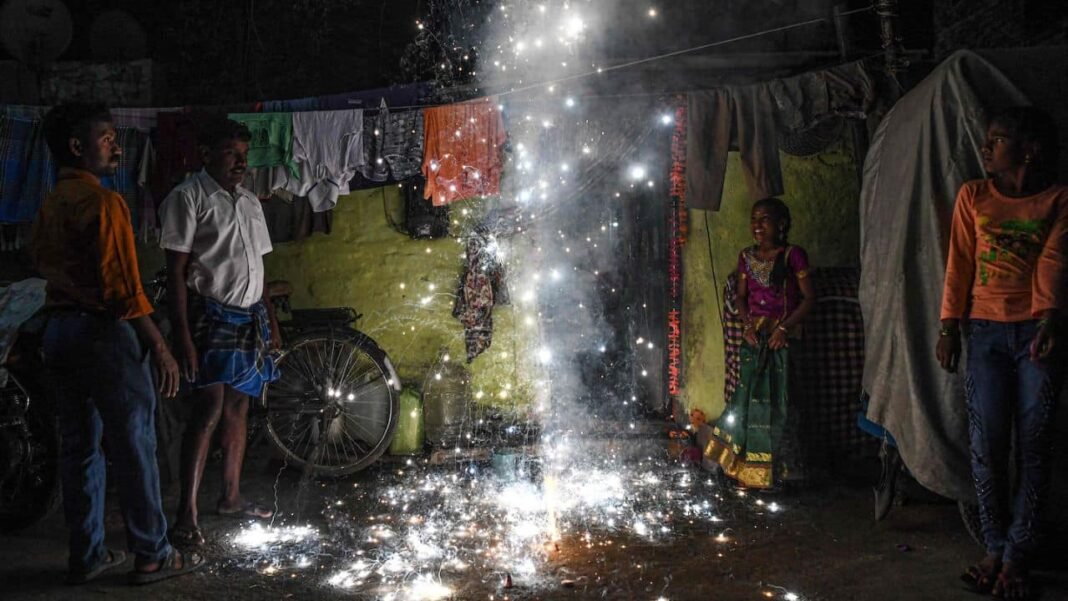


Diwali firecrackers split India again this year, as the festival ended with Delhi choking under a thick blanket of smog and environmentalists calling the air a public health emergency. Residents woke on the morning after Diwali to air quality in the severe range at several monitoring stations, with the Air Quality Index crossing 400 in parts of the capital.
Diwali firecrackers and the Delhi smog
The smoke came after a weekend in which the Supreme Court had allowed certified green crackers in Delhi-NCR on November 7 and 8, with strict time limits. Conventional fireworks were still barred, but residents burst crackers across the capital on Diwali night, and the pollutants stayed trapped over the city as unfavourable weather kept them from dispersing. Environmentalist Bhavreen Kandhari told ANI that Delhi was already struggling with toxic air before Diwali and that the crackers had added another massive burden of particulate pollution. The row over Diwali firecrackers now sits at the centre of the capital’s annual pollution crisis.
Private air quality monitors recorded readings far above the official scale during the night. Kandhari said PM2.5 levels rose from about 300 in the morning to about 1,000 at night, and other private devices recorded readings between 1,000 and 1,500. The official scale runs to 500, and anything above 400 is classed as severe. Vimlendu Jha, another environmentalist, said Diwali firecrackers had been burst in several parts of Delhi despite the Supreme Court’s directions, and criticised the failure to enforce the restrictions. He said the AQI had almost reached 500 on government figures and had gone past it on private monitors.
What the Supreme Court allowed in 2026
The court’s order, issued on November 2, allowed certified green crackers only on November 7 and 8, between 6 a.m. and 7 a.m. and between 8 p.m. and 10 p.m. A complete ban returned on November 9. The case has been before the court since a petition was filed in 2015. In its latest order, the court said it did not have adequate data to decide whether the complete ban imposed in Delhi-NCR in 2024 had served its purpose. The rules on Diwali firecrackers are therefore set by a court that is itself unsure how far they work.
The certified green crackers at the centre of the Diwali firecrackers debate were developed by the Council of Scientific and Industrial Research’s National Environmental Engineering Research Institute, and are claimed to produce around 30 per cent less pollution than conventional fireworks. They use smaller quantities of certain chemicals and additives meant to suppress dust and smoke, and are designed to produce less noise, but they still release emissions. Only manufacturers with valid CSIR-NEERI and Petroleum and Explosives Safety Organisation certifications can produce and sell approved products, each box must carry a QR code, and fireworks containing barium and long joined series known as ladis remain prohibited.
Diwali firecrackers, faith and the law
For many Hindus, Diwali is one of the most important festivals of the year, tied to the return of Lord Rama to Ayodhya and the worship of Goddess Lakshmi. Fireworks have become part of the festive experience in many places, and some people see restrictions on Diwali firecrackers as interference with a familiar cultural practice. Political leaders have at times framed the limits as an attack on Hindu traditions, and the argument has shifted from pollution to whether one community is being singled out.
The same argument over Diwali firecrackers played out in Mumbai this year, where a pollution-awareness campaign by the Brihanmumbai Municipal Corporation became a political flashpoint. The campaign featured actor Dia Mirza urging people to follow the Bombay High Court’s directions on firecrackers. Mumbai BJP president Ameet Satam objected to the video on X, writing that the city did not need lessons on how to celebrate Diwali. The civic body removed Mirza’s video within hours, although videos featuring other public figures stayed online. The Bombay High Court later expressed displeasure at political leaders’ remarks and directed the civic body to re-upload it.
Why the argument returns every year
Diwali falls in October or November, when Delhi’s air is already at its worst. Cooler temperatures, slower winds and stagnant air keep pollutants close to the ground, and smoke from crop residue fires in Punjab and Haryana adds to the load. Vehicles account for 23 per cent of Delhi’s winter pollution and biomass burning for 20 per cent, according to the Ministry of Environment, Forest and Climate Change. Shweta Narayan, a public health expert at the Global Climate and Health Alliance, described the government’s response so far as knee-jerk and temporary. Until the wider sources of pollution are dealt with, the argument over Diwali firecrackers is likely to return with every festival.