
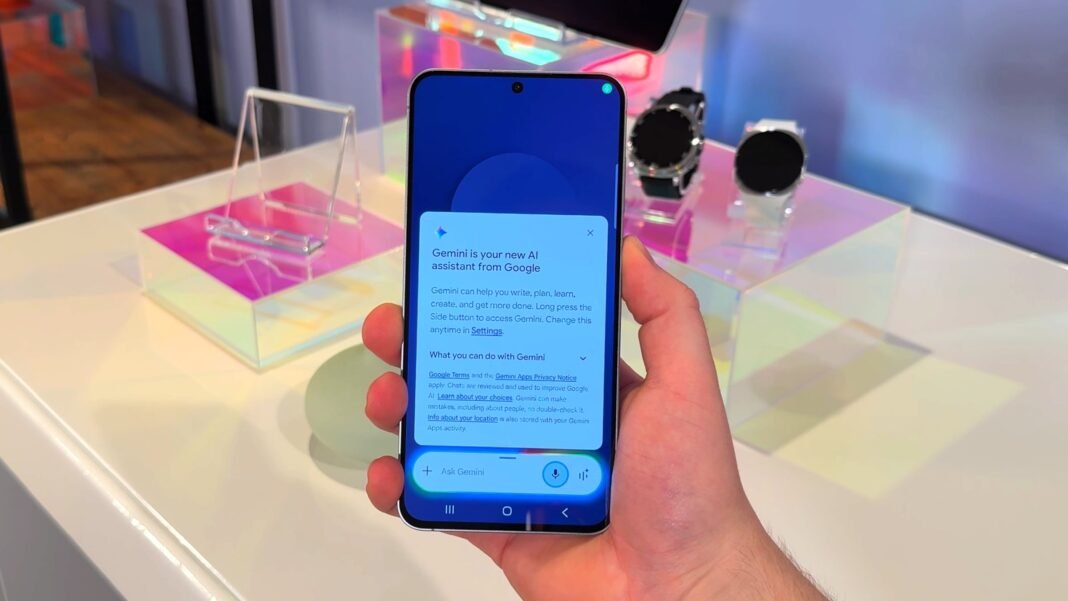


Google released Gemini 4 Hydrogen on 12 November 2026, a fast and lower cost model that replaces Gemini 3.8 Flash across the company’s products. Gemini 4 Hydrogen is available in the Gemini app, Google Search, the Gemini API and Google AI Studio, and Google says it is rolling out to all users. The launch puts the newest Gemini 4 model in front of everyday users at once, a sharp break from the staged release of the two models before it.
Google DeepMind senior vice president Koray Kavukcuoglu said Hydrogen is built for rapid execution across agentic workflows, multi-step tasks in which an AI model works on its own. Gemini 4 Carbon and Gemini 4 Argon, the two frontier models in the same family, are aimed at deep reasoning on hard problems. Gemini 4 Hydrogen takes the other role: routine coding, document work and tool calls at speed.
The rollout is broad from the first day. Google says Hydrogen is available now in all tiers of Google AI Studio, the Gemini API, Gemini for business, the Gemini app and Google Search. In the Antigravity development platform, it is offered to paid Google AI Pro and Ultra subscribers. Ars Technica reports that access in the Gemini app is tiered in a different way, with AI Pro and Ultra subscribers getting Hydrogen live while AI Plus and free users stay on Gemini 3.5 Flash-Lite. Free users get Hydrogen through automatic model selection, according to a note in the announcement.
Gemini 4 Hydrogen speed and benchmark results
Google says Gemini 4 Hydrogen finishes tasks 2.5 times faster than Gemini 3.8 Flash at its default high thinking setting. The company also says the model cuts fabricated claims by more than five times. On Terminal-Bench 4.1, a test of AI performance on terminal tasks, Google reports a score of 57 percent against 18.2 percent for the older model, more than triple the Flash result. On the Artificial Analysis Intelligence Index, Google reports 51 for Hydrogen at high thinking against 50 for Argon, and 54 at the highest setting. These figures come from Google and have not been independently replicated.
Google also lists results for Gemini 4 Hydrogen from other tests. The company reports fifth place on Agent Arena for multi-step work, 58.8 percent on HLE-Diamond, first place on the Vals Tax Agent Bench at 52.3 percent and a tie for first on the Vals Legal Research Bench at 55.8 percent. Partners that tested graph, SQL and data-heavy enterprise work saw runs two to 2.8 times faster, with token use down 12 to 23 percent against 3.8 Flash.
Gemini 4 Hydrogen pricing and thinking levels
Gemini 4 Hydrogen has four thinking levels: low, medium, high as the default, and a new xhigh tier. Google says the levels let users trade quality, latency and cost in a predictable way, paying only for the reasoning depth a task needs. Pricing is flat across the full 1 million-token context window at $1.50 per million input tokens and $7.50 per million output tokens, unchanged from Gemini 3.8 Flash. Carbon and Argon cost $2 and $10 now but rise to $4 and $20 starting next month.
Google is also introducing Orchestrator in Google Antigravity, a setting that switches between models such as Carbon and Hydrogen inside one session. On Terminal-Bench 4.0, Google says Orchestrator reached task success rates close to Carbon, while quota use fell 24 percent on average and jobs finished 19 percent faster. For parallel work, Carbon can act as coordinator while Hydrogen runs worker and verifier agents in separate workspaces. The model can also be used on its own for everyday coding, from writing code to running tests and checking changes.
Gemini 4 Hydrogen in Search and the Gemini app
Google calls Hydrogen the biggest model upgrade to Search so far. Search should handle questions with several parts, hard-to-read typos and highly specific requests, and address each part of a query. The model feeds a query fan-out method that splits a prompt into several subqueries run at once, which Google says connects users to a wider range of links. Answers in AI Mode will carry more images, structured answers, comparison tables and custom tools in all languages AI Mode supports.
In the Gemini app, Google says Gemini 4 Hydrogen follows tone, format and rules more closely across multi-turn conversations. It pulls context from uploads, Gmail, Google Drive and connected apps such as Airtable and Dropbox, and it calls tools more often when a task needs them. In Google Sheets, Hydrogen turns financial data into interactive models, with work in Sheets canvas running more than 30 percent faster than with earlier models.
The model card lists a March 2026 knowledge cutoff. It also notes occasional hallucinations and slowdowns, and higher token use at the deeper thinking levels.