
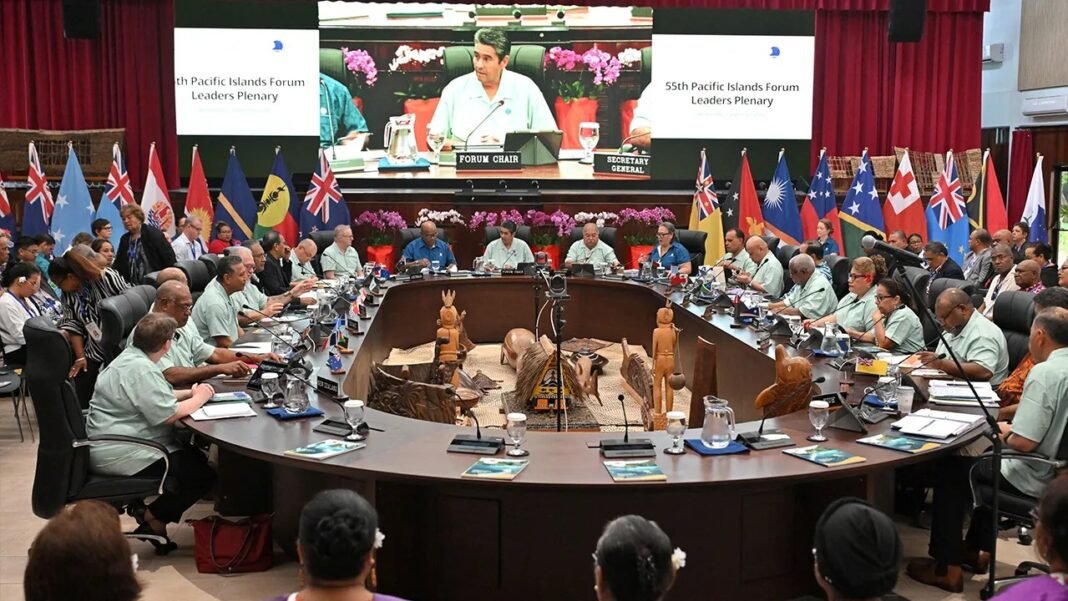


Israel has been accepted as a dialogue partner of the Pacific Islands Forum, Foreign Minister Gideon Sa’ar announced, after Pacific leaders approved the country’s application at their meeting in Palau. The decision, reported by Reuters, marks a diplomatic milestone for Israel in a region where it has been steadily building ties, and opens the door to cooperation on water, desalination, agriculture and climate change.
Dialogue partner status gives Israel a formal channel for engagement with the 18-member Pacific Islands Forum, the region’s premier political and economic policy organisation. For Jerusalem, it is the latest step in a broader push to expand its diplomatic footprint beyond its traditional partnerships.
A diplomatic breakthrough in Palau
The approval in Palau did not happen in a vacuum. Israel has spent years cultivating relationships across the Pacific, offering development assistance and technical expertise to small island states facing existential challenges. The forum’s decision reflects the cumulative weight of that engagement.
Foreign Minister Sa’ar framed the announcement as a natural fit, pointing to the practical areas where Israeli know-how aligns with Pacific needs. For the island nations, the partnership is less about geopolitics than about results: access to technology and expertise that can make a tangible difference to daily life.
The Palau meeting itself drew the usual attention as a barometer of Pacific diplomacy, where major powers compete for influence and small states leverage their votes with considerable skill. Israel’s admission adds another player to an already crowded diplomatic landscape.
Water, food and climate: the cooperation agenda
The cooperation agenda announced alongside the partnership reads like a list of the Pacific’s most pressing vulnerabilities. Water scarcity, addressed through Israeli desalination technology, is a existential concern for low-lying atolls. Agricultural cooperation promises help with food security in the face of saltwater intrusion and extreme weather. Climate change cooperation speaks to the single greatest threat facing the region.
Israel’s expertise in these areas is well established. Decades of managing scarce water resources in an arid climate have made it a world leader in desalination, drip irrigation and water recycling. For Pacific islands confronting rising seas and unreliable rainfall, that experience is directly relevant.
Whether the partnership delivers on its promise will depend on implementation. Dialogue partner status is a framework, not a guarantee, and Pacific leaders have heard ambitious pledges from larger powers before. The test will be in the projects that follow the Palau handshake.
What it means for the region
Israel’s entry into the forum’s orbit comes at a time of intensifying competition for Pacific influence. The region’s strategic importance has grown markedly, and every new partnership is watched closely by established players. Israel’s move is modest in scale but notable in direction.
For the Pacific Islands Forum, adding Israel as a dialogue partner diversifies its network of external relationships at no obvious cost. The forum has long balanced engagement with a wide range of partners, and Jerusalem’s focus on practical cooperation fits the organisation’s development-first ethos.
As Sa’ar returns from Palau with a diplomatic win in hand, the real work begins: turning dialogue partner status into desalination plants, agricultural projects and climate resilience that Pacific islanders can see and touch. In the Pacific, partnerships are ultimately judged not by announcements but by outcomes.
The Reuters report on the Palau decision notes that cooperation will focus on water, desalination, agriculture and climate change, areas where Israel’s technical expertise is globally recognised. Officials on both sides say detailed project discussions will begin in the coming months.
For the Pacific island nations, the partnership offers practical help with urgent problems. Desalination plants can secure drinking water for atolls threatened by saltwater intrusion, agricultural cooperation can strengthen food security, and climate collaboration can support adaptation planning.
Diplomats will now work on turning the forum’s approval into concrete programmes. If they succeed, the Palau meeting will be remembered as the moment a new and productive partnership began. The announcements in Palau were only the first step.