
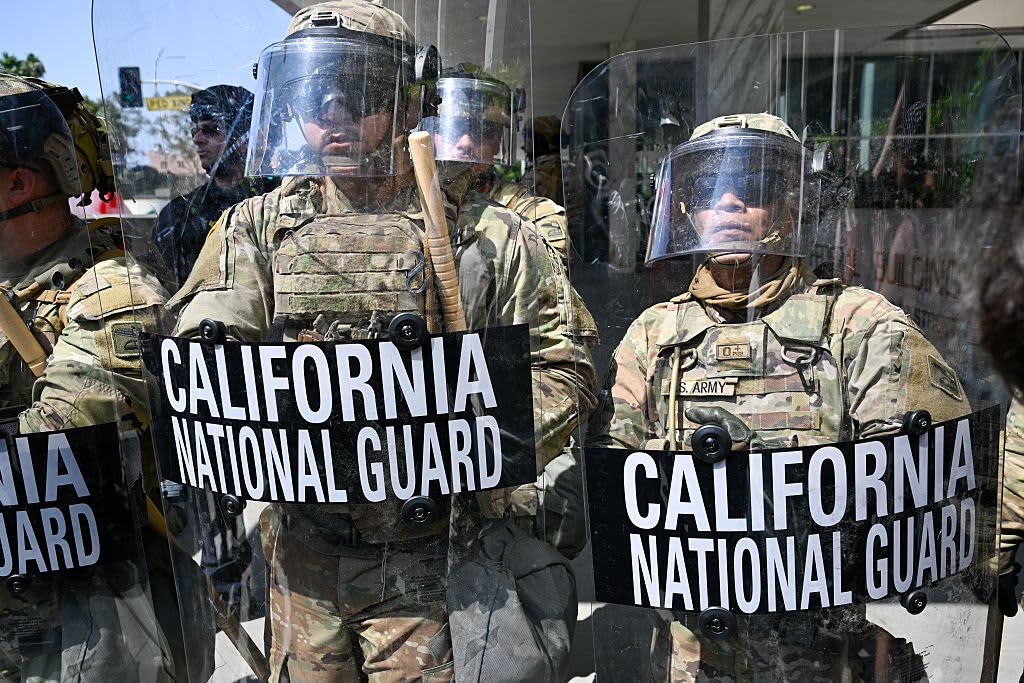


A split federal appeals court ruled Friday that President Donald Trump’s deployment of 4,000 California National Guard members to Los Angeles last year was an unlawful abuse of his authority, a national guard ruling that strikes at the administration’s use of federal military power at home.
The 2-1 decision by a three-judge panel of the U.S. 9th Circuit Court of Appeals found the federalization did not meet legal requirements. The court rejected the president’s assertion that there was a “rebellion” in Los Angeles that warranted federalizing the guard, an argument the judges determined did not stand within a “range of honest judgment.”
Trump invoked 10 U.S.C. 12406 in June 2025 to federalize the troops amid immigration protests in Los Angeles. Section 12406 of Title 10 is the statute presidents use to bring state Guard units under federal command, moving them out of the governor’s control.
The Trump administration said violent demonstrations in downtown Los Angeles and immigration protests justified the president taking control of the guard from Governor Gavin Newsom. California challenged the move, and Newsom welcomed the outcome. He called the national guard ruling “a crucial day for the rule of law, upholding the Constitution and defending democracy.”
In a statement, Newsom said another court had fully rejected what he called Trump’s illegal takeover of the state’s National Guard, adding that California’s fight had created legal precedent protecting all Americans.
The federalization placed 4,000 Guard members under presidential command in the middle of a major American city during the immigration protests.
What the national guard ruling found
The majority concluded that the conditions on the ground did not meet the legal threshold for federalizing a state’s Guard over its governor’s objection. “Defendants have not made either of the required threshold showings here,” wrote Judge Jennifer Sung, an appointee of former President Biden. “Thus, they have not carried their burden.”
The court also disagreed with the administration’s argument that the president’s decision to federalize the Guard was insulated from judicial review. Judges can examine whether the legal requirements were met, the panel held.
The national guard ruling is the latest court check on the administration’s deployment power. The published opinion now binds future panels on similar California cases, which gives the decision weight beyond this one deployment.
The panel split and the earlier round
The case has a history. Previously, the 9th Circuit agreed with Trump, finding that the president acted within the law when he called the troops into federal service for 60 days “to protect federal personnel performing federal functions and to protect federal property.”
Friday’s decision moved the other way. Trump-nominated Judge Mark Bennett dissented, writing that the panel should not have ruled on the case because the Trump administration had wanted to drop its appeal of a lower court’s order for a preliminary injunction against the deployment.
The 2-1 split shows how contested the legal questions remain. The majority and the dissent differed on the outcome and on whether the court should have decided the case at all.
National guard ruling follows the Illinois precedent
The decision follows precedent set by the U.S. Supreme Court in December holding that Trump’s federalization of the Illinois National Guard was illegal. Together, the two cases narrow the president’s room to deploy state Guard units without a governor’s consent.
The national guard ruling adds to a growing line of court decisions limiting how the federal government can use state Guard units at home. For California, the precedent matters twice over: the state now has both a Supreme Court decision on the Illinois facts and a binding circuit opinion on its own.
The U.S. Justice Department did not immediately respond to a request for comment on the ruling.
What happens after the national guard ruling
The administration can seek a rehearing before the full Ninth Circuit or take the national guard ruling to the Supreme Court. A rehearing would put the case before a larger group of circuit judges. A Supreme Court appeal would ask the justices to settle the question of presidential power over the Guard nationally.
Either route takes time. While further appeals play out, the panel’s ruling remains the governing law for the California deployment.
The deployment began in June 2025. What the administration does next will decide how long the legal fight continues.
For Newsom, who led the state’s challenge, the national guard ruling is vindication after more than a year of litigation.