
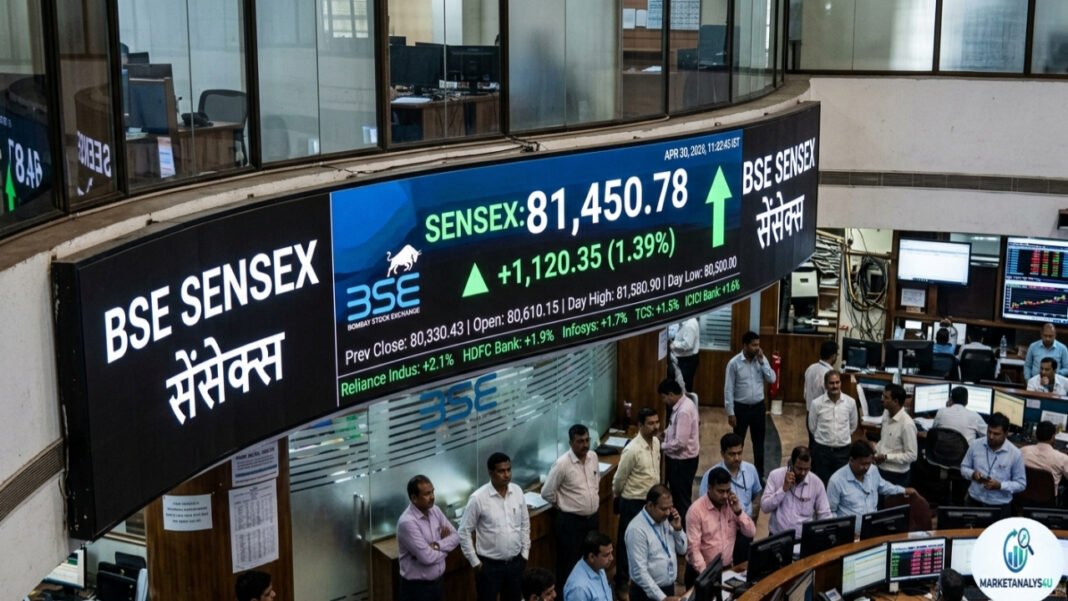


Indian shares jumped on Wednesday, 11 November, as the Sensex rally carried the benchmark more than 1,000 points higher in morning trade and pushed the Nifty 50 above 25,300. The BSE Sensex rose 1,204.24 points, or 1.48 per cent, to 82,310.89 by 10.37 am, while the Nifty 50 gained 318.60 points, or 1.27 per cent, to 25,363.25. Markets had been closed on Tuesday for Diwali Balipratipada.
The gains faded a little by the close, but both indices still finished at their highest levels since 26 February. The Sensex settled at 81,879.40, up 772.75 points or 0.95 per cent, and the Nifty 50 closed at 25,255.05, up 210.40 points or 0.84 per cent. The Sensex had touched an intraday high of 82,520.40 and the Nifty reached 25,424.35. Investors added about Rs 6 lakh crore to the market value of BSE-listed companies in the first 45 minutes.
What drove the Sensex rally
Three factors drove the Sensex rally on 11 November: foreign investors kept buying Indian shares, crude oil prices stayed near two-month lows, and September-quarter earnings came in stronger than many had expected. The mix gave buyers a reason to act after the holiday break, and the buying spread from banks and cars to aviation, insurance and telecom shares.
Crude oil gave the Sensex rally room to run. Brent crude held near $92 a barrel on 11 November after settling 1.17 per cent lower at $91.49 a barrel on 10 November. It had touched an intraday low of $89.16 on 10 November, trading below $90 a barrel for the first time since August 2026. The fall followed remarks from United States President Donald Trump on the conflict with Iran. Cheaper oil matters for India because the country imports most of its crude, and lower prices ease pressure on inflation and the trade deficit.
Earnings gave the Sensex rally a base. Nifty 50 companies recorded nearly 24 per cent earnings growth in the second quarter, the strongest in 12 quarters, according to Geojit Investments. VK Vijayakumar, chief investment strategist at Geojit Investments, said the Nifty 50 had risen 8.6 per cent in six trading days in November, mainly on foreign buying. Strong earnings also pulled the forward price-earnings ratio of the Nifty 50 down to what Vijayakumar called fair levels.
Foreign money behind the Sensex rally
Foreign money was the engine of the Sensex rally. Foreign portfolio investors turned net buyers of Indian equities in the first nine days of November, investing Rs 53,739 crore, according to National Securities Depository data cited by NDTV Profit. The inflow followed two months of net selling: overseas investors withdrew Rs 34,843 crore in October and Rs 35,861 crore in September. On Monday, 9 November, foreign institutional investors bought shares worth a net Rs 7,212.22 crore, exchange data showed.
Domestic institutions moved the other way on 9 November, selling shares worth a net Rs 7,172.53 crore, according to provisional exchange data. The contrast showed how much of the day’s buying came from overseas accounts. Foreign buying has now run for 14 straight trading sessions, and net inflows reached Rs 45,960 crore in the week that ended on 6 November. The steady flow of overseas money has kept the Sensex rally alive since the second half of October.
Earnings and crude oil support the gains
Banking shares were among the leaders of the Sensex rally. The Bank Nifty crossed 60,600 in early trade, gaining about 880 points to reach 60,624. Information technology shares also took part as market breadth improved, with more shares rising than falling.
Analysts urged caution after the sharp move. Shrikant Chouhan, head of equity research at Kotak Neo, said investors should book some profit on existing long positions if the market opened between 25,300 and 25,500, and look to buy on dips rather than chase the opening strength. He said the Nifty and the Sensex could extend the move towards 25,500 and 82,700, but chasing prices there offered less reward.
Vijayakumar pointed to risks. United States inflation data for October came in hotter than expected, with consumer prices up 0.4 per cent in the month against a forecast of 0.3 per cent. Traders now expect the Federal Reserve to raise rates by at least 25 basis points in December, and the yield on the 10-year United States Treasury bond moved close to 4.99 per cent. Vijayakumar said higher United States yields and profit booking by domestic institutions would restrain the Sensex rally a little.
What analysts watch next
The Sensex rally will face its next test in the September-quarter earnings still to be reported and in foreign flows. If overseas investors keep buying at this pace, the indices may hold above 25,300. If they pause, the market may give back some of the gains made since the start of November.