
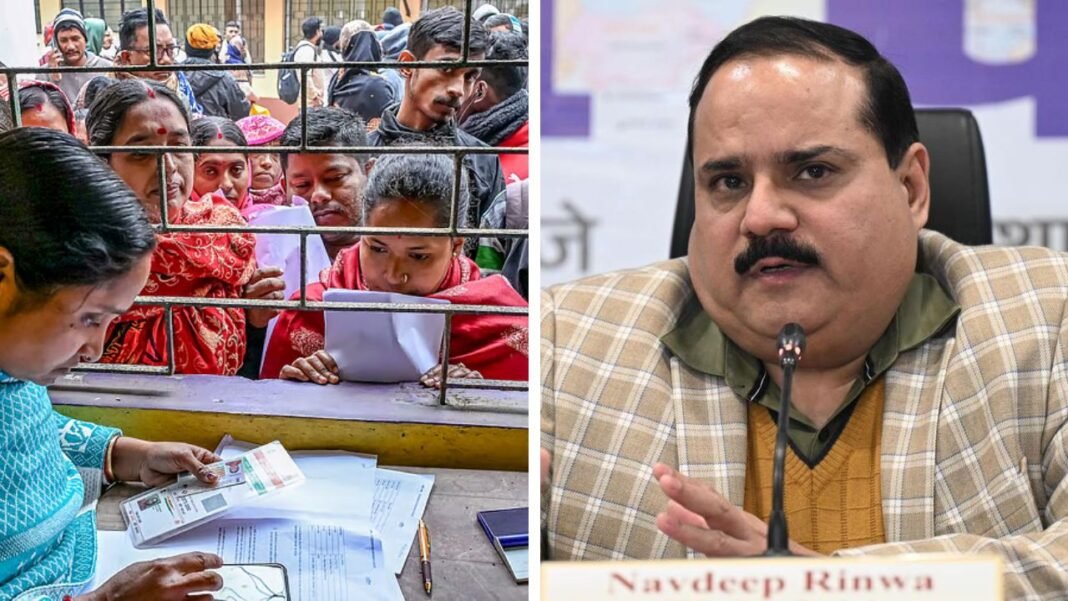


LUCKNOW: Uttar Pradesh Chief Electoral Officer Navdeep Rinwa has described the manipulation of voter records in Pilibhit as a deliberate crime after 10,470 approved entries in the Pilibhit voter roll were found to be irregular. An FIR was registered at the Kotwali police station on 22 October against two electoral registration officers and a computer operator. “This is not an error or negligence. This is a crime. It was done deliberately,” Rinwa told the Times of India in a report published on 23 October.
The case centres on the Pilibhit voter roll in Amaria, the assembly constituency where the irregularities were first flagged by voters earlier this month. The accused are Mayank Goswami, who was the sub-divisional magistrate of Amaria and its electoral registration officer (ERO), Hemant Kumar, also a former SDM and ERO, and Anil Kumar, a computer assistant who worked as the voter registration centre (VRC) operator.
How the Pilibhit voter roll fraud was detected
The manipulation came to light after voters complained that searching their EPIC numbers on the Election Commission’s online portal displayed another voter’s details. Advocate Faizan Ali Khan said he discovered 142 altered entries among 1,037 voters at his own booth on 12 October, and complaints from other voters followed. A check ordered after these complaints revealed that 13,779 Form-8 applications had been entered into the system between 31 May and 29 August 2026, months after the special intensive revision (SIR) final roll was published on 10 April.
Of those 13,779 applications, 10,470 were approved and 3,309 were rejected. Every one of the 10,470 approved entries in the Pilibhit voter roll was later found to be irregular. No supporting forms or documents were found in official records for any of the entries, according to the inquiry.
OTP credentials used to enter the applications
The inquiry found that the operator entered the Form-8 applications using OTP-authenticated credentials, and the two EROs approved them. Rinwa said the officers could not claim their login credentials had been misused by someone else. “You cannot simply claim that somebody stole your password. An OTP also goes to your registered phone,” he told the Times of India.
Form-8 applications are used to correct entries in the electoral roll. The absence of any supporting documents for thousands of approved applications, entered well after the final roll was published, pointed to deliberate tampering rather than clerical mistakes, officials said.
Congress allegation on the Pilibhit voter roll
A day before the FIR was registered, the Congress alleged on 21 October that the names of 13,150 voters in the Pilibhit voter roll had been changed after the final roll while their EPIC and serial numbers stayed the same. The party’s allegation drew attention to the constituency, and the Election Commission’s inquiry was already under way when the FIR followed.
Section 32 of the Representation of the People Act provides for imprisonment of up to two years, a fine, or both, for breaches of official duty in connection with the preparation of electoral rolls. The computer operator is being removed from service, while departmental proceedings are being initiated against both SDMs, officials said.
What the FIR alleges in the Pilibhit voter roll case
The FIR alleges that thousands of voter records in the Pilibhit voter roll were altered through bulk data entries made between 31 May and 29 August 2026, long after the 10 April SIR final roll was published. The entries were approved without any supporting documents on record, and officials say the scale of the Pilibhit voter roll manipulation points to a planned operation rather than isolated mistakes.
Officials have stressed that the approvals went through the EROs’ own OTP-authenticated logins, which makes the case against the two officers harder to dismiss. The allegation is that the operator carried out the entries while the EROs cleared them, a charge the FIR frames as a criminal conspiracy under the electoral law and the Bharatiya Nyaya Sanhita. The officers have not yet responded publicly to the allegations, and the probe is continuing.
Wider scrutiny ordered across the district
Rinwa has ordered scrutiny of all Form-6 and Form-7 applications entered by the same operator. Form-6 applications are for inclusion of new voters and Form-7 for deletion of entries. Similar scrutiny has been ordered in Pilibhit’s three other assembly constituencies, and all district magistrates in Uttar Pradesh have been asked to submit reports within two days.
The Pilibhit case is the first of its kind in the state to see an FIR registered against electoral registration officers over Pilibhit voter roll tampering, with the chief electoral officer publicly calling the manipulation a crime.