
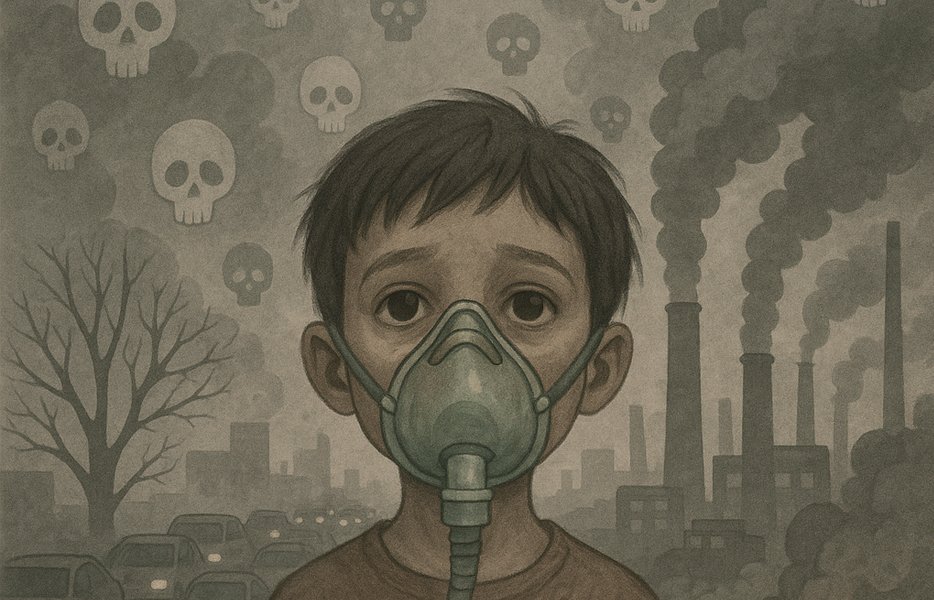


Rising air pollution across North India is stunting children’s lung development and harming their ability to learn, Dr Soumya Swaminathan, former chief scientist of the World Health Organization, warned on 22 October 2026, as Delhi’s air quality slid back into the “poor” category.
Swaminathan, who now chairs the MS Swaminathan Research Foundation, said air pollution hits children’s developing lungs, brains, hearts and blood vessels hardest because they are still forming. “Air pollution is stunting lung development and affecting learning capacity,” she said, flagging infants and children as the worst affected by the region’s worsening smog.
She added a comparison meant to convey the scale of exposure: “Breathing PM at 22 micrograms per cubic metre over 24 hours is said to be equivalent to smoking one cigarette.”
Delhi’s air pollution readings keep worsening
The warning came as Delhi’s air quality index stood at 299, in the “poor” band, at 10:31 am on 22 October. The Commission for Air Quality Management invoked Stage I of the Graded Response Action Plan across Delhi-NCR after the daily average AQI climbed from 179 on 20 October to 244 on 21 October.
The GRAP invocation triggers the first rung of emergency measures, including curbs on dust-generating construction and stricter checks on polluting vehicles.
North India’s air pollution follows a familiar annual pattern. Stubble burning, vehicular emissions, construction dust and falling temperatures that trap pollutants close to the ground combine through October and November, and Delhi routinely records some of the world’s worst air in these weeks.
How air pollution harms children’s lungs and brains
Children breathe faster than adults and take in more air relative to their body weight, which means a higher dose of fine particles for every hour spent outdoors. Their lungs are still growing through adolescence, so damage done in childhood can reduce lung function for life.
The brain is at risk as well. NDTV reported on 23 October that emerging research links fine particles crossing the blood-brain barrier to cognitive decline, Alzheimer’s and Parkinson’s disease, affecting memory, learning and mental health. The findings add weight to Swaminathan’s warning that air pollution is affecting children’s learning capacity, not just their breathing.
Particles small enough to slip from the lungs into the bloodstream can reach the brain, where they are associated with inflammation and damage to neural tissue.
Why infants face the greatest risk
Swaminathan singled out infants and young children because their organs are still forming. Lungs, brains, hearts and blood vessels all develop rapidly in the first years of life, and each is sensitive to the inflammation that fine particles provoke.
In past years, schools have moved sports indoors and advised children with asthma to stay home on bad-air days. Those steps help on the worst days, but not the chronic exposure that shapes a child’s development.
The equity dimension of air pollution is hard to ignore. Families that can afford air purifiers, filtered school buses and homes away from traffic corridors can reduce a child’s exposure. Children in poorer households, who often live closer to busy roads and construction sites, breathe the same air with fewer defences.
What authorities are doing about winter smog
The CAQM’s Stage I GRAP activation is the standard opening move, and stricter stages follow if the AQI keeps climbing. Past winters have seen bans on non-essential construction, restrictions on diesel generators and staggered office timings, all aimed at shaving peak pollution.
Longer-term measures against air pollution, from stubble-management incentives to the push for cleaner fuels, have shown mixed results. Stubble burning continues in parts of Punjab and Haryana despite fines and subsidies for alternatives, and vehicular emissions keep rising with the region’s vehicle fleet.
Swaminathan’s warning adds a medical voice to a debate that is usually framed around policy and enforcement. Her argument is that the cost of inaction on air pollution is measured in children’s lungs and learning ability, and that it compounds every year the smog returns.
Protecting children during the smog season
Health advisories ask parents to limit children’s outdoor play in the early morning and late evening, when pollution peaks, and to keep windows closed during the worst hours. Masks rated for fine particles help when children are outdoors, and children with asthma should keep medication at hand.
Doctors also advise watching for warning signs such as persistent cough, wheezing or unusual breathlessness in children, and seeking medical advice rather than waiting for symptoms to pass. Schools in the region typically follow government advisories on outdoor activities when the AQI crosses into the severe range.
The smog season is only beginning. With the AQI already near 300 in late October, the coming weeks will test whether this year’s measures can keep the air any cleaner than last year’s, and whether warnings like Swaminathan’s finally move the needle on protecting North India’s children.