
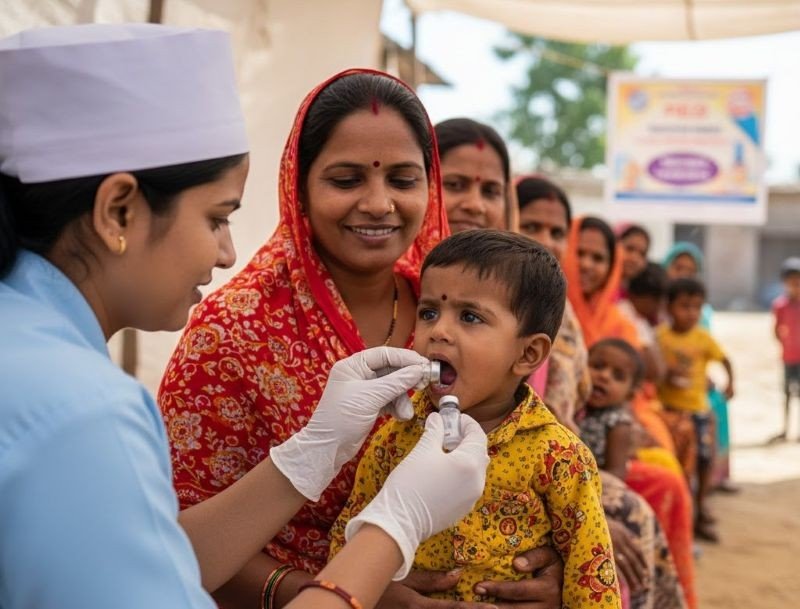


India marks World Polio Day on 24 October as a country that has kept the wild poliovirus out for more than a decade, but health officials and doctors say the polio vaccination effort cannot slow down while the virus still circulates in neighbouring countries.
India reported its last case of wild poliovirus on 13 January 2011, and the World Health Organization certified the South-East Asia Region polio-free on 27 March 2014. The achievement rested on years of mass polio vaccination drives, and doctors warn that the protection it bought has to be renewed with every birth cohort.
“Just because a country is free from polio doesn’t mean it is immune to the disease,” said Gulam A. Vahanvaty, Chairman of the India National PolioPlus Committee at Rotary International. His warning captures the central message of this year’s observance: a polio-free certificate is not the same as permanent safety.
Where the polio threat still lives
As of 21 October 2026, Afghanistan had reported 42 wild poliovirus cases and Pakistan 6, the only two countries in the world where the virus remains endemic. Both share long, porous borders with the region, and the virus does not respect checkpoints.
Dr Aparna G, Consultant in Paediatrics and Neonatology at Rainbow Children’s Hospital in Sholinganallur, Chennai, said the risk of the virus being reintroduced from neighbouring countries remains real. Population movement across borders means a case imported from Afghanistan or Pakistan could find unvaccinated children anywhere in India.
That is why surveillance has become as important as the vaccine itself. India runs acute flaccid paralysis surveillance, which investigates every case of sudden limb weakness in children, and environmental surveillance, which tests sewage samples to detect the virus circulating silently in a community.
How polio vaccination works in India
India uses two polio vaccines. The inactivated polio vaccine, or IPV, is given by injection, and the oral polio vaccine, or OPV, is given as drops. The two are used together in the routine immunisation schedule that covers every newborn.
On top of the routine schedule sits Pulse Polio, the mass campaign that gives extra OPV doses to all children under five in annual rounds. The programme was the engine of India’s polio-free certification, reaching children in every district.
The polio vaccination system now functions as a permanent safety net rather than an emergency response. Health workers track due lists, follow up on missed doses, and run the surveillance systems that watch for the virus’s return.
Why polio vaccination coverage must stay high
Polio spreads through contaminated water and food, and most infections cause no symptoms, which makes the disease dangerous even at low case counts. An infected child who shows no sign of illness can still pass the virus to others, and only a small fraction of infections lead to the paralysis the disease is known for.
High polio vaccination coverage is what keeps that silent transmission from taking hold. When nearly every child in a community is immunised, the virus finds no susceptible host and dies out. Let coverage slip in a few districts, and the chain of protection breaks where it is weakest.
Vahanvaty’s point about immunity goes to the same arithmetic. A country can be free of cases for years and still be vulnerable, because vulnerability is measured in unvaccinated children. Every child who misses the polio vaccination schedule adds one more opening for the virus.
What parents need to know
Doctors say the message for parents is simple and unchanged. Children should receive both the injectable and the oral polio vaccines on schedule, and they should also take the extra OPV drops offered during Pulse Polio rounds, even if they have already completed their routine doses. The extra doses are a booster layer, not a sign that the earlier doses failed. Parents who keep polio vaccination records can check a child’s status at a glance.
The drops are free at government booths during the rounds, and the injectable vaccine is part of the routine programme. Parents unsure whether their child is up to date can check with their local health worker.
The road to a polio-free world
Global eradication now depends on Afghanistan and Pakistan, where conflict, displacement and vaccine hesitancy have slowed the final push. The 48 cases reported between the two countries this year are a fraction of the hundreds of thousands recorded in the 1980s.
India’s role has shifted from fighting its own cases to guarding the region’s gains, and its polio vaccination experience is studied by health agencies elsewhere.
World Polio Day began as a celebration of progress. India’s polio vaccination record gives it reason to celebrate, but the deeper purpose is the one Vahanvaty stated: staying free of polio is an active job, and it ends only when the virus is gone everywhere.