
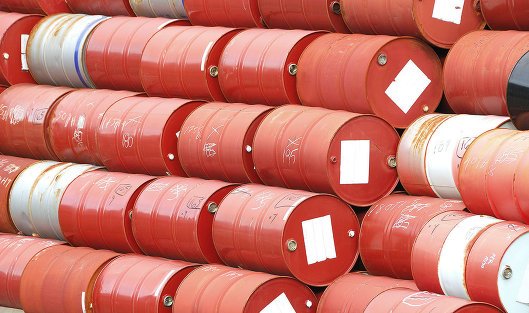


Brent crude fell below $100 a barrel on Thursday after voters in the United States swept Democrats to a series of midterm election wins, a result that raised hopes for an end to the war between the United States and Iran.
Brent crude futures dived nearly 9 percent overnight in Asia, and the benchmark has dropped by about 20 percent so far this week. If the fall holds through to Friday’s close, it would make for the largest weekly drop in oil prices since a week in April 2020, when United States crude briefly fell into negative territory.
At $93.50 a barrel in the Asia morning, oil was testing its overnight lows. Traders bet that President Donald Trump, facing a Democratic Congress and hurt by high energy prices caused by the Middle East conflict, would be less likely to escalate the war with Iran.
Brent crude drops sharply in Asia trading
The drop in energy prices pushed bond prices higher and yields lower. The dollar fell to a one-month low of $1.1273 per euro, and lower yields helped stocks across the region. Broad stock indexes climbed on the clear outcome, with the S&P 500 closing 1.6 percent higher and European shares reaching a two-month high.
The yield on benchmark 10-year United States Treasuries fell 6 basis points overnight and by a further basis point in early Tokyo trade to 4.87 percent, while 2-year yields fell about 2 basis points to 4.56 percent. A resolution of the conflict could push oil prices lower still, easing pressure on inflation and reducing the chance of future interest rate rises.
Solar supply chain stocks jumped the most in Asia, in anticipation of Democrats boosting support for renewables, while shares in data centre companies and their equipment suppliers fell on expectations of tougher regulation.
South Korea’s chipmaker-heavy KOSPI slid 4 percent and in morning trade was not far from hitting a seven-month low. Taiwan’s benchmark index fell 1.8 percent, and tech equipment suppliers dragged on the Nikkei, which fell 0.5 percent.
Brent crude and the wider market reaction
Democratic candidates who campaigned, in part, on moratoriums on data centre construction won stunning victories in Texas and Georgia, in a sign public opinion is shifting on artificial intelligence. The magnitude of the victory caught markets off guard, said Chris Weston, head of research at brokerage Pepperstone in Melbourne.
Most analysts think the result will not dent demand for artificial intelligence, data centres or computer chips in the end, but they now expect at least a temporary slowdown. The question is how long the pause lasts and which projects are delayed first. Data centre operators have already faced local opposition over power use and water use, and the election results give those campaigns fresh weight.
Trump acknowledged on Wednesday that the war played a role in the Republicans’ defeat, and his vice president, JD Vance, was more direct on X. ‘The reason we lost is the war,’ Vance wrote.
What Brent crude traders watch next
The next test for Brent crude comes on Friday, when the weekly close will show whether the drop of about 20 percent holds. A close near current levels would confirm the largest weekly fall in oil prices in more than six years.
Brent crude has now given back a large part of its recent gains in a matter of days. The speed of the fall has caught out traders who had bet that the Middle East conflict would keep prices high through the end of the year.
For now, the market is pricing in a calmer outlook for Brent crude supply and a slower path for data centre building in the United States. Both readings rest on the same election result, and both could change fast if the new Congress takes a different line.
Oil traders have watched the Middle East conflict closely all year because it has kept energy prices high and added to inflation pressure. A settlement would remove one of the main supports for Brent crude, and traders are now betting that the election result makes that outcome more likely.
The fall in oil also feeds through to fuel prices and transport costs, which is one reason cheaper Brent crude tends to lift consumer spending and company profits. That link helps explain why stocks rose even as oil and chip shares fell.