
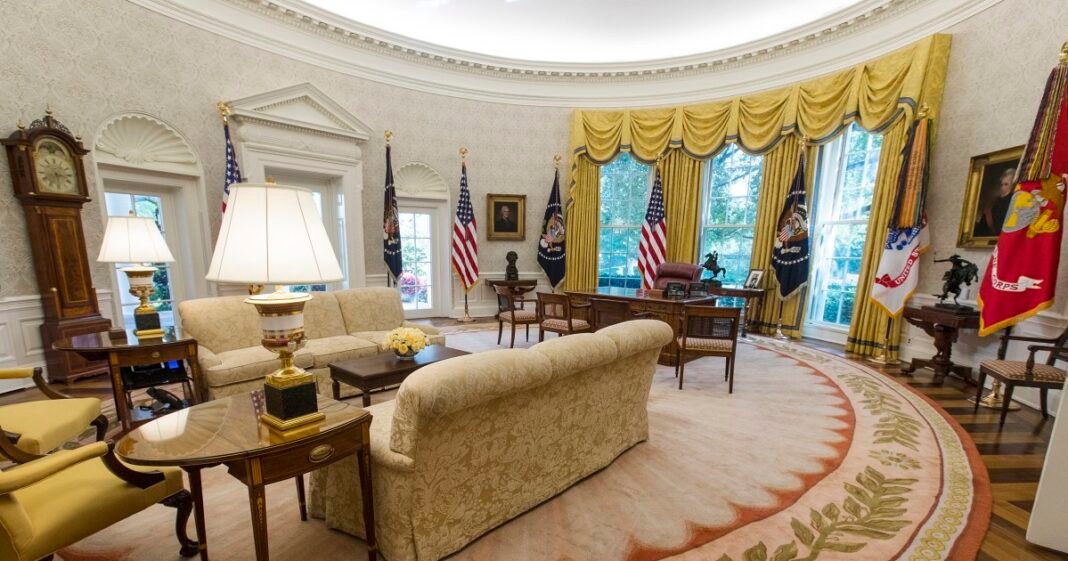


President Donald Trump signed a proclamation on Thursday declaring the Oval Office and the Cabinet Room national monuments, in a move he said would stop future presidents from changing the gold-covered rooms.
The signing was Trump’s first official action since Republicans lost control of Congress in Tuesday’s midterm elections. Sitting behind the Resolute Desk, with a red baseball cap marked “VETO” beside him, Trump said the rooms would become “a landmark for the ages.”
“We’re making it a national monument, and it will not be allowed to be touched by anybody, destroyed, ripped down by stupid people, in order to build something in a slightly different shape,” Trump told reporters in the gold-covered Oval Office.
What the Oval Office proclamation says
The proclamation covers the Oval Office, the Outer Oval Office and the Cabinet Room, all on the first floor of the West Wing. It orders the interior secretary to manage the monument through the National Park Service, and it requires documentation, review and consideration of alternatives before any action that would substantially alter or demolish the rooms.
Trump said the step would make it impossible for anyone to destroy the space. “No major modification without the approval of Congress,” he said. That requirement does not appear in the text of the proclamation itself.
The White House is already recognized as a national historic landmark. The proclamation says the Oval Office merits specific recognition and protective management as a discrete historic structure of national significance.
The proclamation invokes the Antiquities Act of 1906, a conservation law first written to protect prehistoric ruins, archaeological sites and natural wonders on federal land. Trump said the signing was the first step toward declaring the West Wing spaces a national monument to mark their place in American history. Trump said his proclamation would need congressional approval, though it was unclear what led him to seek protection from Congress now, as there has been no move to tear down or dramatically alter the spaces.
Oval Office changes under Trump
Since returning to the White House in January 2025, Trump has remade the room with gold accents, including 24-karat gold trim on the ceilings, gilded frames, gleaming vases and burnished wood carvings. New portraits hang on the walls, along with a copy of the Declaration of Independence, and new chandeliers were installed in the Cabinet Room.
The redesign follows a French rococo style, with gold leaf detailing, heavy gilded drapery and portraits of figures such as Andrew Jackson and George Washington. Gold wall appliques and gold-framed artwork now cover many of the room’s surfaces.
Every president redecorates the Oval Office, but the scale of the gold work under Trump stands out. Earlier presidents changed furniture, artwork and curtains. Trump has added gold trim to the ceilings, gilded frames across the walls and a set of new chandeliers, and he has promoted the rooms as one of his pet projects this week.
The changes go beyond the Oval Office. Trump paved over the Rose Garden, tore down the East Wing to make way for a ballroom, and resurfaced the Lincoln Memorial Reflecting Pool.
The gold decor has drawn mockery from former president Barack Obama, who said: “He’s got the White House looking like Saddam Hussein opened a Cheesecake Factory. Just gold everywhere.”
Can a future president undo the Oval Office order
The proclamation does not stop future presidents from restyling the rooms. Its text states that it does not restrict a president’s authority to redecorate, select furnishings or change the decor, or to carry out ordinary operational and security changes.
A successor could also revise or revoke the designation with a new executive action. Trump has himself reversed national monument designations made by his predecessors, so the protection he described may not last beyond his presidency.
The red cap on the desk during the signing carried its own message. It appeared to refer to Trump’s threat to block the legislative priorities of the new Democratic-controlled Congress when it takes office in January.
Trump said he would return if anyone tried to knock down walls. “If anyone ever decides to come and start knocking down walls, you’ll call me wherever I may be, and I will come back here and I will make sure it never happens,” he said.